

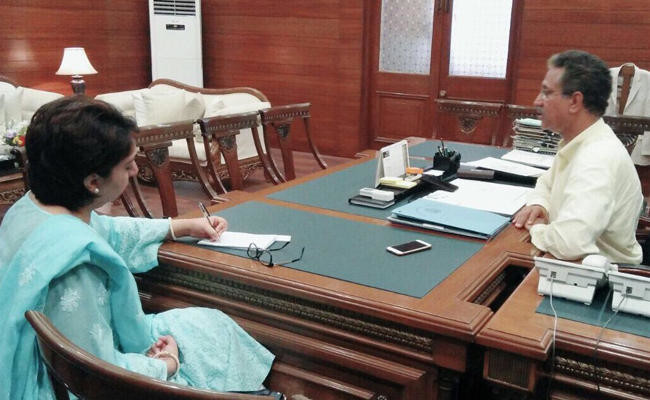
KARACHI, Pakistan: Former Jeddah resident and now mayor of Karachi, Waseem Akhtar, has appealed to Pakistanis living in the Gulf to help him improve government hospitals in the city.
In an exclusive interview with Arab News, Akhtar said that the people of Karachi need help from expats to fix the city’s problems.
“I don’t want money,” Akhtar stressed. “I want equipment that can be used to benefit the city. We need medicines, especially, to cope with deadly viruses. We need oxygen cylinders.”
Akhtar, 61, explained that the city’s hospitals need everything from syringes to operating equipment. “(Government) hospitals and clinics in Karachi, right now, are in the worst condition,” he said. “We need to save them.”
Akhtar worked in Jeddah for 12 years as consultant for AT&T and returned to Karachi in 1986.
“I miss Jeddah and my friends there. It was a comfortable life. But I had to return, not just for my ailing parents but also for my country,” he said.
According to Akhtar, despite being the economic heart of the country, Karachi is also its most neglected city. There is little infrastructure, he said. “There are not enough hospitals and universities in the city. No urban planning. But despite all this, the city has magical resilience and it continues to fight against all odds,” he said.
With a population of more than 16 million, Karachi is the largest city in the Muslim world. And, Akhtar claimed, more than half the population lives in slums.
“This city never got its due share. When Islamabad became the capital, no one bothered about Karachi. It is a revenue-generating city with two ports. It is a safe haven for everyone across the country,” he said.
Akhtar explained that Karachi has always welcomed refugees and immigrants.
“Be it be partition migration, Bangladeshi refugees, Afghans, Burmese, or Central Asians, Karachi has always opened its arms for everyone. Yesterday’s immigrants are today’s people of Karachi,” said Akhtar, who also belongs to a family that migrated to Karachi after the partition of India and Pakistan.
Akhtar did, however, say that immigrants should be registered and counted in the census. According to the Sindh Police, there are over 1 million illegal immigrants living in Karachi, most of them Afghans, Bengalis or Burmese. And the fact they are not registered, Akhtar said, is one reason why Karachi is struggling economically.
“If we don’t count them, then ultimately we won’t be able to get the appropriate budget to run this magnificent city,” he said. “(Karachi) contributes around 70 percent of the total taxes to Islamabad but gets only a mere 5 percent in return. As a result, we don’t have enough hospitals, universities, water, power, or jobs for our people. We need to make a comprehensive national and provincial policy to deal with our (immigrant) population,” said Akhtar.
Akhtar urged Gulf expats from Karachi to come forward and help their city.
“We are fortunate that we belong to one of the greatest cities in the world — a city which once used to be the Paris of South Asia. It was considered the most modern, stylish and clean city in the subcontinent,” he claimed. “Now this is the time to give back to your city. Spare some time with your children and spend vacations in Karachi. Allow your children to feel and understand Karachi. Give them an opportunity to come out their comfortable Gulf lives and serve the city through different means. Just own, and feel proud of, being ‘Karachi-wala.’”


