US Internet firms back bill to fight online sex trafficking

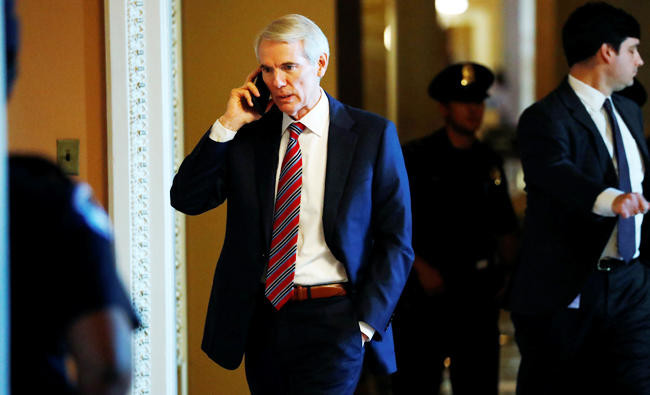
U.S. Senator Rob Portman (R-OH) arrives for the weekly Republican party caucus luncheon at the U.S. Capitol in Washington, U.S. October 31, 2017. REUTERS/Jonathan Ernst
Updated 04 November 2017
Follow

US Internet firms back bill to fight online sex trafficking

WASHINGTON: Major US Internet firms on Friday said they would support legislation to make it easier to penalize operators of websites that facilitate online sex trafficking, marking a sharp reversal for Silicon Valley on an issue long considered a top policy priority.
The decision to endorse a measure advancing in the US Senate could clear the way for Congress to pass the first rewrite of a law adopted 21 years ago that is widely considered a bedrock legal shield for the Internet industry.
Michael Beckerman, president of the Internet Association, said in a statement it supported a bipartisan proposal advancing in the US Senate making it easier for states and sex-trafficking victims to sue social media networks, advertisers and others that fail to keep exploitative material off their platforms.
“Important changes made to (Stop Enabling Sex Traffickers Act) will grant victims the ability to secure the justice they deserve, allow Internet platforms to continue their work combating human trafficking, and protect good actors in the ecosystem,” Beckerman said. His organization represents tech companies including Facebook, Amazon and Alphabet’s Google.
This week, the US Senate Commerce Committee said it would vote next week on the bill authored by Republican Rob Portman and Democrat Richard Blumenthal.
The Internet industry has fought such a change in the law for years, but now Washington is stepping up scrutiny on the sector on a range of policy issues after decades of hands-off regulation.
US technology companies had long opposed any legislation seeking to amend Section 230 of the decades-old Communications Decency Act, arguing it is a bedrock legal protection for the Internet that could thwart digital innovation and prompt endless litigation.
Bill negotiators agreed to make a handful of technical changes to the draft legislation, which Beckerman said helped earn support of the Internet companies.
Those changes include clarity that criminal charges are based on violations of federal human trafficking law and that a standard for liability requires a website “knowingly” assisting of facilitating trafficking.


US military boards another oil tanker in Indian Ocean after tracking it from the Caribbean

Updated 5 sec ago
Follow

US military boards another oil tanker in Indian Ocean after tracking it from the Caribbean

  • Venezuela has relied on a shadow fleet of falsely flagged tankers to smuggle crude into global supply chains
  • The Veronica III left Venezuela on Jan. 3, the same day as Maduro’s capture, with nearly 2 million barrels of crude and fuel oil

WASHINGTON: US military forces boarded another sanctioned tanker in the Indian Ocean after tracking the vessel from the Caribbean Sea in an effort to target illicit oil connected to Venezuela, the Pentagon said Sunday.
Venezuela had faced US sanctions on its oil for several years, relying on a shadow fleet of falsely flagged tankers to smuggle crude into global supply chains. President Donald Trump ordered a quarantine of sanctioned tankers in December to pressure then-President Nicolás Maduro before Maduro was apprehended in January during an American military operation.
Several tankers fled the Venezuelan coast in the wake of the raid, including the ship that was boarded in the Indian Ocean overnight. The Defense Department said in a post on X that US forces boarded the Veronica III, conducting “a right-of-visit, maritime interdiction and boarding.”
“The vessel tried to defy President Trump’s quarantine — hoping to slip away,” the Pentagon said. “We tracked it from the Caribbean to the Indian Ocean, closed the distance, and shut it down.”
Video posted by the Pentagon shows US troops boarding the tanker.
The Veronica III is a Panamanian-flagged vessel under US sanctions related to Iran, according to the website of the Treasury Department’s Office of Foreign Assets Control.
The Veronica III left Venezuela on Jan. 3, the same day as Maduro’s capture, with nearly 2 million barrels of crude and fuel oil, TankerTrackers.com posted Sunday on X.
“Since 2023, she’s been involved with Russian, Iranian and Venezuelan oil,” the organization said.
Samir Madani, co-founder of TankerTrackers.com, told The Associated Press in January that his organization used satellite imagery and surface-level photos to document that at least 16 tankers left the Venezuelan coast in contravention of the quarantine.
The Trump administration has been seizing tankers as part of its broader efforts to take control of the Venezuela’s oil. The Pentagon did not say in the post whether the Veronica III was formally seized and placed under US control, and later told the AP in an email that it had no additional information to provide beyond that post.
Last week, the US military boarded a different tanker in the Indian Ocean, the Aquila II. The ship was being held while its ultimate fate was decided by the United States, according to a defense official who spoke last week on condition of anonymity to discuss ongoing decision-making.