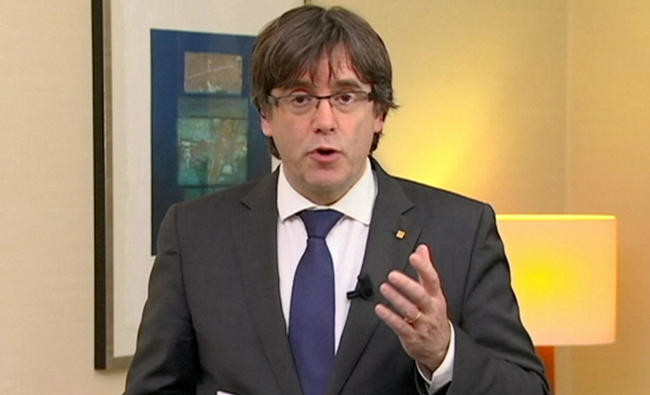
BRUSSELS: The EU on Friday refused to intervene over the European arrest warrant Spain is set to issue for Catalonia’s deposed leader Carles Puigdemont, currently holed up in Belgium, saying it was a matter for the courts.
A Spanish judge is expected to issue the warrant demanding Belgium return Puigdemont, who is wanted for questioning over alleged sedition, rebellion and misuse of public funds in relation to his region’s independence drive.
Catalan efforts to make the crisis an international issue have so far failed, and the EU has been steadfast in its support for Madrid throughout, insisting it is an internal matter for Spain.
European Commission spokeswoman Annika Breidthardt reiterated that support at a news conference on Friday, deflecting a barrage of questions about Catalonia with the same response.
“This is a matter entirely for the judicial authorities whose independence we respect fully,” Breidthardt said.
Puigdemont’s Belgian lawyer Paul Bekaert, who in the past has helped Basque separatists militants challenge Spanish extradition requests, told Flemish television channel VRT on Thursday his client would fight efforts to send him to Spain.
Puigdemont, sacked as regional president a week ago by Madrid after the Catalan Parliament issued a declaration of independence, has been in Belgium since Monday and calls the allegations against him politically motivated.
A Spanish judge on Thursday threw eight members of Puigdemont’s axed regional government behind bars pending potential trial, prompting a protest by some 20,000 people in Barcelona.
The Catalan independence declaration was roundly spurned across Europe, with Germany, France and Britain rejecting it and EU institutions sticking to their support for the government of Spanish Prime Minister Mariano Rajoy.
The European Commission’s powerful chief, Jean-Claude Juncker, warned after the independence declaration that the 28-member bloc “doesn’t need any more cracks, more splits,” saying he did not want the EU “to consist of 95 member states.”
Juncker will be in the Spanish city of Salamanca on Thursday to receive an honorary degree.
EU officials fear Catalonia could spark a domino effect in a continent with numerous separatist movements from Britain to Belgium to Romania, and with the bloc still reeling from the impact of Brexit, a fresh blow to unity is seen as a major threat.
But the bloc’s stance is causing disquiet among some MEPs, who see Madrid’s hard-line handling of the crisis as running counter to European democratic ideals.
“The silence of the European Institutions remains astounding,” Ska Keller and Philippe Lamberts, the heads of the Greens bloc in the European Parliament, said Friday.
“While the European Com-mission is right to assert the rule of law as a foundation of the Union, so are fairness, building bridges and democratic principles, which have to be respected in all member states.”


![]()
EU refuses to get involved in Catalan leader arrest warrant
EU refuses to get involved in Catalan leader arrest warrant

Latest updates


© 2026 SAUDI RESEARCH & PUBLISHING COMPANY, All Rights Reserved And subject to Terms of Use Agreement.