SAN FRANCISCO: The global smartphone market has momentum going into the year-end holiday shopping season, according to preliminary figures released Thursday by International Data Corporation (IDC).
An estimated 373.1 million smartphones were shipped worldwide during the third quarter of this year in a 2.7 percent rise from the same period in 2016, IDC said in a statement.
While IDC analysts considered the growth low, they saw it as a sign “the industry still has momentum.”
“Collectively, the industry continues to grow, but at a much slower pace than past years,” said Ryan Reith, a vice president with the global market intelligence firm.
“What is clear is that the ‘Others’ outside of the top five leading vendors continue to struggle and the industry leaders are quickly forming two camps.”
Reith depicted those camps as those driving high-volume sales — Apple, Huawei, and Samsung — and a few Chinese smartphone makers finding traction outside that country.
The five top smartphone makers all shipped more units than they did in the same quarter last year, according to IDC.
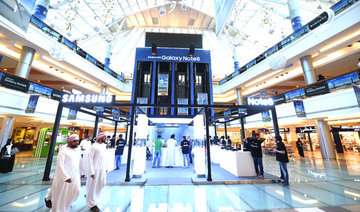
South Korean smartphone titan Samsung remained the overall leader, shipping 83.3 million handsets in a 9.5 percent increase from the same quarter last year, according to IDC.
Apple’s new iPhone 8 models helped its third quarter shipments climb 2.6 percent to 46.7 million, and on Friday the California technology giant was releasing a new flagship iPhone X model with a starting price of $999.
China-based Huawei shipped 39.1 million smartphones in a “healthy” increase of 16.1 percent from a year earlier, according to IDC.
New Huawei models “will challenge both Apple and Samsung at the top of the market regarding premium flagship offerings as well as in the race for overall worldwide market dominance,” IDC said.
China-based OPPO ranked fourth with shipments, climbing 19 percent to 30.7 million compared to the same quarter last year, IDC reported.
China’s Xiaomi was in fifth place but had the strongest gain, doubling its sales to 27.6 million units, driven mainly by success in India, according to the report.
“The fourth quarter will be extremely competitive as vendors will fight it out to win over holiday shoppers,” said IDC research manager Anthony Scarsella.
“Although (new) premium flagships will capture all the hype while driving up the average selling price in the quarter, we still believe a clear majority of shipments will come from more affordable models across many markets.”
IDC has forecast smartphone sales growth in the current quarter of less than a percent, due in part to limited supply of the iPhone X and high prices on flagship models prompting people to put off buys until handsets are more affordable.

Samsung remains top brand as global smartphone sales keep momentum
PIF’s Humain invests $3bn in Elon Musk’s xAI prior to SpaceX acquisition
JEDDAH: Humain, an artificial intelligence company owned by Saudi Arabia’s Public Investment Fund, invested $3 billion in Elon Musk’s xAI shortly before the startup was acquired by SpaceX.
As part of xAI’s Series E round, Humain acquired a significant minority stake in the company, which was subsequently converted into shares of SpaceX, according to a press release.
The transaction reflects PIF’s broader push to position Saudi Arabia as a central hub in the global AI ecosystem, as part of its Vision 2030 diversification strategy.
Through Humain, the fund is seeking to combine capital deployment with infrastructure buildout, partnerships with leading technology firms, and domestic capacity development to reduce reliance on oil revenues and expand into advanced industries.
The $3 billion commitment offers potential for long-term capital gains while reinforcing the company’s role as a strategic, scaled investor in transformative technologies.
CEO Tareq Amin said: “This investment reflects Humain’s conviction in transformational AI and our ability to deploy meaningful capital behind exceptional opportunities where long-term vision, technical excellence, and execution converge, xAI’s trajectory, further strengthened by its acquisition by SpaceX, one of the largest technology mergers on record, represents the kind of high-impact platform we seek to support with significant capital.”
The deal builds on a large-scale collaboration announced in November at the US-Saudi Investment Forum, where Humain and xAI committed to developing over 500 megawatts of next-generation AI data center and computing infrastructure, alongside deploying xAI’s “Grok” models in the Kingdom.
In a post on his X handle, Amin said: “I’m proud to share that Humain has invested $3 billion into xAI’s Series E round, just prior to its historic acquisition by SpaceX. Through this transaction, Humain became a significant minority shareholder in xAI.”
He added: “The investment builds on our previously announced 500MW AI infrastructure partnership with xAI in Saudi Arabia, reinforcing Humain’s role as both a strategic development partner and a scaled global investor in frontier AI.”
He noted that xAI’s trajectory, further strengthened by SpaceX’s acquisition, exemplifies the high-impact platforms Humain aims to support through strategic investments.
Earlier in February, SpaceX completed the acquisition of xAI, reflecting Elon Musk’s strategy to integrate AI with space exploration.
The combined entity, valued at $1.25 trillion, aims to build a vertically integrated innovation ecosystem spanning AI, space launch technology, and satellite internet, as well as direct-to-device communications and real-time information platforms, according to Bloomberg.
Humain, founded in August, consolidates Saudi Arabia’s AI initiatives under a single entity. From the outset, its vision has extended beyond domestic markets, participating across the global AI value chain from infrastructure to applications.
The company represents a strategic initiative by PIF to diversify the Kingdom’s economy and reduce oil dependence by investing in knowledge-based and advanced technologies.