

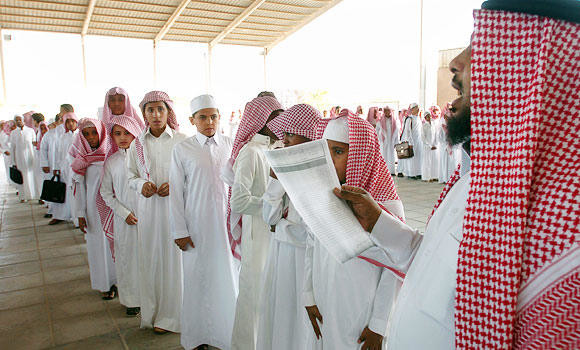
Saudi Education Ministry steps up to face challenges of school safety, security

Updated 03 November 2017
Follow

Saudi Education Ministry steps up to face challenges of school safety, security

RIYADH: The General Supervisor of the Schools Security and Safety Administration at the Ministry of Education, Dr. Majed Adeeb Al-Harbi, revealed that his administration is facing several challenges; however, at the same time, many successes have been achieved.

The ministry has allocated a budget of SR 800 million ($213 million) to provide a minimum level of security and safety in schools. One of the most important implementations is the awareness campaign about the importance of emergency exits, and considering their closure in some schools a serious mistake.

According to Sabq e-newspaper, during his interview on Al Eqtisadiah channel, Al-Harbi indicated that his administration is required to provide safety and security to more than 38,000 school facilities in the Kingdom that include more than 5 million students and 70,000 teachers and workers, not to mention the problem of school buildings. Some of these facilities are new and prepared, while others are very old rented buildings suffering from technical problems.

Al-Harbi added: “Concerning the safety of schools, the ministry is treating the problem of closing the emergency exits by training students on evacuation plans. The ministry appointed each school with the task of holding four evacuation drills per year and assessing each one in terms of the time required to implement it. We had 35,000 evacuation drills last year, and we have 9,000 planned for this year.”

The initiative of guarding schools was implemented in 100 schools in Riyadh and Al-Qassim this year, and is expected to be implemented in 1,000 schools next year and 9,000 schools by 2020, he said.

“A new security guard project will be revealed in the next few days and will promote high security in the schools,” he added.


Saudi Arabia’s KAUST named FIFA’s first research institute in MENA

The canal in the King Abdullah University of Science and Technology campus. (Shutterstock)
Updated 10 February 2026
Follow

Saudi Arabia’s KAUST named FIFA’s first research institute in MENA

  • KAUST President Prof. Sir Edward Byrne said that the university’s selection as the fifth FIFA Research Institute in the world — and the first in the region — marks a significant achievement, reflecting Kingdom’s growing presence in international football

RIYADH: FIFA has designated the King Abdullah University of Science and Technology as its first research institute in the Middle East and Asia to support the development of innovative football research, the Saudi Press Agency reported on Tuesday.

The recognition highlights KAUST’s commitment to integrating sports, academic research and industry through advanced, high-level initiatives grounded in rigorous scientific methodologies, contributing to the advancement of football studies.

KAUST President Prof. Sir Edward Byrne said that the university’s selection as the fifth FIFA Research Institute in the world — and the first in the region — marks a significant achievement, reflecting Saudi Arabia’s growing presence in international football.

The accreditation aligns with national efforts to invest in research and development and promote the knowledge economy, supporting Saudi Vision 2030’s goals of building an advanced sports system based on innovation and sustainability.

The collaboration’s first project focuses on developing advanced AI algorithms to analyze historical FIFA World Cup broadcast footage, transforming decades of match videos into structured, searchable data, according to the KAUST website.

This work opens new opportunities to apply state-of-the-art computer vision techniques and deepen understanding of how football has evolved over time.

The second project uses player and ball tracking data from the FIFA World Cup 2022 in Qatar and the FIFA Women’s World Cup 2023 in Australia and New Zealand to compile comprehensive datasets capturing in-game dynamics.

These datasets provide deeper insights into human movement, playing techniques and performance dynamics through AI-driven analysis.