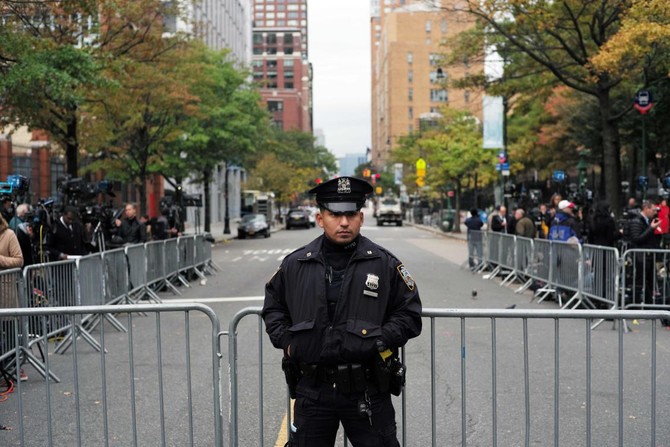
WASHINGTON: The deadliest terrorist attack in New York since 9/11 has once again put the spotlight on US measures in place to prevent such attacks.
The suspected attacker, Sayfullo Saipov, is a citizen of Uzbekistan who entered the US legally in 2010.
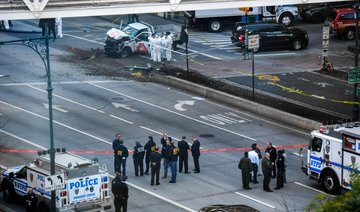
On Tuesday afternoon, Saipov drove a rented truck into a busy bike path in lower Manhattan along the Hudson River, killing eight people and injuring at least 11 others. Five of the victims were tourists from Argentina.
US media outlets are reporting that Saipov was under the radar of counterterrorism officials, and might have been previously questioned by the Federal Bureau of Investigation (FBI).
It is not clear whether he had raised concerns because of his behavior and activities, or because of his affiliation with possible suspects in other investigations.
Eyewitnesses told police that the attacker allegedly began screaming “Allahu Akbar” (God is Greatest) upon getting out of the truck, which struck a school bus before stopping. Officials investigating the attack are suggesting that literature was found near the crime scene suggesting that Saipov might have pledged allegiance to Daesh.
So far authorities are treating the crime as having been inspired by the terrorist group, but are yet to establish a connection between Saipov and Daesh that suggests it provided him with operational support.
Almost immediately after news of the attack was reported, President Donald Trump began commenting about it on his Twitter account.
On Wednesday morning, he appeared to assign at least partial blame for the attack on immigration laws passed by Democratic lawmakers.
“The terrorist came into our country through what is called the ‘Diversity Visa Lottery Program,’ a Chuck Schumer beauty. I want merit based,” Trump tweeted, referring to the Democratic senator.
Frances Townsend, homeland security and counterterrorism adviser to former President George W. Bush, and president of the Counter Extremism Project, said the attack suggests that Daesh continues to inspire attacks in the US and beyond.
“This attack followed the ISIS (Daesh) playbook: Use a truck or car, leave a note attributing it to ISIS, then get out with a knife or gun,” Townsend told Arab News.
He said the timing and location were not coincidental, and were meant to inflict significant damage and have symbolic value, being a few blocks away from the location of the World Trade Center.
The attack is likely to raise questions about whether Uzbekistan is facing a threat to its national security by militant groups.
John G. Horgan, professor of global studies and psychology at Georgia State University, said challenging political conditions have led to a surge in Uzbeks leaving in search of a better life, and some have joined conflicts in other countries.
“Many Uzbeks joined Daesh, and this isn’t the first time an Uzbek national has been involved in terror attacks in the West,” Horgan told Arab News.
“An Uzbek man was involved in ramming a truck into a crowd of people in Sweden earlier this year.”
Townsend expressed similar concerns, saying: “Uzbekistan has long had an extremism problem.”
As to whether the attack will lead to tougher immigrations policies in the US, Mathew Levitt, director of the Stein Counterterrorism Program at the Washington Institute for Near East Policy, expressed doubts about the effectiveness of such measures.
“Implementing a restrictive immigration policy isn’t going to address this problem,” he told Arab News.
“The most immediate threat today comes from individuals who’ve been radicalized at home. The radicalization didn’t happen abroad, it happened here.”


![]()

New York attack puts counterterror measures, immigration under focus
New York attack puts counterterror measures, immigration under focus

Trump hikes US global tariff rate to 15 percent
WASHINGTON: President Donald Trump raised the global duty on imports into the United States to 15 percent on Saturday, doubling down on his promise to maintain his aggressive tariff policy a day after the Supreme Court ruled much of it illegal.
Trump said on his Truth Social platform that after a thorough review of Friday’s “extraordinarily anti-American decision” by the court to rein in his tariff program, the administration was hiking the import levies “to the fully allowed, and legally tested, 15 percent level.”
Shortly after the court’s 6-3 ruling that rejected the president’s authority to impose tariffs under a 1977 economic emergency powers act, Trump had initially announced a new 10 percent global levy by invoking a different legal avenue.
At the same time, the Republican launched an extraordinary personal attack on the conservative justices who had sided with the majority, slamming their “disloyalty” and calling them “fools and lap dogs.”
The ruling was a stunning rebuke by the high court, which has largely sided with the president since he returned to office, and marked a major political setback in striking down Trump’s signature economic policy that has roiled the global trade order.
Saturday’s announcement is sure to provoke further uncertainty as Trump carries on with a trade war that he has used to cajole and punish countries, both friend and foe.
It is the latest move in a process that has seen a multitude of tariff levels for countries sending goods into the United States set and then altered or revoked by Trump’s team over the past year.
Several countries have said they are studying the Supreme Court ruling and Trump’s subsequent tariff announcements.
Brazil’s President Luiz Inacio Lula da Silva on Sunday urged Donald Trump to treat all countries equally.
“I want to tell the US President Donald Trump that we don’t want a new Cold War. We don’t want interference in any other country, we want all countries to be treated equally,” Lula told reporters in New Delhi.
German Chancellor Friedrich Merz said Saturday he would hold talks with European allies to formulate “a very clear European position” and joint response to Washington before he travels to the US capital in early March.
On the domestic front, Pennsylvania Governor Josh Shapiro, a Democrat, said on X it was time for Trump to “listen to the Supreme Court, end chaotic tariffs, and stop wreaking havoc on our farmers, small business owners, and families.”
The new duty by law is only temporary — allowable for 150 days. According to a White House fact sheet, exemptions remain for sectors that are under separate probes, including pharma, and goods entering the US under the US-Mexico-Canada agreement.
On Friday, the White House said US trading partners that reached separate tariff deals with Trump’s administration would also face the new global tariff.
- High court defeat -
Friday’s court ruling did not impact sector-specific duties Trump separately imposed on steel, aluminum and various other goods. Government probes still underway could lead to additional sectoral tariffs.
But it nevertheless marked Trump’s biggest defeat at the Supreme Court since returning to the White House 13 months ago. The court has generally expanded his power.
Trump heaped praise on the conservative justices who voted to uphold his authority to levy tariffs — Clarence Thomas, Samuel Alito and Brett Kavanaugh, a Trump nominee — thanking them “for their strength and wisdom, and love of our country.”
The president alleged the majority of six justices, including two nominated during his first term, had been “swayed by foreign interests.”
“I think that foreign interests are represented by people that I believe have undue influence,” he said.
Shares on Wall Street — a metric closely watched by Trump — rose modestly Friday after the decision, which had been expected.
Business groups largely cheered the ruling, with the National Retail Federation saying this “provides much-needed certainty” for companies.
In court arguments, the Trump administration said companies would receive refunds if the tariffs were deemed unlawful. But the Supreme Court’s ruling did not address the issue.
Trump said he expected years of litigation on whether to provide refunds. Kavanaugh noted the refund process could be a “mess.”
Trump said on his Truth Social platform that after a thorough review of Friday’s “extraordinarily anti-American decision” by the court to rein in his tariff program, the administration was hiking the import levies “to the fully allowed, and legally tested, 15 percent level.”
Shortly after the court’s 6-3 ruling that rejected the president’s authority to impose tariffs under a 1977 economic emergency powers act, Trump had initially announced a new 10 percent global levy by invoking a different legal avenue.
At the same time, the Republican launched an extraordinary personal attack on the conservative justices who had sided with the majority, slamming their “disloyalty” and calling them “fools and lap dogs.”
The ruling was a stunning rebuke by the high court, which has largely sided with the president since he returned to office, and marked a major political setback in striking down Trump’s signature economic policy that has roiled the global trade order.
Saturday’s announcement is sure to provoke further uncertainty as Trump carries on with a trade war that he has used to cajole and punish countries, both friend and foe.
It is the latest move in a process that has seen a multitude of tariff levels for countries sending goods into the United States set and then altered or revoked by Trump’s team over the past year.
Several countries have said they are studying the Supreme Court ruling and Trump’s subsequent tariff announcements.
Brazil’s President Luiz Inacio Lula da Silva on Sunday urged Donald Trump to treat all countries equally.
“I want to tell the US President Donald Trump that we don’t want a new Cold War. We don’t want interference in any other country, we want all countries to be treated equally,” Lula told reporters in New Delhi.
German Chancellor Friedrich Merz said Saturday he would hold talks with European allies to formulate “a very clear European position” and joint response to Washington before he travels to the US capital in early March.
On the domestic front, Pennsylvania Governor Josh Shapiro, a Democrat, said on X it was time for Trump to “listen to the Supreme Court, end chaotic tariffs, and stop wreaking havoc on our farmers, small business owners, and families.”
The new duty by law is only temporary — allowable for 150 days. According to a White House fact sheet, exemptions remain for sectors that are under separate probes, including pharma, and goods entering the US under the US-Mexico-Canada agreement.
On Friday, the White House said US trading partners that reached separate tariff deals with Trump’s administration would also face the new global tariff.
- High court defeat -
Friday’s court ruling did not impact sector-specific duties Trump separately imposed on steel, aluminum and various other goods. Government probes still underway could lead to additional sectoral tariffs.
But it nevertheless marked Trump’s biggest defeat at the Supreme Court since returning to the White House 13 months ago. The court has generally expanded his power.
Trump heaped praise on the conservative justices who voted to uphold his authority to levy tariffs — Clarence Thomas, Samuel Alito and Brett Kavanaugh, a Trump nominee — thanking them “for their strength and wisdom, and love of our country.”
The president alleged the majority of six justices, including two nominated during his first term, had been “swayed by foreign interests.”
“I think that foreign interests are represented by people that I believe have undue influence,” he said.
Shares on Wall Street — a metric closely watched by Trump — rose modestly Friday after the decision, which had been expected.
Business groups largely cheered the ruling, with the National Retail Federation saying this “provides much-needed certainty” for companies.
In court arguments, the Trump administration said companies would receive refunds if the tariffs were deemed unlawful. But the Supreme Court’s ruling did not address the issue.
Trump said he expected years of litigation on whether to provide refunds. Kavanaugh noted the refund process could be a “mess.”
Latest updates



© 2026 SAUDI RESEARCH & PUBLISHING COMPANY, All Rights Reserved And subject to Terms of Use Agreement.