Baghdad regains Habur border gate from the KRG, with Turkey’s help

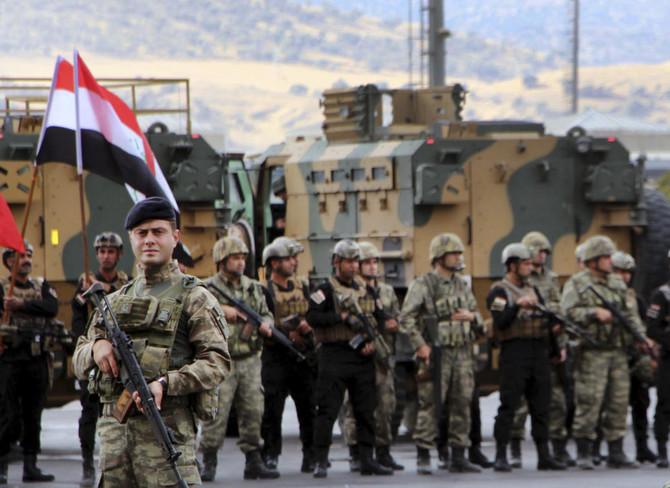
Turkish and Iraqi troops some holding their national flags participate in a ceremony at the Habur/Ibrahim Khalil border crossing with Iraq, near Silopi, southeastern Turkey, Tuesday, Oct. 31, 2017. Turkey's Prime Minister Binali Yildirim, in a speech, said that the border crossing was handed over to authorities of the Iraqi central government this morning. (DAP)
Updated 31 October 2017
Follow

Baghdad regains Habur border gate from the KRG, with Turkey’s help

ANKARA: Iraq and Turkish army forces gained control of the Habur border gate, also known as the Ibrahim Al-Khalil border gate on the Iraqi side, from the Iraqi Kurdistan Regional Government (KRG) and raised the Iraqi national flag.
State-run Anadolu Agency reported that Iraqi military forces were deployed at the Ibrahim Al-Khalil crossing in Iraqi territories, alongside Turkish forces, after making a joint drill in Turkey’s southeastern town of Silopi.
Iraqi Chief of General Staff Osman Ganimi thanked Turkish military officers and said: “We will be stronger as long as we stand together,” according to Anadolu Agency.
Turkey has a trade volume of $8 billion with Iraq that passes through the Habur border gate, currently the main passage between the two countries.
Speaking to the ruling AK Party politicians at the parliament, Prime Minister Binali Yildirim confirmed that Habur border gate had been handed over to the Iraqi central government by the KRG without any problem.
Yildirim also said that from now on the border crossing will be under the control of officials from Turkey and the Iraqi central government, while the transportation will be still carried out on the current route, but he added that Ankara would prevent KRG officials from taking racketeering from the trucks and imposing illegitimate taxes across the border.
After completing the necessary security reinforcements and feasibility studies, Turkey and Iraq are expected to open a second border gate in the near future, as an alternative border crossing that will pass through the Iraqi town of Tal Afar.
Mete Sohtaoglu, an Istanbul-based researcher on the Middle East, said the handover on Tuesday was initially aimed at gaining control of the border region.
“But, at the later phase, the Turkish army may be deployed across the border or on the Iraqi part of the border,” he told Arab News.
Sohtaoglu also expects a new joint operation between Tehran, Baghdad and Ankara in the region.
“A joint operation against those under the umbrella of the outlawed Kurdistan Workers’ Party and its military wing the People’s Defense Forces is looming on the horizon, particularly in Sinjar in northern Iraq. The unfolding military mobility in the region can be read as the gradual implementation of a bigger plan toward the region,” he added.
“The Iraqi national army is also deployed in a way to ensure the security of the second border gate between Turkey and Iraq. But what is interesting is that Iranian militia under the Iraqi national army are kept out of Turkish borders,” Sohtaoglu underlined.


UN rights chief shocked by ‘unbearable’ Darfur atrocities

Updated 19 January 2026
Follow

UN rights chief shocked by ‘unbearable’ Darfur atrocities

  • Mediation efforts have failed to produce a ceasefire, even after international outrage intensified last year with reports of mass killings, rape, and abductions during the RSF’s takeover of El-Fasher in Darfur

PORT SUDAN: Nearly three years of war have put the Sudanese people through “hell,” the UN’s rights chief said on Sunday, blasting the vast sums spent on advanced weaponry at the expense of humanitarian aid and the recruitment of child soldiers.
Since April 2023, Sudan has been gripped by a conflict between the army and the paramilitary Rapid Support Forces that has left tens of thousands of people dead and around 11 million displaced.
Speaking in Port Sudan during his first wartime visit, UN Human Rights commissioner Volker Turk said the population had endured “horror and hell,” calling it “despicable” that funds that “should be used to alleviate the suffering of the population” are instead spent on advanced weapons, particularly drones.
More than 21 million people are facing acute food insecurity, and two-thirds of Sudan’s population is in urgent need of humanitarian aid, according to the UN.
In addition to the world’s largest hunger and displacement crisis, Sudan is also facing “the increasing militarization of society by all parties to the conflict, including through the arming of civilians and recruitment and use of children,” Turk added.
He said he had heard testimony of “unbearable” atrocities from survivors of attacks in Darfur, and warned of similar crimes unfolding in the Kordofan region — the current epicenter of the fighting.
Testimony of these atrocities must be heard by “the commanders of this conflict and those who are arming, funding and profiting from this war,” he said.
Mediation efforts have failed to produce a ceasefire, even after international outrage intensified last year with reports of mass killings, rape, and abductions during the RSF’s takeover of El-Fasher in Darfur.
“We must ensure that the perpetrators of these horrific violations face justice regardless of the affiliation,” Turk said on Sunday, adding that repeated attacks on civilian infrastructure could constitute “war crimes.”
He called on both sides to “cease intolerable attacks against civilian objects that are indispensable to the civilian population, including markets, health facilities, schools and shelters.”
Turk again warned on Sunday that crimes similar to those seen in El-Fasher could recur in volatile Kordofan, where the RSF has advanced, besieging and attacking several key cities.
Hundreds of thousands face starvation across the region, where more than 65,000 people have been displaced since October, according to the latest UN figures.