TOKYO: Philippine President Rodrigo Duterte won pledges from Japan of help with fighting terrorism and assistance in building the country’s crumbling infrastructure, as he met with Japan’s prime minister on Monday during a visit to Tokyo.
Japan promised its support in the reconstruction of the strife-torn southern Philippine city of Marawi. A military campaign recently ended a five-month siege of the city by Daesh group-aligned militants that left more than 1,100 combatants and civilians dead.
Japanese Prime Minister Shinzo Abe welcomed the liberation of Marawi and gave credit to Duterte’s leadership.
“I express my heartfelt respect for President Duterte’s leadership on the recent declaration of liberation in Marawi,” Abe said. “We will provide full support for (the Philippines’) counterterrorism effort and steps to ensure peace and stability” in the region.
The two leaders also agreed to cooperate on various projects, including a subway system for metropolitan Manila, the traffic-jammed capital, energy development, maritime safety and the Philippines’ fight against drugs and drug trafficking. The two sides are now laying out project details under a 1 trillion yen ($9 billion) assistance package spanning five years that Japan had pledged earlier this year.
Duterte said he chose Japan as the destination of his first official overseas trip after Marawi’s liberation.
“The true friend of us stood squarely behind the Philippines in my country’s onward advance at greater peace, progress and prosperity,” Duterte said.
He praised Japan for its support and thanked Abe for his pledge of help in rebuilding Marawi and the surrounding region “in a timely manner.”
The siege in the southern Philippines displaced some 400,000 residents, including the entire population of Marawi, a bastion of the Islamic faith in the predominantly Roman Catholic Philippines. Military airstrikes, artillery and heavy machine-gun fire turned the lakeside city’s central business district and outlying communities into a smoldering wasteland of disfigured buildings and bullet-pocked mosques and houses.
The assistance from Tokyo also includes 15.9 billion yen ($140 million) in low-interest financing for a water management project in the Philippines’ flood-prone Cavite province, and another 100 billion yen ($880 million) for the Manila subway, Japan’s Foreign Ministry said in a statement. Japan is also providing patrol boats and speed boats for the Philippine coast guard and financing training programs to step up its security capacity in the region.
Before leaving the Philippines for Tokyo late Sunday, Duterte said he hoped to discuss concerns over North Korea with Abe and declared that someone should talk to North Korean leader Kim Jong Un, reassure him that nobody is out to remove him or destroy his country, and ask him to stop threatening attacks.
“You must remember that he is a leader of his people,” Duterte said, adding that “whatever he proclaims himself to be, somebody has got to talk to him.”
“So, if somebody could just reach out, talk to him and say, ‘My friend, why don’t you just join me in the table and we’ll just talk about these things?’” Duterte told reporters in the southern Philippine city of Davao. “Nobody’s talking to him.”
Duterte echoed US President Donald Trump in saying he believes China has the greatest leverage with Pyongyang, a longtime Beijing ally. And he expressed concern over the potential for dangerous missteps in the standoff with North Korea over its nuclear program.
“We are worried, all of us, that you know, Murphy’s Law, ‘If anything can go wrong, it will go wrong.’“
On Monday, Duterte condemned North Korea for threatening peace and stability in the region with its repeated missile launches, urging Pyongyang and other involved parties to return to negotiations to resolve the problem.
Apart from his talks with government officials in Tokyo, Duterte met with Japanese business leaders earlier Monday and will have an audience with Emperor Akihito and Empress Michiko before heading home Tuesday. He told reporters that he wants to express his respect for Akihito and thank him for his visit to the Philippines last year.


![]()
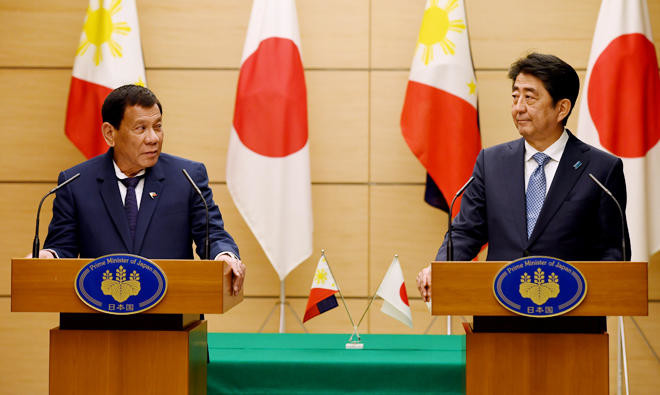
Japan offers Duterte aid for rebuilding, fighting terrorism
Japan offers Duterte aid for rebuilding, fighting terrorism


Latest updates


© 2026 SAUDI RESEARCH & PUBLISHING COMPANY, All Rights Reserved And subject to Terms of Use Agreement.