NATO chief calls N. Korea ‘global threat’ during Japan visit

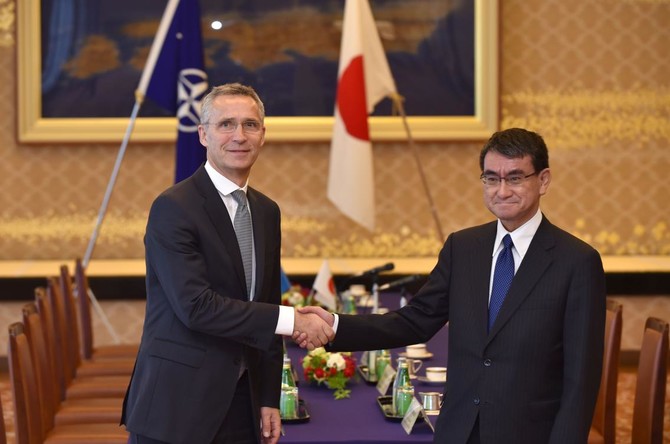
NATO Secretary General Jens Stoltenberg (L) shakes hands with Japan’s Foreign Minister Taro Kono at the Iikura guest house in Tokyo on October 30, 2017. (AFP)
Updated 30 October 2017
Follow

NATO chief calls N. Korea ‘global threat’ during Japan visit

TOKYO: NATO chief Jens Stoltenberg called North Korea a “global threat” Monday and said he backed tighter sanctions against it during a visit to Japan, which has been targeted by Pyongyang’s provocations.
Stoltenberg is in Tokyo to meet Prime Minister Shinzo Abe and other senior officials including defense minister Itsunori Onodera later in the day.
“We are as concerned as you are about the provocative, reckless behavior from North Korea,” he said in a speech to a group of security experts and defense officials.
“It is really dangerous, it poses a direct threat to countries in this region (including) Japan, but it is also a global threat,” he added.
Pyongyang has sparked global alarm in recent months by conducting its sixth nuclear test and test-launching missiles capable of reaching the US mainland, while US president Donald Trump and the North’s young ruler Kim Jong-Un have traded threats of war and personal insults.
It fired two projectiles over northern Japan in less than a month, ringing alarm bells in Tokyo as Abe called for a get-tough approach toward Pyongyang.
“NATO strongly support political, diplomatic, economic pressure on North Korea and we welcome the strengthening of the sanctions” adopted by the UN Security Council in September, Stoltenberg said.
“But even more important, we need to be sure that the sanctions are fully and transparently implemented,” he added.
Stoltenberg’s visit comes after Abe met with him in Brussels in July to agree on boosting security cooperation.
“We know and you know that (North Korea’s missile) ranges reach the west coast of the United State and the ranges reach most of Europe,” he said Monday.
But the NATO chief warned this month that military action against Pyongyang would have “devastating consequences,” after Trump said diplomatic efforts had failed.
Stoltenberg has stressed that Washington had the right to defend itself and its allies but called for greater diplomatic efforts.
“We don’t have to use military force — peaceful resolution is the aim,” he said Monday.
Maritime security, including territorial rows involving China in the East and South China Seas, was also likely to be a topic of discussion during Stoltenberg’s visit, according to a Japanese foreign ministry official.


US immigration officials grilled by Congress over Trump crackdown

Updated 2 sec ago
Follow

US immigration officials grilled by Congress over Trump crackdown

  • Trump administration officials faced a barrage of criticism and tough questions from Democratic lawmakers over the major crackdown on migrants in multiple US cities
  • Rodney Scott hailed efforts on the southern US frontier, saying CBP ‘spent the last year rebuilding what was an intentionally broken border’
WASHINGTON: The heads of US immigration agencies faced heavy criticism in Congress Tuesday as they defended President Donald Trump’s mass deportation drive and fielded questions about the fatal shootings of two protesters in Minneapolis.
Trump acknowledged in the wake of the Minneapolis killings that a “softer touch” may be needed on immigration, and his administration announced concessions including the withdrawal of hundreds of officers from the Midwestern city.
But the issue remains far from resolved, with Democrats demanding changes to the way the Department of Homeland Security (DHS) conducts its immigration sweeps and threatening to block its funding, while Trump’s administration vows to maintain its deportation efforts, with backing from Republican lawmakers.
“The president tasked us with mass deportation, and we are fulfilling that mandate,” Todd Lyons, the acting head of Immigration and Customs Enforcement (ICE), said in his opening remarks during the Tuesday hearing on DHS oversight.
He testified alongside Rodney Scott, the head of US Customs and Border Protection (CBP), and Citizenship and Immigration Services director Joseph Edlow.
Scott hailed efforts on the southern US frontier, saying CBP “spent the last year rebuilding what was an intentionally broken border” and that “the United States... enjoys the most secure border in our nation’s history.”
The Trump administration officials faced a barrage of criticism and tough questions from Democratic lawmakers over the major crackdown on migrants in multiple US cities, which Republican representatives largely defended.
“This administration and the agencies represented before us have shown a complete and utter disregard for the law and the Constitution,” Democratic Representative Tim Kennedy said.
Representative Eli Crane, a Republican, pushed back on criticism of immigration enforcement, accusing Democrats of seeking to “demonize ICE and Homeland Security.”

‘Days, not weeks’

In Minneapolis, thousands of federal agents have in recent weeks conducted raids in what the administration claims are targeted operations against criminals.
Minnesota Governor Tim Walz said Tuesday that he expects the crackdown — which has seen detentions of broad categories of immigrants and sometimes citizens — to end soon.
“We’re very much in a ‘trust but verify’ mode. But it’s my expectation... that we are talking days, not weeks and months, of this occupation,” Walz said.
The operations have sparked mass protests in Minneapolis, and the fatal shootings of US citizens Renee Good and Alex Pretti less than three weeks apart last month led to a wave of outrage.
When Democratic Representative Eric Swalwell asked Tuesday if Lyons would apologize to Good and Pretti’s families over the Trump administration’s initial description of them as “domestic terrorists,” he declined, saying he would not comment on active investigations.
Opposition Democrats have been calling for sweeping reforms to ICE operations, including ending mobile patrols, prohibiting agents from concealing their faces, and requiring warrants.
Democratic leaders in Congress are also threatening to block the 2026 funding bill for DHS. The White House has indicated it is willing to negotiate, but its response has failed to satisfy opposition lawmakers so far.
“Republicans shared an outline of a counterproposal, which included neither details nor legislative text,” House Minority Leader Hakeem Jeffries and Senate Minority Leader Chuck Schumer said in a statement.
They denounced the White House response as “incomplete and insufficient in terms of addressing the concerns Americans have about ICE’s lawless conduct,” and said they were awaiting further details.
If negotiations fail, DHS could face a funding shortfall starting Saturday. CBP and ICE operations could continue using funds approved by Congress last year, but other sub-agencies such as federal disaster organization FEMA could be affected.