Oil markets stable on expected extension of output cuts

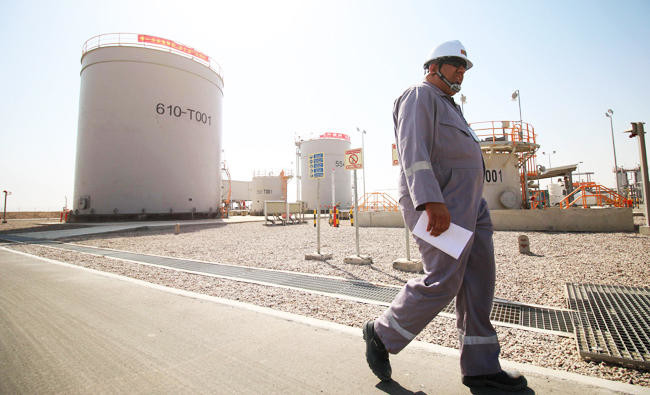
A photo taken on October 23, 2017 shows an employee walking at the Rumaila natural gas powerstation, north of the southern Iraqi port of Basra. (AFP)
Updated 30 October 2017
Follow

Oil markets stable on expected extension of output cuts

SINGAPORE: Oil markets were stable on Monday, with Brent remaining above $60 per barrel supported by expectations that an OPEC-led production cut due to expire next March would be extended.
Brent crude oil futures, the international benchmark for oil prices, were at $60.40 per barrel at 0236 GMT, 4 cents above their last settlement but still close to their highest level since July 2015 and up more than 36 percent since their 2017 lows last June.
US West Texas Intermediate (WTI) crude futures were up by 5 cents, or 0.1 percent, at $53.95 a barrel.
“With strong compliance to OPEC’s production curbs already supporting prices, comments from the Saudi Arabian Crown Prince that suggested the production cut agreement should be extended added to gains,” ANZ bank said.
The Organization of the Petroleum Exporting Countries (OPEC) plus Russia and nine other producers have agreed to hold back about 1.8 million barrels per day (bpd) to get rid of a supply glut. The pact runs to March 2018, but Saudi Arabia and Russia, who are leading the effort, have both voiced their support to extend the agreement.
OPEC is scheduled to meet officially at its headquarters in Vienna, Austria, on Nov. 30.
While OPEC and its partners are withholding supply, US production has risen almost 13 percent since mid-2016. As a result WTI is trading at a steep discount of around $6.50 per barrel against Brent , which has made US crude exports to the world attractive.
Confidence in the oil market is evident in the way financial traders have positioned themselves.
Hedge funds and other money managers raised their bullish wagers on US crude futures and options in the week to October 24, the US Commodity Futures Trading Commission (CFTC) said on Friday.
The speculator group raised its combined futures and options position in New York and London by 15,041 contracts to 280,634 during the period.
Despite this, some analysts were cautious, pointing to technical chart indicators.
“We note that both contracts’ (Brent and WTI) relative strength indices (RSI) are both approaching over-bought levels. This may imply that crude has risen enough in the short term and some consolidation is required,” said Jeffrey Halley, senior market analyst at futures brokerage OANDA in Singapore.


Saudi Arabia’s foreign reserves rise to a 6-year high of $475bn

Updated 22 February 2026
Follow

Saudi Arabia’s foreign reserves rise to a 6-year high of $475bn

RIYADH: Saudi Arabia’s foreign reserves climbed 3 percent month on month in January to SR1.78 trillion, up SR58.7 billion ($15.6 billion) from December and marking a six-year high.

On an annual basis, the Saudi Central Bank’s net foreign assets rose by 10 percent, equivalent to SR155.8 billion, according to data from the Saudi Central Bank, Argaam reported.

The reserve assets, a crucial indicator of economic stability and external financial strength, comprise several key components.

According to the central bank, also known as SAMA, the Kingdom’s reserves include foreign securities, foreign currency, and bank deposits, as well as its reserve position at the International Monetary Fund, Special Drawing Rights, and monetary gold.

The rise in reserves underscores the strength and liquidity of the Kingdom’s financial position and aligns with Saudi Arabia’s goal of strengthening its financial safety net as it advances economic diversification under Vision 2030.

The value of foreign currency reserves, which represent approximately 95 percent of the total holdings, increased by about 10 percent during January 2026 compared to the same month in 2025, reaching SR1.68 trillion.

The value of the reserve at the IMF increased by 9 percent to reach SR13.1 billion.

Meanwhile, SDRs rose by 5 percent during the period to reach SR80.5 billion.

The Kingdom’s gold reserves remained stable at SR1.62 billion, the same level it has maintained since January 2008.

Saudi Arabia’s foreign reserve assets saw a monthly rise of 5 percent in November, climbing to SR1.74 trillion, according to the Kingdom’s central bank.

Overall, the continued advancement in reserve assets highlights the strength of Saudi Arabia’s fiscal and monetary buffers. These resources support the national currency, help maintain financial system stability, and enhance the country’s ability to navigate global economic volatility.

The sustained accumulation of foreign reserves is a critical pillar of the Kingdom’s economic stability. It directly reinforces investor confidence in the riyal’s peg to the US dollar, a foundational monetary policy, by providing SAMA with ample resources to defend the currency if needed.

Furthermore, this financial buffer enhances the nation’s sovereign credit profile, lowers national borrowing costs, and provides essential fiscal space to navigate global economic volatility while continuing to fund its ambitious Vision 2030 transformation agenda.