LONDON: Christie’s decision to hold its autumn sale of Middle Eastern Modern and Contemporary Art in London for the first time was greeted with an enthusiastic reception by art lovers who competed to buy the most coveted pieces in the auction held on Oct. 25. The traditional March sale week will continue to take place in Dubai and will occur during the Dubai Art Season.
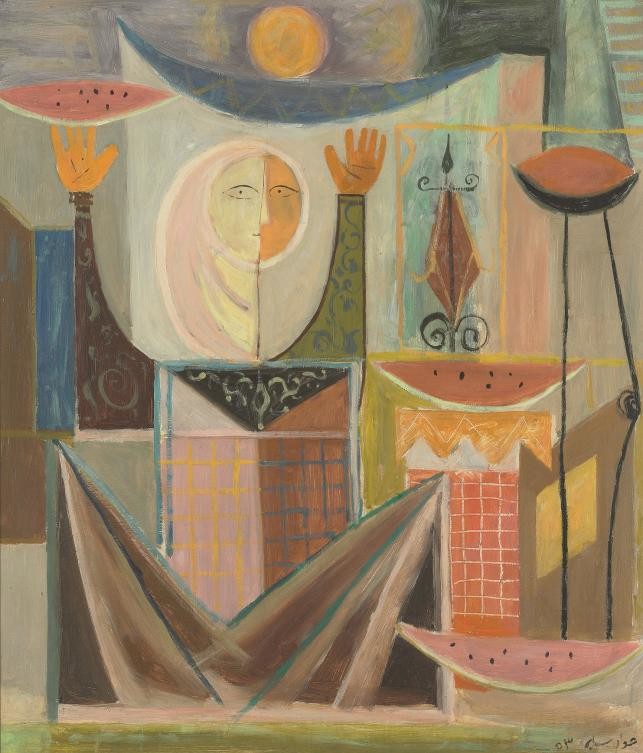
Registered bidders from 23 countries confirmed the international appetite for works from the region. The sale was led by a world auction record for the Iraqi artist Jewad Selim, whose painting “The Watermelon Seller” sold for $876,73, more than double its high estimate of $328,150.
Another highlight was Mahmoud Sabri’s “Grief,” which sold for $876,731, more than ten times its high estimate of $78,756 and a new world auction record for the artist.
The Emirati artist Abdul Qader Al-Rais donated two paintings, “The Dream” ($81,938) and “Untitled” ($81,938) with proceeds from the sale benefitting the Emirates Red Crescent Authority.
Arab News spoke to Michael Jeha, deputy chairman and managing director for Christie’s in the Middle East, who explained that demand for Middle Eastern art is increasing globally.
“We are seeing more and more collectors and institutions from around the world participating in Middle Eastern art sales. It’s moving up and the market is becoming more mature. Established collectors from the Middle East particularly are now extremely knowledgeable about the art; they ask a lot more questions and are all focusing on a narrower group of artists than five years ago.
“In Saudi Arabia, and Jeddah in particular, you can sense there is an increasing appetite for art – there are more galleries opening up and you have the 2139 initiatives – more and more patrons and foundations being set up,” he said.
The sale comprised approximately 60 works, mostly consigned by private collectors and led by and important group of works by Egyptian artists, highlighted by their recognized master Mahmoud Said (1897-1964).
Mahmoud Said’s portrait “Hanem” sold for $420,503 alongside his second version of “La Fille aux Yeux Verts,” which was sold for $229,425.
It was fascinating to listen to Christie’s experts talking about the paintings.
Hala Khayat, head of Sale for Middle Eastern Art, Christie’s, based in Dubai, told an intriguing story about a controversy that arose over Mahmoud Said’s “La Fille aux Yeux Verts.” When Christie’s first put this painting up for auction several years ago, the sale was stopped because it was thought to be a stolen work. As it happens, all was above board.
The recently published catalogue raisonné of Mahmoud Saod, co-written by Valerie Hess from Christie’s, revealed that he painted two versions of the piece. One was painted in 1931 and is still part of the collection of the Museum of Modern Art in Cairo. He painted another version in 1932, “La Fille aux Yeux Verts (réplique),” originally in the collection of Charles Terrasse, the first director of the Museum of Modern Art in Cairo. That version was put up for sale by Christie’s.
Khayat explained that Said was from an upper class aristocratic family. His father was the Prime Minister of Egypt. He was a lawyer by profession but his real passion was art.
“His mind and soul were in painting and exploring the Egyptian identity. We refer to him as the father of all modernists in the Arab world because, very early on, he started to look at the people of the land and to paint them with their traditional look. The painting “Hanem” depicts a woman sitting in her house wearing her turban. This representation was something new as prior to this you wouldn’t have seen women depicted in this way — they would have been shown wearing their jewelry sitting in a Western style,” she said.
Two striking works in the sale were by the Syrian artist Safwan Dahoul who had to leave his country due to the war and is now based in Dubai. Khayat, when asked if the woman in the painting “Reve” was the artist’s late wife, who died of cancer, said Dahoul has said that he does not consciously set out to paint her image but that she always comes to his mind.
Khayat, who is Syrian, was taught by Dahoul
“I grew up in Damascus and he was one of my teachers at university,” she explained.
Khayat gave some insights into the artist Jewad Selim whose “Watermelon Seller” proved to be a highlight of the sale, selling for double its estimate.
“Jewad Selim died very young in his 40s. He was one of the first artists who on returning to Iraq after studying in Italy and London tried to come up with an Iraqi identity. He looked to the colors of Mesopotamia and used simple forms. He was one of the first artists to exhibit in the US. His work is extremely rare; in my eleven years with Christie’s we have managed to sell just one small painting and one small sculpture,” she said.
Painted in 1953, the painting combines Selim’s inspiration from his Eastern tradition and Western influences obtained when studying in Paris, London and Rome. The watermelon represents modern Iraq, the land of the two rivers, with its intersection of the Tigris and Euphrates and hints to the novelty of modern Iraq. The composition is rendered in shapes and the crescent shape is taking a leading role in representing the watermelon slices, an association to the fertile crescent of the Middle Eastern region, which is historically considered as the cradle of civilization.
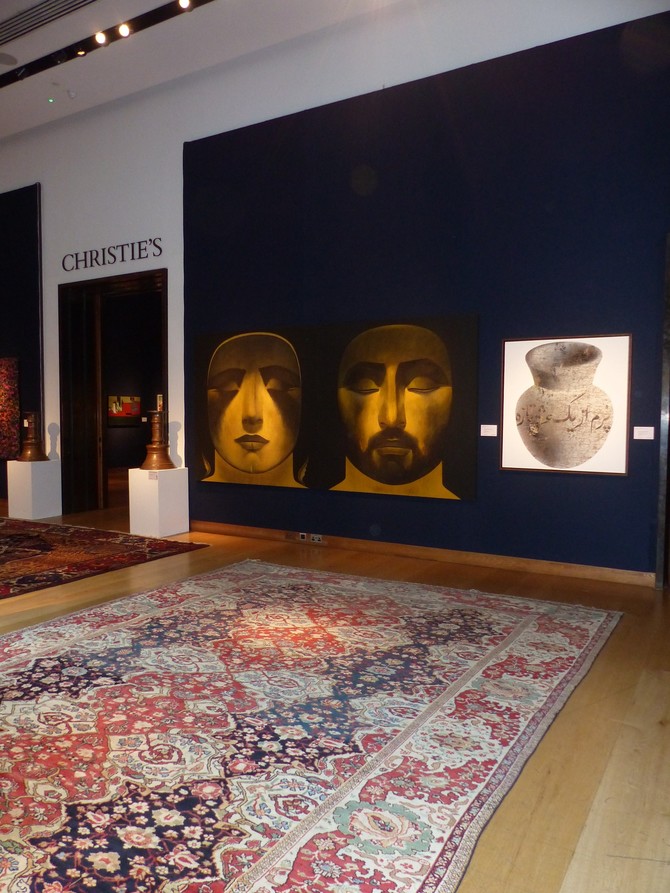
The Middle Eastern art was exhibited alongside the works sold at the Art of the Islamic and Indian Worlds’ auction on Oct. 26.
Khayat commented: “I love the juxtaposition with the Islamic and Indian Art week — it is like a dialogue.”
She noted how, for example, the work of contemporary artist Reza Derakhshani echoed the traditions embodied in the fine paintings in the adjoining rooms.
Sara Plumbly, head of the department of Islamic and Indian Art, gave Arab News a tour of some of artworks in the sale.
She encouraged us to look closely at a portrait of Safdar Khan, attributed to Bichitr, Mughal, India, circa 1635-40, in order to fully appreciate the exquisite detail and coloring.
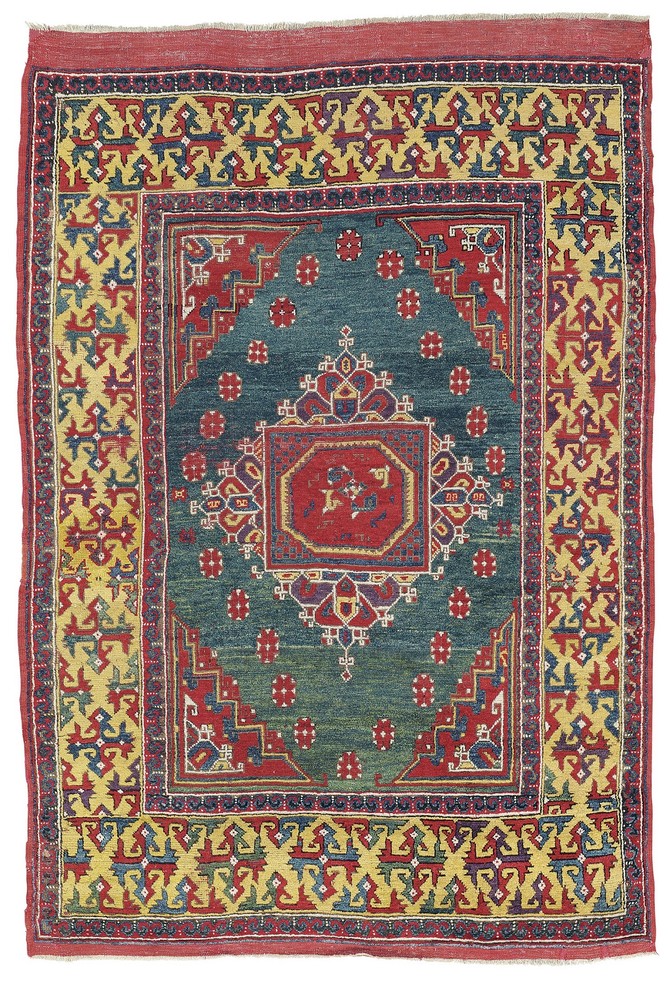
Some beautiful carpets were featured in the sale too. Christie’s Oriental Rugs and Carpets expert, Louise Broadhurst, was on hand to explain some of the distinctive features which indicate quality and authenticity. She helped us to understand the qualities of a West Anatolian Ghirlandaio rug of the late 17th century.
“Tonal changes in the color signify a natural dyed carpet. Each time a new batch of dye was made it would be of a different consistency which is why you get this natural change of color which you don’t get in a synthetic dye from a bottle which is always of the same consistency.
“These are the kind of ‘fingerprints’ we are looking for in hand woven carpets — these types of irregularities. Some colors are particularly sought after by collectors — for example, the color aubergine — which was a rare plant.
“Browns were woven from fungi and mushroom bark — these dyes have a natural corrosive element within them — so when you run your hand over the surface of a 16th or 17th century carpet you will feel a relief effect happening from this natural corrosion. Reds also corroded. Blues and greens are stronger due to the natural preservative in the dye which keeps the colors looking better for longer.
“We want to be assured that the carpet hasn’t been re-piled or overly restored,” she said.
The way the artworks were presented in the pre-sale exhibitions greatly added to the excitement around the auctions. Having the experts on hand to share their special knowledge helped bring the works to life and added to the appreciation of the rich cultures of the respective regions.


![]()
![]()
![]()
![]()
![]()
International bidders prove Mideast art is all the rage at Christie’s London auction


International bidders prove Mideast art is all the rage at Christie’s London auction
Latest updates


Recommended


© 2026 SAUDI RESEARCH & PUBLISHING COMPANY, All Rights Reserved And subject to Terms of Use Agreement.