

Turkey’s Mapa wins prestigious order for Arafat-Taif Water Transmission System

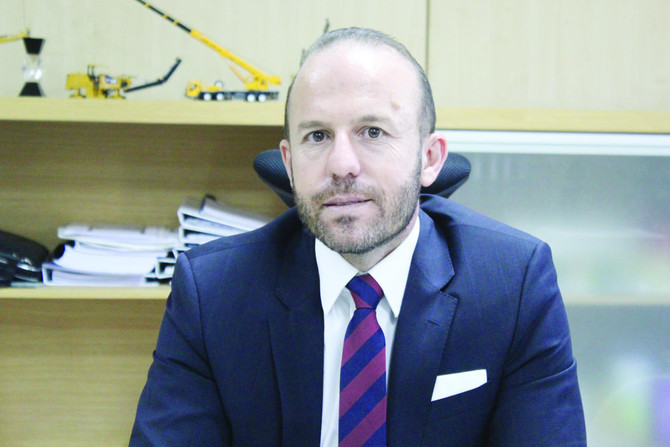
Mapa General Manager Cihan Yilmaz
Updated 30 October 2017
Follow

Turkey’s Mapa wins prestigious order for Arafat-Taif Water Transmission System

RIYADH: As part of an ambitious plan to ensure adequate water supply and management, Saudi Arabia has awarded a prestigious SR985 million Arafat-Taif Water Transmission System project to Turkey’s Mapa Construction and Trade Co. The Mapa and the Saline Water Conversion Corporation (SWCC) signed the project only a few weeks back.
“The construction of the Arafat-Taif Water Transmission System will be supervised by the SWCC and the project will consist of a 45-km pipeline from Arafat to Taif as well as pumping stations and 12.5-km tunnels,” said Cihan Yilmaz, Mapa’s general manager, while speaking on the occasion of Turkish national day. Cihan congratulated and thanked King Salman, Saudi people and Turkish expatriates on this occasion.
In his interview, the Mapa chief also spoke about other ongoing projects including the construction of Al-Raidah Housing Complex (BP02), which is supervised by Al-Raidah Investment Company. This major housing complex project, currently being successfully executed, consists of different types of buildings a part of a 2.5-million-square-meters urban facility in Jeddah region. He also gave an overview of Mapa’s operations in the Kingdom as well as other countries across the globe.
Spelling out the details of the new Arafat-Taif Water Transmission System Project, Mapa chief said: “The pipeline will involve the construction of a 60-inch single line from PS2E near Arafat Tanks to Taif Strategic Reservoirs.”
“This section includes pipe installation in the tunnel and installation of pipe supports/fixed points,” said the Mapa chief, adding that “the project also includes laying of a second buried 60-inch line in the area upstream and downstream of the west portal.”
He pointed out that a housing compound and an administration area will be built near the SWCC Taif Terminal as part of the project. The total contract value is SR984.7 million ($262.5 million) with a contract period of 1,460 days from the date of the site’s handover, which is expected to be Nov. 5.
Asked about the details of Al-Raidah Housing Complex Project BP02, Yilmaz said that the client is Al-Raidah Investment Company. The project details, he pointed out, include all engineering, construction, supervision, material supply, tools, equipment and other services necessary for the installation, testing and commissioning and maintenance of all civil, architectural, and MEP works. This includes 74 apartment buildings of different types as per international standards.
He said that the main jobs for Al-Raidah include piling works, structure works, civil works, mechanical and electrical works, finishing works and landscaping works etc. The total contract value of this project is SR1.8 billion. He further said that 65 percent of the project has been completed and the expected completion date is Dec. 13, 2018.
On the technical capabilities of Mapa, Yilmaz said that Mapa ranks among major contractors, which provides civil and electromechanical contracting for infrastructure projects, commercial and residential buildings, power, industrial and wastewater treatment plants besides many other jobs. Mapa, he said, “has very successfully increased its footprint in the Kingdom and elsewhere in the world.”

Correction:
An earlier version of this story said in the sixth paragraph that the total contract value is SR98.4 million ($26.2 million). The correct figures are SR984.7 million ($262.5 million).


‘I’ve never seen more confidence in Saudi Arabia’s ability to get things done,’ Diriyah CEO Jerry Inzerillo tells Arab News

Updated 4 sec ago
Follow

‘I’ve never seen more confidence in Saudi Arabia’s ability to get things done,’ Diriyah CEO Jerry Inzerillo tells Arab News

  • Jerry Inzerillo says Founding Day reflects ancestral pride while Diriyah builds the Kingdom’s next 300 years
  • Diriyah’s CEO points to strong investor momentum behind Saudi Arabia’s nationwide giga-project drive

RIYADH: As Saudi Arabia prepares to mark Founding Day on Feb. 22, and looks ahead to the 300th anniversary of the First Saudi State in 2027, few places capture the spirit of that moment quite like Diriyah.

Rising from the historic mudbrick walls of At-Turaif — the UNESCO World Heritage site that marks the birthplace of the Kingdom — a $63 billion giga-project is taking shape, blending heritage, hospitality, and high-end living into what its leaders describe as the world’s premier cultural and lifestyle destination.

At the helm is Jerry Inzerillo, group CEO of Diriyah Company, who speaks about the project with the conviction of someone who understands both its symbolism and its scale.

“Founding Day is our favorite day of the year,” Inzerillo told Arab News. “We love National Day. We love Ramadan. We love family time. But Founding Day is different. It marks the ancestral birthplace of the Kingdom, the home of Al-Saud. It is the source of our identity and our pride.”

Diriyah is not simply another urban development. It is an exercise in national storytelling.

As Saudi Arabia approaches the 300th anniversary of the founding of the First Saudi State on Feb. 22, 2027, the restoration and expansion of Diriyah serve as both acts of homage and a vision statement.

“Founding Day allows us to reflect on where our rich history has been for 300 years,” Inzerillo said. “And it allows us to look forward to the next 300.”

That dual lens — heritage and horizon — defines the project. Every design decision is anchored in Najdi architecture, the traditional mudbrick style of central Arabia. To preserve authenticity, more than 20 million mud bricks have been handcrafted to replicate historic construction methods.

“It’s very complex,” Inzerillo said. “But authenticity matters. We are not just building quickly. We are building with quality, with heritage, and with respect.”

The result is a master-planned city that feels rooted in the 18th century while operating firmly in the 21st.

For many giga-projects around the world, the masterplan often remains conceptual for years. In Diriyah’s case, Inzerillo said the project is visibly, tangibly underway.

“Today, Diriyah is out of the ground,” he said. “Hotels are operating. Restaurants are operating. We recently served 3,200 covers in a single evening.”

The numbers are striking. More than 4 million visitors have already come through the site. One flagship hotel is tracking occupancy at more than 90 percent. And 56,000 workers report to construction sites daily across central Riyadh to advance the development.

“What makes investors confident is that they can see it,” Inzerillo said. “It’s not theoretical. It’s real. It’s built. It’s operating.”

Diriyah is slated to be substantially complete in time for Expo 2030 in Riyadh — a milestone Inzerillo describes as a “phenomenal moment” for the Kingdom.

With a total projected investment of $63 billion, Diriyah is one of the most ambitious urban development projects globally. But Inzerillo is quick to point out that funding alone does not ensure success.

“Money is one factor,” he said. “But two other factors are just as important: time and quality. Being the master developer means we control both.”

That control has translated into rising foreign direct investment. International hospitality brands and global investors are increasingly committing to the project.

“We recently completed a major joint venture worth over €1.4 billion with an Italian investor,” Inzerillo said. “We’ve signed landmark deals for branded residences. People want to own here because they see the progress.”

The appeal extends beyond tourism. According to Inzerillo, Diriyah’s success reflects broader confidence in Saudi Arabia’s economic transformation under Vision 2030.

“I’ve never seen a period where there’s more confidence in the Kingdom’s ability to execute,” he said. “Whether it’s tourism, mining, agriculture, AI, tech — people believe in the vision.”

Inzerillo views Diriyah not an outlier but a showcase, demonstrating that the Kingdom can turn blueprints into bricks and mortar on schedule.

Stressing that the Kingdom’s flagship schemes are “coming online” and “coming to life,” Inzerillo said this a breakthrough moment in which Saudi Arabia’s plans are transforming into vibrant destinations, drawing visitors, investment and global attention, and underscoring his conviction that the giga‑project drive is firmly on track.

While Diriyah’s architecture and investment figures command headlines, Inzerillo insists that the project’s proudest achievement is its people.

Diriyah’s workforce is 82 percent Saudi, with women representing nearly 40 percent of employees.

“These are superstars,” he said. “Young Saudi men and women who are passionate, multilingual, and proud to welcome the world.”

He recounts a recent visit by Ban Ki-moon, during which a young Saudi woman greeted the former UN secretary-general in fluent Korean — a language she had taught herself through watching television dramas.

“He stopped the golf cart and asked her where she learned Korean,” Inzerillo said. “He took a selfie with her. That moment represents the new Saudi Arabia.”

Another young tour guide had learned English through daily interactions with international visitors. “This is real cultural exchange,” Inzerillo said. “It’s happening organically.”

BIO: Jerry Inzerillo

- Jerry Inzerillo has spent decades at the top of the global hospitality industry. As group chief executive of Diriyah Company, he oversees the planning and delivery of one of Saudi Arabia’s most ambitious development projects.

- Before joining Diriyah, he served as CEO of Forbes Travel Guide, expanding its presence to more than 100 countries. Over the course of his career, he has held senior roles linked to brands including One&Only Resorts, Ian Schrager Company, Four Seasons Hotels and Resorts and Hilton Hotels & Resorts.

- He also served as president of Kerzner International, overseeing major resort destinations across Africa, the Middle East, Asia and the Caribbean, and was previously CEO of IMG Artists.

- In 2021, he received the “Corporate Hotelier of the World” award from HOTELS Magazine, one of the sector’s most prominent industry honors.

Beyond hospitality and heritage, Diriyah is positioning itself as a residential destination.

To date, SR16.5 billion ($4.4 billion) worth of residential real estate has been sold. The project includes luxury villas, branded residences attached to hotels, and newly tested mid-market housing aimed at Saudi families.

“At Cityscape, we introduced 60 mid-market units starting from SR1.9 million,” Inzerillo said. “They sold immediately. That told us the demand is there.”

The first Ritz-Carlton residences are scheduled for handover soon, while thousands more units are under development for delivery before 2030.

Diriyah’s residential concept centers on walkability and community.

“You’ll be able to walk to pray, walk to work, walk to school,” Inzerillo said. “It will be the Kingdom’s first fully pedestrian-friendly cultural city.”

Diriyah’s growing global profile has drawn high-level visitors, including Britain’s Prince William.

Inzerillo recalls a recent visit in which the royal guest toured the site on foot for nearly 90 minutes.

“He remarked on how much had been accomplished in such a short time,” he said.

But it is not just dignitaries who are drawn to Diriyah. Celebrities, athletes, and global figures are increasingly stopping to take photos in front of Salwa Palace — the former seat of the First Saudi State.

“I like to joke that if you ask celebrities whether they have a picture at the Eiffel Tower or the pyramids, of course they do,” Inzerillo said. “Now, when people come to Riyadh, they want that photo in front of Salwa Palace.”

For him, that image symbolizes Saudi Arabia’s growing cultural confidence.

“It’s the emblem of the birthplace of the Kingdom,” he said. “It represents who we are.”

Diriyah’s rise coincides with Saudi Arabia’s broader expansion into global tourism. Mega-events such as the Saudi Cup horse race and international motorsport competitions have brought thousands of visitors to the Kingdom.

Inzerillo described walking through Diriyah one evening and hearing conversations in Chinese, Japanese, and a range of other languages — families strolling, children laughing, birds settling into newly planted trees.

“We planted 6.5 million trees in the wadi,” he said. “Now there are thousands of birds that were not here before.”

For him, those small details underscore a bigger shift.

“When visitors leave, their reviews are in the high 90s,” he said. “Many arrive with uncertainty. They leave saying they experienced warmth, beauty, and hospitality they didn’t expect.”

He views this as a powerful form of soft power — not imposed, but experienced.

Executing a giga-project of this scale is not without challenges. A German journalist once asked Inzerillo how often he encounters major problems.

“I told him: hourly,” he said, laughing. “There is always a ‘hot potato’ on my desk.”

But he frames these challenges as part of the process.

“These projects are complex. They require discipline and teamwork. But when you have great leadership and a strong team, you navigate through it.”

He credits the broader Vision 2030 framework and national leadership for creating an environment where such ambitious projects can thrive.

While Founding Day is an annual celebration, 2027 will mark a historic milestone — 300 years since the establishment of the First Saudi State.

The 300th anniversary celebrations, overseen by senior national figures including Princess Sara bint Mashhour bin Abdulaziz and leading historians, are expected to span an entire week, featuring hundreds of cultural, artistic, and family-focused activities.

“It will likely be one of the greatest cultural celebrations in the history of the Kingdom,” Inzerillo said.

For him, the anniversary is not only a commemoration of the past but a declaration of confidence in the future.

“There is only one Diriyah,” he said. “Three hundred years of history. And now we are building the next chapter.”

Inzerillo concluded with an invitation.

“Come visit the birthplace of the Kingdom,” he said. “Come see where our heart and soul began.”

For Saudi Arabia, Diriyah is more than a development project. It is a living narrative — one that connects mudbrick walls to modern skylines, ancestral pride to global ambition.

And as the Kingdom moves steadily toward 2030 and beyond, Diriyah stands as both anchor and aspiration — a testament to what can be built when history is not erased, but elevated.