RIYADH: Saudi Arabia and Turkey have signed eight agreements in Istanbul in the presence of Commerce and Investment Minister Majid Al-Qassabi and Turkish Economy Minister Nihad Zabka to boost bilateral trade.
The signing of agreements took place during the Saudi-Turkish Joint Business Council meeting in Istanbul on Wednesday.
Speaking after the signing of the agreements, Zabka said that Turkey has set up an investment-friendly climate for foreigners to do businesses with a sense of security, which would protect their interests in the country. "We have removed all obstacles and facilitated smooth investment procedures in Turkey,” Zabka noted, adding that Saudi and Turkish businessmen can harness these incentives for mutual interests.
Responding to Zabka's speech, Al-Qassabi said that such incentives are important for the two countries to forge ahead.
Mazen Rajab, head of the Saudi side of the business council, said that Saudi investments in Turkey have reached $10 billion which is a healthy growth of bilateral trade.
Saudi companies mainly invest in the industrial sector in Turkey in collaboration with the Turkish private and public sectors. They can also increase their investments in agricultural, finance, tourism and communications sectors.
Turkey, on the other hand, has had a sizable number of highly qualified and technologically superior contractors who are present today in every part of the globe, including the Arabian Gulf states.
In the field of tourism, Turkey has been doing very well. A total of 39 million tourists visited Turkey in 2013, raising revenue from tourism to reach $32 billion.
“Economic ties between the two countries are strongly backed by identical approaches on the whole range of bilateral and regional issues,” Yunus Demirer, the Turkish ambassador in Riyadh, said in an earlier interview.
Trade between Turkey and Saudi Arabia has been growing consistently. Around 80 percent of Turkey’s exports to the Kingdom are industrial products, whereas agricultural products account for 10 percent of exports.
On the other hand, the bulk of Turkey’s imports from Saudi Arabia come from crude oil and petrochemical products.
A close observation of the imports shows that the share of crude oil in total imports declined from 79 percent to below 40 percent between 2000 and 2014, while the share of petrochemicals increased drastically (the value of imports of polypropylene rose to $1 billion) in the same period. On the other hand, the decrease in the last two years was mainly related to the decline in crude oil prices.
Speaking about the upswing in trade and investment, Ambassador Demirer said that there is a genuine opportunity to establish a long-term partnership between the Turkish and Saudi business communities. Saudi visitors feel at ease in Turkey, says the envoy.
“As neighbors and two of the world’s oldest civilizations, Turkey and Saudi Arabia have shared a long history of religious, cultural, scientific and economic linkages,” said the envoy, adding that Turkish imports from Saudi Arabia have been traditionally dominated by fossil fuels.


![]()
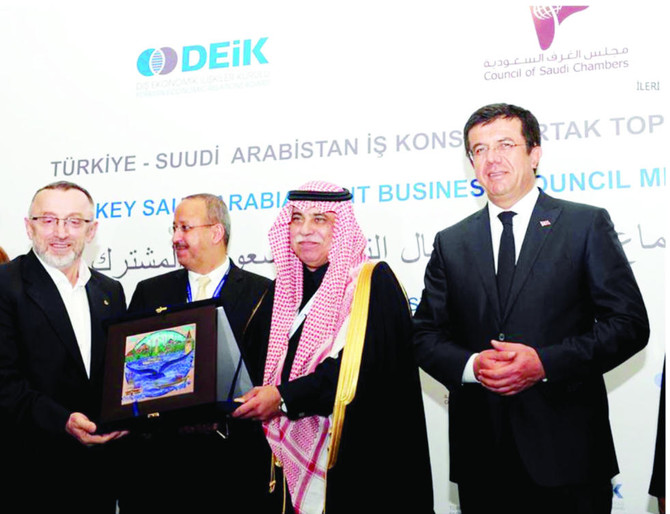
Saudi Arabia, Turkey sign 8 agreements to promote business
Saudi Arabia, Turkey sign 8 agreements to promote business
Latest updates


© 2026 SAUDI RESEARCH & PUBLISHING COMPANY, All Rights Reserved And subject to Terms of Use Agreement.