SULAIMANIYAH, Iraq: Iraqi Kurdistan’s leader Masoud Barzani will not extend his presidential term beyond Nov. 1, a Kurdish government official said on Saturday.
A plan to divide up the president’s powers was outlined in a letter Barzani sent to the Kurdish Parliament on Saturday, which it will discuss on Sunday, the official said.
Parliament said it will meet on Sunday to redistribute the powers of Barzani.
On Tuesday, Parliament decided to freeze the activities of Barzani, his Vice President Kosrat Rasul and the head of the presidential Cabinet, Fuad Hussein.
Barzani came under growing opposition from his detractors after he organized the Sept. 25 referendum on Kurdish independence that triggered a deep crisis with Baghdad.
The federal government opposed the vote which it deemed unconstitutional, and its forces have since seized a swathe of disputed territory from Kurdish fighters.
Iraqi Kurdistan’s main opposition party, the Goran movement, called on Barzani to step down after the loss of Kurdish-controlled territory.
Kurdish MP Iden Maarouf said Parliament will meet on Sunday to see how best to “redistribute the president’s powers” among the legislative, executive and judicial authorities.
Earlier, Iraqi and Kurdish commanders made “progress” in talks on Kurdish fighters withdrawing from disputed areas, Iraq’s chief of staff said hours before a truce in clashes over a key border post was due to expire.
But Gen. Othman Al-Ghanimi told reporters after the talks in central Nineveh province that there are “sticking points” that still need to be resolved.
“We have reached an agreement on some points,” he said, adding that the Iraqi side is still waiting to hear from the Kurds on a number of other issues.
“There has been progress, but the definitive solution is in the hands of the other (Kurdish) delegation. They must return to Kurdistan for consultation and give us their answer,” Al-Ghanimi said. “We will remain in touch by phone,” he added.
(Iraqi Prime Minister Haider) Al-Abadi’s spokesman earlier Saturday told AFP that a “joint technical committee” comprising Iraqi and Kurdish delegates was meeting to find a solution to the standoff at the border post.
“The main task of this joint technical committee is to allow the deployment without violence of federal forces along the borders,” Saad Al-Hadithi said.
“Commanders of the federal forces and of the Peshmerga are meeting to allow for this redeployment in a peaceful and humane fashion,” he said.
The aim of the talks was to negotiate the return to a 2003 “blue line” restricting autonomous Iraqi Kurdistan to the three northern provinces of Irbil, Dohuk and Sulaimaniyah, said Al-Hadithi.
A Kurdish official said the US-led coalition pushed them toward negotiations.


Iraqi Kurdistan leader Barzani to step down, parliament to redistribute his powers
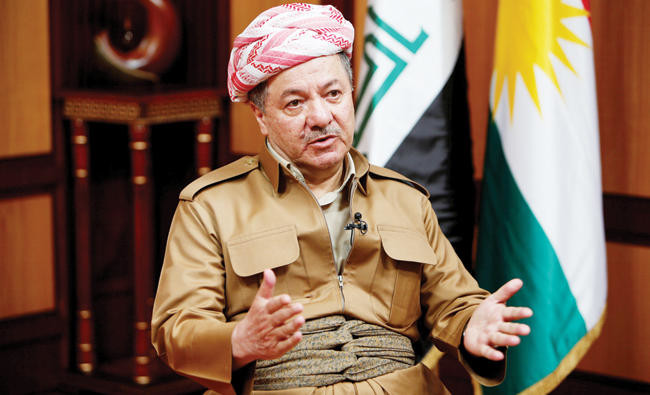
Iraqi Kurdistan leader Barzani to step down, parliament to redistribute his powers

Israel police to deploy around Al-Aqsa for Ramadan, Palestinians report curbs
- The Al-Aqsa compound is a central symbol of Palestinian identity and also a frequent flashpoint
JERUSALEM: Israeli police said Monday that they would deploy in force around the Al-Aqsa Mosque during the Muslim holy month of Ramadan, which begins this week, as Palestinian officials accused Israel of imposing restrictions at the compound.
Over the course of the month of fasting and prayer, hundreds of thousands of Palestinians traditionally attend prayers at Al-Aqsa — Islam’s third-holiest site, located in east Jerusalem, which Israel captured in 1967 and later annexed.
Arad Braverman, a senior Jerusalem police officer, said forces would be deployed “day and night” across the compound, known to Jews as the Temple Mount, and in the surrounding area.
He said thousands of police would also be on duty for Friday prayers, which draw the largest crowds of Muslim worshippers.
Braverman said police had recommended issuing 10,000 permits for Palestinians from the occupied West Bank, who require special permission to enter Jerusalem.
He did not say whether age limits would apply, adding that the final number of people would be decided by the government.
The Palestinian Jerusalem Governorate said in a separate statement it had been informed that permits would again be restricted to men over 55 and women over 50, mirroring last year’s criteria.
It said Israeli authorities had blocked the Islamic Waqf — the Jordanian?run body administering the site — from carrying out routine preparations, including installing shade structures and setting up temporary medical clinics.
A Waqf source confirmed the restrictions and said 33 of its employees had been barred from entering the compound in the week before Ramadan.
The Al-Aqsa compound is a central symbol of Palestinian identity and also a frequent flashpoint.
Under long?standing arrangements, Jews may visit the compound — which they revere as the site of their second temple, destroyed by the Romans in 70 AD — but they are not permitted to pray there.
Israel says it is committed to maintaining this status quo, though Palestinians fear it is being eroded.
Braverman reiterated Monday that no changes were planned.
In recent years, a growing number of Jewish ultranationalists have challenged the prayer ban, including far?right politician Itamar Ben-Gvir, who prayed at the site while serving as national security minister in 2024 and 2025.