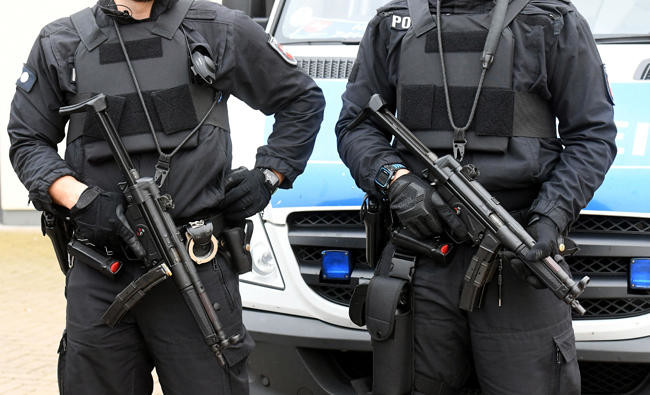
BERLIN: A Frankfurt court has sentenced two men to jail in separate cases for joining extremist fighters in Somalia and Syria.
A Somali-born German national, identified only as 29-year-old Abshir A., was found guilty of membership of a foreign terrorist group for fighting alongside Al-Qaeda-linked Al-Shabab militants.
The court in the western German city handed him a prison term of two years and ten months.
The same court sentenced Turkish-origin Ozkan C., 29, to two years and eight months for joining the militia Junud Al-Sham in Syria.
In the first case, the court said the Mogadishu-born accused left Germany for Somalia in 2012 after becoming radicalized and was active for the militant group until early 2014.
He spent around four months in combat training after arriving, during which time Al-Shabab militia taught him how to handle weapons and employ guerrilla tactics, according to the court statement.
He was then sent to an Al-Shabab base but left “shortly afterwards because of health problems,” it added.
He, however, remained in Somalia until returning to Germany last year when he was arrested at the airport.
The accused denied taking part in any fighting in Somalia, where the Al-Shabab is seeking to overthrow the country’s internationally-backed government.
In the second case, the court said Ozkan C. traveled to Syria with his wife in 2013 to join Junud Al-Sham, many of whose fighters later defected to Daesh.
The accused received weapons training and taught Arabic to other German-speaking radicals, the court said.
He returned to Germany in late 2013 and was arrested last year.
German courts have jailed a number of returning extremists for their membership in terror groups abroad.
Five men were sentenced to prison terms of up to five years in 2016 for having joined the Al-Shabab in Somalia.
In another case that year, a court jailed three young German men for up to four-and-a-half years for having joined extremist fighters in Syria in 2013.

Germany jails two extremists for fighting in Somalia, Syria
Ukraine sanctions Belarus leader for supporting Russian invasion
- Ukraine on Wednesday sanctioned Belarus’s long-time leader Alexander Lukashenko for providing material assistance to Russia in its invasion and enabling the “killing of Ukrainians.”
KYIV: Ukraine on Wednesday sanctioned Belarus’s long-time leader Alexander Lukashenko for providing material assistance to Russia in its invasion and enabling the “killing of Ukrainians.”
Lukashenko is one of Russian President Vladimir Putin’s closest allies and allowed his country to be used as a springboard for Moscow’s February 2022 attack.
Russia has also deployed various military equipment to the country, Ukraine alleges, including relay stations that connect to Russian attack drones, fired in their hundreds every night at Ukrainian cities.
“Today Ukraine applied a package of sanctions against Alexander Lukashenko, and we will significantly intensify countermeasures against all forms of his assistance in the killing of Ukrainians,” President Volodymyr Zelensky said in a statement.
Russia has also said it is stationing Oreshnik missiles in Belarus, a feared hypersonic ballistic weapon that Putin has claimed is impervious to air defenses. It has twice been fired on Ukraine during the war — launched from bases in Russia — though caused minimal damage as experts said it was likely fitted with dummy warheads both times.
Zelensky also accused Lukashenko of helping Moscow avoid Western sanctions.
The measures are likely to have little practical effect, but sanctioning a head of state is a highly symbolic move.
Ukraine and several Western states sanctioned Putin at the very start of the war.
Lukashenko has at times tried to present himself as a possible intermediary between Kyiv and Moscow.
Initial talks on ending Russia’s invasion in the first days of the war were held in the country.
But Kyiv and its Western backers have largely dismissed his attempts to mediate, seeing him as little more than a mouthpiece for the Kremlin.
Lukashenko is one of Russian President Vladimir Putin’s closest allies and allowed his country to be used as a springboard for Moscow’s February 2022 attack.
Russia has also deployed various military equipment to the country, Ukraine alleges, including relay stations that connect to Russian attack drones, fired in their hundreds every night at Ukrainian cities.
“Today Ukraine applied a package of sanctions against Alexander Lukashenko, and we will significantly intensify countermeasures against all forms of his assistance in the killing of Ukrainians,” President Volodymyr Zelensky said in a statement.
Russia has also said it is stationing Oreshnik missiles in Belarus, a feared hypersonic ballistic weapon that Putin has claimed is impervious to air defenses. It has twice been fired on Ukraine during the war — launched from bases in Russia — though caused minimal damage as experts said it was likely fitted with dummy warheads both times.
Zelensky also accused Lukashenko of helping Moscow avoid Western sanctions.
The measures are likely to have little practical effect, but sanctioning a head of state is a highly symbolic move.
Ukraine and several Western states sanctioned Putin at the very start of the war.
Lukashenko has at times tried to present himself as a possible intermediary between Kyiv and Moscow.
Initial talks on ending Russia’s invasion in the first days of the war were held in the country.
But Kyiv and its Western backers have largely dismissed his attempts to mediate, seeing him as little more than a mouthpiece for the Kremlin.
© 2026 SAUDI RESEARCH & PUBLISHING COMPANY, All Rights Reserved And subject to Terms of Use Agreement.