In Raqqa, jihadists are gone but they can still kill

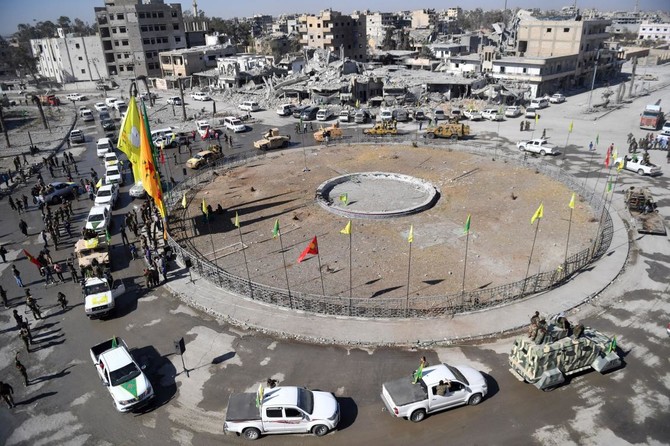
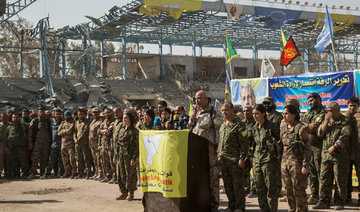
Female fighters of the Syrian Democratic Forces (SDF) gather during a celebration at the iconic Al-Naim square in Raqa on October 19, 2017, after retaking the city from Daesh fighters. (AFP)
Updated 02 November 2017
Follow

In Raqqa, jihadists are gone but they can still kill

RAQQA, SYRIA: Dozens of civilians at a checkpoint into Raqqa were pleading to be let through to inspect their homes when an explosion ripped through the air: one resident had slipped in.
The man had managed to reach his nearby neighborhood despite a clear ban on civilian entry into the devastated Syrian city and triggered an explosive device left behind by the Daesh group.
Ambulances and fighters from the Syrian Democratic Forces (SDF) who retook Raqqa this month screeched past the panicked civilians at the checkpoint on the city’s western edge.
The victim’s brother, who snuck into Raqqa with him, survived the blast unscathed but his face was livid with shock.
“My brother and I went to inspect our ceramics workshop. A mine went off and he died,” he said, as people tended to him in the Al-Dariya neighborhood.
Next to a pile of rubble and mangled iron, his dead brother lay on his side, still straddling his motorbike and his face covered in white dust. A huge tarp bag was still strapped to the rack.
The US-backed SDF took full control of Raqqa on October 17, wrapping up an operation that lasted more than four months to capture a city that had been the inner sanctum of IS’s now moribund “caliphate.”
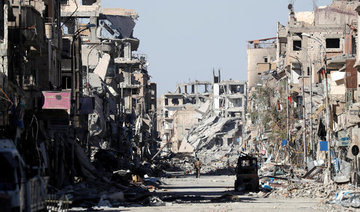
Hundreds of thousands of people fled the city since 2014 and by the time the SDF retook it, Raqqa had become a ghost town of collapsed buildings.
The jihadists used Raqqa as a hub from which they organized their administration and projected power for more than three years.
Routed IS fighters are now defending their last redoubts further down the Euphrates Valley and along the border with Iraq but the bombs they left behind are still killing people.
The team of SDF medics that morning were not retrieving their first victim of the week: at least 14 other people, including nine civilians, were killed since the fighting ended.
The SDF has issued clear instructions making Raqqa off-limits but gaggles of civilians wait every day at the city gates for a chance to look for what might be left of their homes.
Despite the heavy human toll that IS’s booby traps, unexploded roadside bombs and other mines are taking, a group waited on the edge of the western neighborhood of Sabahiya, trying to convince SDF fighters to let them through.
Men sat patiently on the saddles of their motorbikes, while women sat looking expectantly toward the city’s craggy, levelled skyline as children played around them.
The civilians seemed determined to ignore the warnings and see their homes but the SDF was having none of it.
“One man came from Kobani to see his house, a mine exploded and we just finished organizing his burial,” a young Kurdish fighter said, raising his voice as residents implored him to open the road.
“We’ve been telling you not to go in, there are mines everywhere but you still sneak in,” the young fighter shouted, pumping his upturned palms in annoyed disbelief.
Umm Abdel Rahman cried because she was barred from returning to her neighborhood of Al-Rumaniya, in western Raqqa.
“My house is over there, all my memories are there, the pictures of my wedding,” the young lady said, tears running down her cheeks. She has not heard from her husband in almost three weeks.
Nearby, another young woman who gave her name as Amina said both her brothers had been missing for four days.
“They had gone to our house in Al-Dariya and they never came back. I came to find them,” she said. “My younger brother already lost a foot in a land mine blast.”
A chubby-cheeked baby saddled on her hip, Amina said she was bent on entering Raqqa regardless. “Even if it kills me, I will go in to find my brothers.”


Israel’s ‘deliberate intention of preventing births among Palestinians’ meets ‘legal criteria of Genocide Convention’: Reports

Updated 10 sec ago
Follow

Israel’s ‘deliberate intention of preventing births among Palestinians’ meets ‘legal criteria of Genocide Convention’: Reports

  • Births in Gaza fell by 41% during conflict as maternal deaths, miscarriages surged
  • ‘The destruction of maternal care in Gaza reflects the deliberate infliction of conditions of life calculated to bring about the destruction of the Palestinian people, in whole or in part’

LONDON: Births in Gaza fell by 41 percent due to Israel’s war on the territory, with the conflict resulting in catastrophic numbers of maternal deaths, miscarriages and birth complications, two reports have found.

The data on pregnant women, babies and maternity care in the war-torn Palestinian enclave also revealed a surge in newborn mortality and premature births, The Guardian reported on Wednesday.

Dangerous wartime conditions and Israel’s systematic destruction of Gaza’s health systems were blamed for the alarming statistics.

The two reports were conducted by Physicians for Human Rights, in collaboration with the University of Chicago Law School’s Global Human Rights Clinic and Physicians for Human Rights — Israel.

Researchers highlighted Israel’s “deliberate intention of preventing births among Palestinians, meeting the legal criteria of the Genocide Convention.”

The reports build on earlier findings by PHR’s Israel branch. They place the testimonies of pregnant women and new mothers within the context of health data and field reports, which recorded “2,600 miscarriages, 220 pregnancy-related deaths, 1,460 premature births, over 1,700 underweight newborns, and over 2,500 infants requiring neonatal intensive care” between January and June 2025.

PHRI’s Lama Bakri, a psychologist and project manager, said: “These figures represent a shocking deterioration from pre-war ‘normalcy,’ and are the direct result of war trauma, starvation, displacement and the collapse of maternal healthcare.

“These conditions endanger both mothers and their unborn babies, newborns, and breastfed infants, and will have consequences for generations, permanently altering families.”

She added: “Beyond the numbers, what emerges in this report are the women themselves, their voices, choices and lived realities, confronting impossible dilemmas that statistics alone cannot fully capture.”

Maternal and newborn care in Gaza has been damaged by Israel’s destruction of health infrastructure, as well as fuel shortages, blocked medical supplies, mass displacement and relentless bombardment.

As a result, survival in Gaza’s overcrowded tent encampments has become the sole option for pregnant women and new mothers.

During the first six months of Israel’s war on the territory, more than 6,000 mothers were killed, at an average of two every hour, according to UN Women estimates.

It is also believed that about 150,000 pregnant women and new mothers have been forcibly displaced by the conflict.

In the first months of last year, just 17,000 births were recorded in Gaza, a 41 percent fall compared to the same period in 2022.

The researchers examined Israel’s apparent strategy to undermine Palestinian births, highlighting a targeted strike in December 2023 on the Al-Basma IVF clinic.

The attack on Gaza’s largest fertility center destroyed about 5,000 reproductive specimens and ended a pattern of 70-100 IVF procedures each month.

The strike was deliberately designed to target the reproductive potential of Palestinians, the Independent International Commission of Inquiry later found.

“Reproductive violence constitutes a violation under international law; when carried out systematically and with them intent to destroy, it falls within the definition of genocide of the Genocide Convention,” the reports said.

“The destruction of maternal care in Gaza reflects the deliberate infliction of conditions of life calculated to bring about the destruction of the Palestinian people, in whole or in part.”