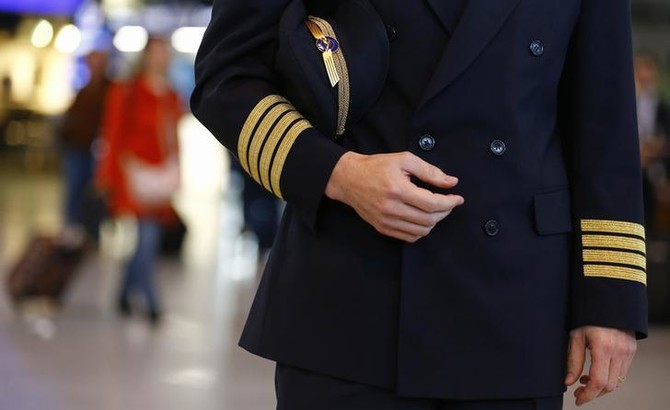
PARIS: An increase in global air traffic means pilots are in high demand and are now often in a position to choose to work for airlines offering better wages or working conditions, a situation that could crimp some low-cost airlines.
The rising demand for cockpit crew is linked to a wave of retirements of baby boomers and the growth of air traffic, which the International Air Transport Association (IATA) expects to nearly double to 7.8 billion passengers in 2036.
“What is certain is that there is a shortage” of cockpit personnel and they are now “going to the airline which offers the best conditions” said Marc Houalla, who was head of France’s national civil aviation institute (ENAC) until mid-October.
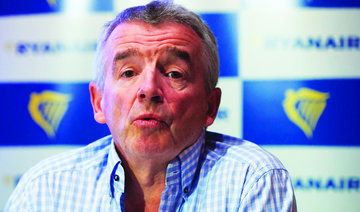
The crisis has already been felt at Irish low-cost airline Ryanair, which was forced to cancel 20,000 flights between September and March as it found itself without sufficient pilots due to scheduling issues and a haemorrhaging of cockpit staff seeking better labor conditions elsewhere.
Currently “all airlines are hiring and in particular traditional airlines ... and as these firms offer better work conditions than those at Ryanair, so when pilots have the choice they’ll go where there is the better offer,” said Christophe Tharot, head of the French airline pilots’ union SNPL.
So far this year, low-cost Norwegian has said it has recruited 160 pilots who have left Ryanair, a quarter of the more than 600 it plans to hire in 2017.
The shifting of the winds in the labor market began to be felt two or three years ago when US airlines sought to lure away pilots, including from Gulf-based airlines, said one pilot on condition of anonymity.
The captain left Ryanair for Air France less than a year ago after having failed to get a job with a Gulf airline.
“Today they are calling me to reconsider,” he said.
Meanwhile Chinese airlines are offering “salaries that are a bit insane,” he added.
China is expected to dethrone the US as the world’s biggest air travel market in 2022, according to the IATA.
“I get emails telling me ‘We’ve improved out conditions, we’re paying more than 300,000’ for a captain,” he added.
He preferred to join Air France — even though he said it paid €1,500 per month less — because of the work-life balance.
The shortage of pilots has reached the point where they have lured away instructors at pilot schools like ENAC, said Houalla.
Even Air France, an airline that had a hiring freeze for seven years as it struggled to reduce its costs to face the onslaught from low-cost airlines, has started hiring again.
It now plans to hire 200 to 250 pilots per year through 2025, according to its HR chief for pilots, Didier Nicolini.
The pilots it hires are attracted to the “overall benefits package” offered by Air France, he said, and come from not only Ryanair but easyJet and Emirates as well.
For Germany’s Lufthansa, which has snapped up half of the aircraft of failed rival Air Berlin and wants parts of defunct Alitalia, the question of securing pilots has become an existential question.
A sign of its desperation — it offered a signing bonus of €20,000 for the first 15 pilots that accepted to fly the aircraft it took over from Air Berlin in order to ensure it didn’t need to cancel any flights.
However, with salaries among the top airlines in Europe at up to €200,000 per year before taxes, it has a narrow path to navigate if it doesn’t want to weaken its competitiveness against low-cost airlines.
Over the longer term, Lufthansa has committed to hiring 700 newly-trained pilots through 2022.
But one pilot noted that bubbles tend to pop.
“Any increase in flights by low-cost airlines will be at the expense of traditional airlines,” said Pierre Coursimault, an easyJet pilot and a member of the SNPL, pointing to the recent surprise collapse of Britain’s Monarch airline.


Pilots flying high as airline travel increases
Pilots flying high as airline travel increases


Cambodia takes back looted historic artifacts handled by British art dealer
- The objects were returned under a 2020 agreement between the Ministry of Culture and Fine Arts and the family of the late Douglas Latchford, a British art collector and dealer who allegedly had the items smuggled out of Cambodia
PHNOM PENH, Cambodia: Cambodian officials on Friday received more than six dozen historic artifacts described as part of the country’s cultural heritage that had been looted during decades of war and instability.
At a ceremony attended by Deputy Prime Minister Hun Many, the 74 items were unveiled at the National Museum in Phnom Penh after their repatriation from the United Kingdom.
The objects were returned under a 2020 agreement between the Ministry of Culture and Fine Arts and the family of the late Douglas Latchford, a British art collector and dealer who allegedly had the items smuggled out of Cambodia.
“This substantial restitution represents one of the most important returns of Khmer cultural heritage in recent years, following major repatriations in 2021 and 2023 from the same collection,” the Culture Ministry said in a statement. “It marks a significant step forward in Cambodia’s continued efforts to recover, preserve, and restore its ancestral legacy for future generations.”
The artifacts were described as dating from the pre-Angkorian period through the height of the Angkor Empire, including “monumental sandstone sculptures, refined bronze works, and significant ritual objects.” The Angkor Empire, which extended from the ninth to the 15th century, is best known for the Angkor Wat archaeological site, the nation’s biggest tourist attraction.
Latchford was a prominent antiquities dealer who allegedly orchestrated an operation to sell looted Cambodian sculptures on the international market.
From 1970 to the 1980s, during Cambodia’s civil wars and the communist Khmer Rouge ‘s brutal reign, organized looting networks sent artifacts to Latchford, who then sold them to Western collectors, dealers, and institutions. These pieces were often physically damaged, having been pried off temple walls or other structures by the looters.
Latchford was indicted in a New York federal court in 2019 on charges including wire fraud and conspiracy. He died in 2020, aged 88, before he could be extradited to face charges.
Cambodia, like neighboring Thailand, has benefited from a trend in recent decades involving the repatriation of art and archaeological treasures. These include ancient Asian artworks as well as pieces lost or stolen during turmoil in places such as Syria, Iraq and Nazi-occupied Europe. New York’s Metropolitan Museum of Art is one of the prominent institutions that has been returning illegally smuggled art, including to Cambodia.
“The ancient artifacts created and preserved by our ancestors are now being returned to Cambodia, bringing warmth and joy, following the country’s return to peace,” said Hun Many, who is the younger brother of Prime Minister Hun Manet.


