

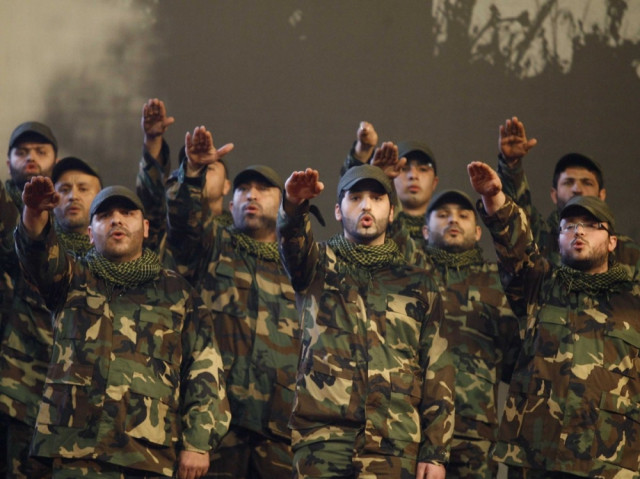
WASHINGTON: The United States House of Representatives voted Wednesday on three bills that aim to restrict the Lebanese militant group Hezbollah’s ability to finance its various illicit activities. The House is also widely expected to pass another bill tomorrow that will curtail Iran’s effort to develop its ballistic missile capability.
The new measures are consistent with the US administration’s recently announced new strategy on Iran, which aims to hold Iran accountable for its “nefarious” activities in the region, including its support of militant groups such as Hezbollah. The group has been designated a terrorist entity by the United States and Saudi Arabia as well as a by a number of other countries around the world.
The three bills that were passed included the Hezbollah International Financing Prevention Amendments Act of 2017 (HIFPA), the Sanctioning Hizbollah’s Illicit Use of Civilians as Defenseless Shields Act and a non-binding resolution “urging the European Union to designate Hizbollah in its entirety as a terrorist organization”. The House is widely expected to pass the Iran Ballistic Missiles and International Sanctions Enforcement Act tomorrow.
Earlier this week, US President Donald Trump and Vice President Mike Pence observed the 34th anniversary of the killing of 241 American servicemen in Beirut by Hezbollah on Oct. 23, 1983. “We will never forget the 241 American service members killed by Hezbollah in Beirut. They died in service to our nation,” Trump wrote on his Twitter account on Monday.
In a statement issued to American media outlets this past Friday, House Foreign Affairs Committee Chairman Ed Royce and House Majority Leader Kevin McCarthy said: “It is the support for terrorist organizations like Hezbollah and murderous regimes like Assad’s, along with continued ballistic missile advancements, that must be addressed.”
Asked by Arab News whether the Trump administration views Hezbollah as being part of the wider conflict with Iran, Hussein Ibish, a senior resident fellow at the Arab Gulf States Institute in Washington, said: “The new sanctions against Hezbollah are definitely part of the Trump administration's efforts to confront Iran and its regional agenda.”
Ibish maintained that the conflict in Syria had strengthened Hezbollah’s position in the region well beyond Lebanon, adding, “It operates as a key and highly effective strike force within this Iranian-led bloc that is absolutely opposed to the status quo in most of the Middle East, the stability of the Sunni Arab world, and the role of the United States in the region.”
Hezbollah leader Hassan Nasrallah has recently acknowledged that US sanctions would adversely impact his group. "This does not affect our main source of finances, but there are people who donate (money) to us who might be cautious," Nasrallah said in what many interpreted as a reference to Hezbollah’s main patron, Iran.
Speaking to Arab News by phone, Katherine Bauer, the Blumenstein-Katz Family Fellow at the Washington Institute for Near East Policy and a former official at the US Treasury Department, said that implementation of HIFPA had drawn a strong and violent response from Hezbollah, which bombed a bank in Beirut in 2016, “to send a message to the banking sector about how rigorously they were implementing the US legislation.”
Asked whether the new US measures would effectively weaken Hezbollah and curb its wide range of financial activities, Joseph Bahout, a fellow at the Carnegie Endowment for International Peace, expressed doubt but maintained that US lawmakers might be using an indirect approach. “It is maybe the US legislators' rationale: Increase the pain level on the Lebanese at large in order to increase the cost of 'accommodating' Hezbollah," Bahout said.


