Afghan government under fire for altering image of president’s meeting with US official

1 / 3
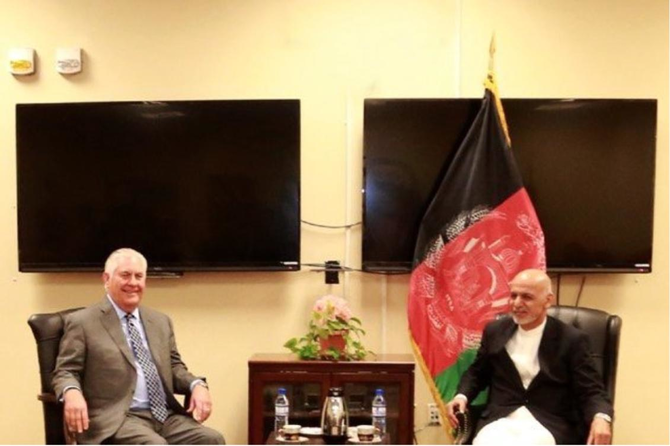
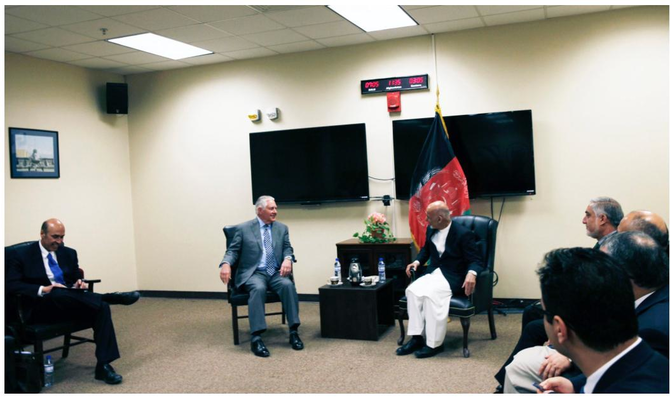
The photo released by the office of Afghanistan’s president, where a clock above the television sets was removed.
2 / 3
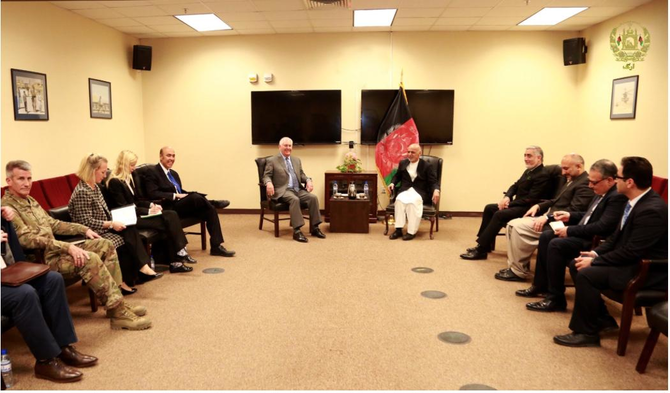
US State Department photo
3 / 3
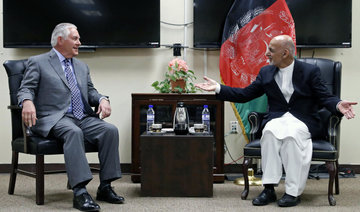
This photo was released by the Office of the President of Afghanistan.
Updated 25 October 2017
Follow

Afghan government under fire for altering image of president’s meeting with US official

KABUL: Images of Afghan President Ashraf Ghani’s Monday meeting with US Secretary of State Rex Tillerson released by the Afghan government appear to have been digitally altered — a move that has drawn outraged responses.
Both the US Embassy in Kabul and the presidential palace released photographs of the meeting, which took place in a bunker at Bagram Airfield, America’s largest military base in Afghanistan — although some officials at the time stated that Tillerson and Ghani had met in Kabul.
It soon became clear that there were significant differences in the images released by the embassy and those released by the palace. For example, a digital clock and red fire alarm, clearly visible in an image released by the embassy, had been digitally erased from the palace’s image.
Dr. Zahir Ayoubi, deputy head of Afghanistan’s National Journalists Union, claimed the image had been manipulated so the palace could avoid the “embarrassment” of admitting Ghani and his delegation had traveled to Bagram to meet US officials.
As Karim Pakzad — a researcher specializing in Iraq, Afghanistan and Iran — pointed out in local daily Mandegar, the president’s meeting
with a visiting official on a US military base contravened diplomatic norms.
“This is an affront to the Afghan nation,” Pakzad wrote. “This meeting means (Ghani) was summoned by Tillerson.”
Journalist Bilal Sarwary tweeted: “If Ghani & Abdullah were sovereign enough, they would have refused to have a bilateral meeting in a bunker. These leaders are embarrassing the Afghan nation.”
Presidential spokesperson Shah Hussain Murtazawi downplayed the significance of the meeting’s location, saying, “Our government places national interests above all, and for the sake of national interests discussions and consultations can be held in any corner of the country.”
His response failed to explain why the palace felt it necessary to doctor images of the meeting, however.
“Had they dealt with the issue in an honest manner, that would have been much better,” Ayoubi told Arab News. “This can have a negative impact. It raises questions about why government dignitaries are hiding the truth from people.”
The palace’s decision has backfired dramatically, with national attention now firmly focused on the falsification of the images and what that says about Ghani’s administration.
Afghan journalist and activist Zaki Daryabi took to Facebook to suggest the palace had committed an illegal act. “Counterfeiting of documents is a crime,” he wrote.
The furor will likely further dent Ghani’s already-damaged image. Many have contrasted Monday’s meeting with former President Hamid Karzai’s refusal to meet his then-US counterpart Barak Obama at Bagram in 2014.
Journalist Saleha Soadat said the fact that the meeting was held in Bagram demonstrated that America lacks trust in the Afghan government, and that it considers its own officials superior to Afghanistan’s.
And Sediqullah Tawhidi, a member of the Afghan Journalists Safety Committee, claimed, “The palace needs to explain why and how this has happened.”
Anwar ul-Haq Ahady, one of the leaders of the Afghan Millat party and former minister of finance, suggested the manipulation of the images reflected Ghani’s nature.


Court ruling jeopardizes freedom for pro-Palestinian activist Mahmoud Khalil

Updated 10 sec ago
Follow

Court ruling jeopardizes freedom for pro-Palestinian activist Mahmoud Khalil

  • The panel ruled a federal judge in New Jersey didn’t have jurisdiction to decide the matter at this time
  • The law bars Khalil “from attacking his detention and removal in a habeas petition,” the panel added

WASHINGTON: A federal appeals panel on Thursday reversed a lower court decision that released former Columbia University graduate student Mahmoud Khalil from an immigration jail, bringing the government one step closer to detaining and ultimately deporting the Palestinian activist.
The three-judge panel of the 3rd US Circuit Court of Appeals didn’t decide the key issue in Khalil’s case: whether the Trump administration’s effort to throw Khalil out of the US over his campus activism and criticism of Israel is unconstitutional.
But in its 2-1 decision, the panel ruled a federal judge in New Jersey didn’t have jurisdiction to decide the matter at this time. Federal law requires the case to fully move through the immigration courts first, before Khalil can challenge the decision, they wrote.
“That scheme ensures that petitioners get just one bite at the apple — not zero or two,” the panel wrote. “But it also means that some petitioners, like Khalil, will have to wait to seek relief for allegedly unlawful government conduct.”
The law bars Khalil “from attacking his detention and removal in a habeas petition,” the panel added.
Ruling won’t result in immediate detention
It was not clear whether the government would seek to detain Khalil, a legal permanent resident, again while his legal challenges continue.
Thursday’s decision marked a major win for the Trump administration’s sweeping campaign to detain and deport noncitizens who joined protests against Israel.
In a statement distributed by the American Civil Liberties Union, Khalil said the appeals ruling was “deeply disappointing, but it does not break our resolve.”
He added: “The door may have been opened for potential re-detainment down the line, but it has not closed our commitment to Palestine and to justice and accountability. I will continue to fight, through every legal avenue and with every ounce of determination, until my rights, and the rights of others like me, are fully protected.”
Baher Azmy, one of Khalil’s lawyers, said the ruling was “contrary to rulings of other federal courts.” He noted the panel’s finding concerned a “hypertechnical jurisdictional matter,” rather than the legality of the Trump administration’s policy.
“Our legal options are by no means concluded, and we will fight with every available avenue,” he added, saying Khalil would remain free pending the full resolution of all appeals, which could take months or longer.
The ACLU said the Trump administration cannot lawfully re-detain Khalil until the order takes formal effect, which won’t happen while he can still immediately appeal.
Khalil has multiple options to appeal
Khalil’s lawyers can request the active judges on the 3rd Circuit hear an appeal, or they can go to the US Supreme Court.
An outspoken leader of the pro-Palestinian movement at Columbia, Khalil was arrested on March 8, 2025. He then spent three months detained in a Louisiana immigration jail, missing the birth of his firstborn.
Federal officials have accused Khalil of leading activities “aligned to Hamas,” though they have not presented evidence to support the claim and have not accused him of criminal conduct. They have also accused Khalil, 30, of failing to disclose information on his green card application.
The government has justified the arrest under a seldom-used statute that allows for the expulsion of noncitizens whose beliefs are deemed to pose a threat to US foreign policy interests.
In June, a federal judge in New Jersey ruled that justification would likely be declared unconstitutional and ordered Khalil released.
President Donald Trump’s administration appealed that ruling, arguing the deportation decision should fall to an immigration judge, rather than a federal court.
Khalil has dismissed the allegations as “baseless and ridiculous,” framing his arrest and detention as a “direct consequence of exercising my right to free speech as I advocated for a free Palestine and an end to the genocide in Gaza.”
Dissenting judge says Khalil has right to fight detention

Judge Arianna Freeman dissented Thursday, writing that her colleagues were holding Khalil to the wrong legal standard. Khalil, she wrote, is raising “now-or-never claims” that can be handled at the district court level. He does not have a final order of removal, which would permit a challenge in an appellate court, she wrote.
Both judges who ruled against Khalil, Thomas Hardiman and Stephanos Bibas, were Republican appointees. President George W. Bush appointed Hardiman to the 3rd Circuit, while Trump appointed Bibas. President Joe Biden, a Democrat, appointed Freeman.
The majority opinion noted Freeman worried the ruling would leave Khalil with no remedy for unconstitutional immigration detention, even if he later can appeal.
“But our legal system routinely forces petitioners — even those with meritorious claims — to wait to raise their arguments, the judges wrote. “To be sure, the immigration judge’s order of removal is not yet final; the Board has not affirmed her ruling and has held the parties’ briefing deadlines in abeyance pending this opinion. But if the Board ultimately affirms, Khalil can get meaningful review.”
The decision comes as an appeals board in the immigration court system weighs a previous order that found Khalil could be deported. His attorneys have argued that the federal order should take precedence.
That judge has suggested Khalil could be deported to Algeria, where he maintains citizenship through a distant relative, or Syria, where he was born in a refugee camp to a Palestinian family.
His attorneys have said he faces mortal danger if forced to return to either country.