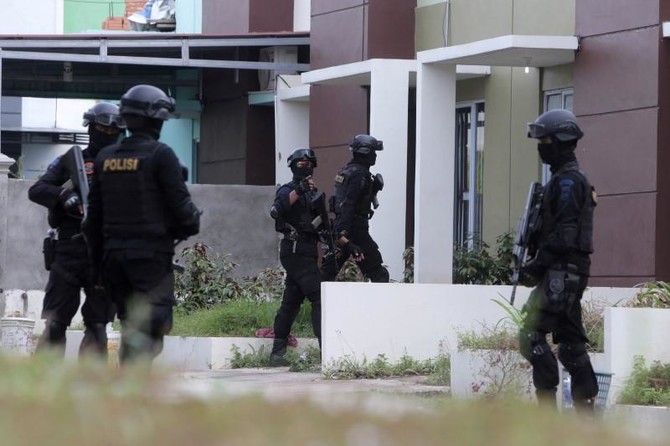
JAKARTA: Indonesian authorities arrested nine men suspected of having links to a militant network loyal to Daesh and planning a series of attacks on police posts, said a police spokesman.
Counter-terrorism police have grappled with a recent resurgence in homegrown radicalism in the world’s largest Muslim-majority country, inspired by extremist group Daesh.
Police said eight men were arrested on Tuesday in Riau province and one man in South Sulawesi province. They were alleged to have links to Indonesia’s most high-profile militant network Jemaah Asharut Daulah (JAD) which is loyal to Daesh.
“They were planning attacks on police stations from the district level all the way to the provincial level,” national police spokesman Rikwanto said of the men arrested in Riau.
He added that the men were suspected of joining a training camp in a neighboring province where they learned to shoot guns and assemble bombs.
Detachment 88, the country’s elite counter-terrorism police unit usually steps up surveillance and raids near the end of the year, foiling militant plots targeting New Year’s Eve and Christmas celebrations and popular tourist spots.
Authorities suspect there are hundreds of Daesh sympathizers in Indonesia, some of whom have traveled to Syria to fight alongside the group. There are heightened concerns over the return of battle-hardened militants as Daesh loses territory in the Middle East.
Four people were killed when Daesh-linked militants launched a gun-and-bomb attack in the heart of the capital Jakarta in January, 2016.

Indonesia arrests nine with alleged Daesh links
Guterres warns UN risks ‘imminent financial collapse’
- “Member States must fundamentally overhaul our financial rules to prevent an imminent financial collapse,” Guterres wrote
- Trump has often questioned the UN’s relevance and attacked its priorities
UNITED NATIONS: United Nations chief Antonio Guterres on Friday warned that the world body is on the brink of financial collapse and could run out of cash by July, as he urged countries to pay their dues.
The UN faces chronic budget problems because some member states do not pay their mandatory contributions in full, while others do not pay on time, forcing it into hiring freezes and cutbacks.
“Either all Member States honor their obligations to pay in full and on time — or Member States must fundamentally overhaul our financial rules to prevent an imminent financial collapse,” Secretary-General Guterres wrote in a letter.
US President Donald Trump’s administration has in recent months reduced its funding to some UN agencies and has rejected or delayed some mandatory contributions.
Trump has often questioned the UN’s relevance and attacked its priorities.
The organization’s top decision-making body, the Security Council, is paralyzed because of tensions between the United States and Russia and China, all three of which are permanent, veto-wielding members.
Trump also launched his “Board of Peace” this month, which critics say is intended to become a rival to the UN.
- ‘Untenable’ -
Although more than 150 member states have paid their dues, the UN ended 2025 with $1.6 billion in unpaid contributions — more than double the amount for 2024.
“The current trajectory is untenable. It leaves the Organization exposed to structural financial risk,” Guterres wrote.
The UN is also facing a related problem: it must reimburse member states for unspent funds, Farhan Haq, one of the Guterres’ spokespeople, said during a press briefing.
The secretary-general also highlighted that problem, writing in the letter: “We are trapped in a Kafkaesque cycle; expected to give back cash that does not exist.”
“The practical reality is stark: unless collections drastically improve, we cannot fully execute the 2026 program budget approved in December,” Guterres’ wrote, adding: “Worse still, based on historical trends, regular budget cash could run out by July.”
Guterres, who will step down at the end of 2026, this month gave his last annual speech setting out his priorities for the year ahead and said the world was riven with “self-defeating geopolitical divides (and) brazen violations of international law.”
He also slammed “wholesale cuts in development and humanitarian aid” — an apparent reference to deep cuts to the budgets of UN agencies made by the United States under the Trump administration’s “America First” policies.