AMMAN: King Abdallah of Jordan met Moqtada Sadr, the head of Iraq’s Islamic Sadrist Movement, on Monday — the day after receiving Iraq’s Prime Minister Haider Al-Abadi.
Al-Abadi visited the king on Sunday, following a high-level Saudi-Iraq summit attended by US Secretary of State Rex Tillerson.
Jordan’s official news agency, Petra, said that, during Monday’s meeting at Al-Husseiniya Palace, King Abdallah and Sadr focused on the importance of cementing economic and trade ties “in a manner to serve the common interest of the two countries and peoples.”
King Abdallah reportedly stressed how important it was “to preserve Iraq's territorial integrity and safety,” and praised the Iraqi army's victories against Daesh.
He also commended Sadr's nationalist and pan-Arabist approach, noting, in this context, the “positive improvement in Iraq's relations with Arab countries,” according to Petra.
Oraib Rantawi, director of the Amman-based Al-Quds Center for Political Studies, told Arab News that Jordan’s invitation to Sadr to meet with the king is part of a regional effort to distance Iraq from Iran.
“Moqtada Sadr is a Shiite Arabist and is opposed to Iranian hegemony,” Rantawi explained. He added that Sadr had taken a “strong position against” Iraq’s previous Prime Minister Nouri Al-Maliki, who was widely perceived as pro-Iranian.
Sadr’s visit, Rantawi said, “fits neatly within the new Saudi strategy, which is aimed to bring Shiites who are against Al-Maliki closer to the Arab Sunni position.”
Sadr, Rantawi added, is “one of the few Iraqi leaders who can move the masses quickly.”
The Sadrist Movement currently holds 35 seats in the Iraqi Parliament, and his militia, Saraya Al-Salam is, Rantawi said, “very popular.”
Jordan’s interest in the meeting, Rantawi believes, is due to the proposed Iraqi-Jordanian pipeline — a crucial development for the energy-poor kingdom.
“Oil is pumped in Shiite-controlled areas and transported through Sunni-controlled areas; therefore Jordan’s interest is to have good relations with all components of Iraq,” Rantawi said.
Bassam Al-Amoush, former Jordanian minister of parliamentary affairs and former ambassador to Iran, told Arab News that this was not Sadr’s first visit to Amman.
“Jordan has good relations with all political components in Iraq, including the various Sunni tribes in Ramadi, Prime Minister Al-Abadi, and the Kurds,” Al-Amoush said.
He added that Jordan’s interests are not only related to oil: “Jordan has geopolitical interests in Iraq and is concerned about Iranian influence there, which some say constitutes Persian hegemony.”
The visits of Al-Abadi and Sadr appear to be part of a post-Daesh political reorganization of the region.
“Everyone wants to fill the empty space that they have left,” Rantawi said.


![]()
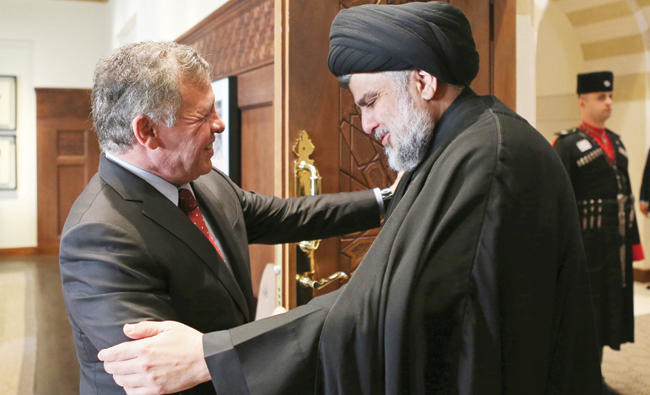
Jordan’s King Abdallah receives Moqtada Sadr
Jordan’s King Abdallah receives Moqtada Sadr

Latest updates


© 2026 SAUDI RESEARCH & PUBLISHING COMPANY, All Rights Reserved And subject to Terms of Use Agreement.