CLARK FIELD: After five months of intense fighting between Philippine government security forces and the Daesh-backed Islamist Maute group in Marawi City, the government has declared victory.
Philippine Defense Secretary Delfin Lorenzana made the announcement at the sidelines of the Association of Southeast Asian Nations (ASEAN) Defense Ministers Meeting, which opened here on Monday.
Ministers from the 10 ASEAN member nations — the Philippines, Cambodia, Indonesia, Laos, Malaysia, Myanmar, Singapore, Thailand, Vietnam, and Brunei Darussalam — arranged a special meeting to discuss ongoing and future coordinated approaches to the growing security threats in Southeast Asia, particularly terrorism and violent extremism.
Lorenza announced the Philippine government’s victory in Marawi in a press conference, saying that combat operations in the country’s only Islamic city had been terminated, as the remaining Maute fighters had been killed.
“There are no more militants inside Marawi City,” Lorenzana said, confirming what President Rodrigo R. Duterte said last week when he declared the city free from terrorists.
Lorenzana claimed the victory meant the government had “defeated terrorism in the Philippines.”
“In crushing the most serious attempt thus far to export violent extremism and radicalism to the Philippines and the region, we have contributed to preventing its spread in Asia and (helped) to maintain global peace, stability, and security,” he said.
“While we (acknowledge) that these tactical and strategic gains will not annihilate the ideology completely, we declare that this achievement is a clear manifestation of how our regional cooperation can lead to a decisive advance against the proliferation of terrorism in this part of the world,” Lorenzana continued.
The defense secretary expressed his gratitude for the help extended by the US, Australia, Malaysia, Indonesia, Brunei, and Singapore, and China as government forces battled the militant forces.
Meanwhile, US Defense Secretary Jim Mattis praised the Philippines for its victory in Marawi.
Mattis is in the Philippines for the ADMM-Plus — a platform for ASEAN defense chiefs to engage their counterparts from Australia, China, India, Japan, New Zealand, South Korea, Russia, and the US.
“One of the first things I’m going to do is commend the Philippine military for liberating Marawi from the terrorists,” Mattis said in a statement released by the Pentagon. “It was a very tough fight, and I think the Philippine military sent a very strong message to the terrorists.”
Mattis added that his attendance was an opportunity to recognize ASEAN for 50 years of promoting peace and stability in Southeast Asia, and 40 years of cooperation with America.
“They have done a very good job of it,” he said.
Australian Defense Minister Marise Payne, who is also attending ADMM-Plus, met the crews of the two Australian Defense Force (ADF) AP-3C Orion aircraft which provided aerial surveillance support to the Philippine government’s successful operations against the Maute group in Marawi.
“We ask a lot of the men and women of the ADF and they answer without question and I particularly want to acknowledge that today,” she said. “I want to acknowledge the very real contribution that our ability to work with the government of the Philippines and the armed forces of the Philippines makes in terms of effective regional engagement.
“Australia and the Philippines have an extremely long, shared regional and military history. And our engagement in surveillance activity here has been an extension of that,” she continued. “An important extension of that.”


![]()
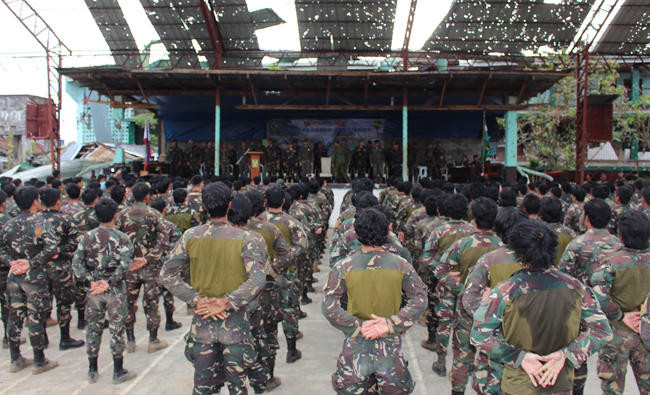
Philippines declares victory over Daesh in Marawi
Philippines declares victory over Daesh in Marawi
Latest updates


© 2026 SAUDI RESEARCH & PUBLISHING COMPANY, All Rights Reserved And subject to Terms of Use Agreement.