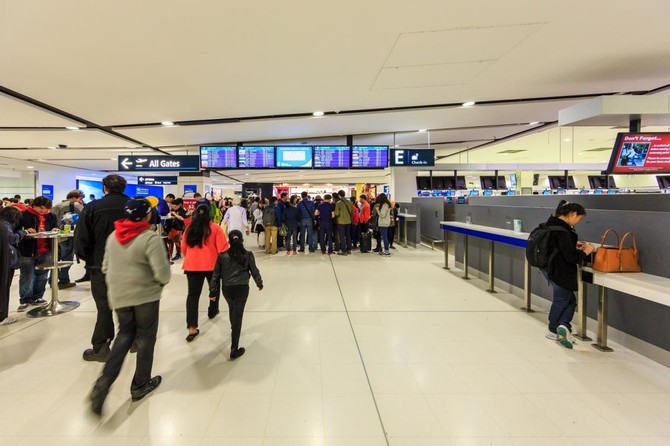
SYDNEY: Australia will introduce random searches of workers entering and inside its airports as it increases security after a recent foiled terrorism plot, officials said.
“These measures strengthen existing controls to ensure airport workers are authorized, properly identified and appropriately trained before entering secure airside areas,” Minister for Infrastructure and Transport Darren Chester said in a statement Sunday.
“They may also be subject to security screening in the course of their duties.”
Airport security was tightened in July after police foiled “Islamic-inspired” plans for a bomb attack on an Emirates flight from Sydney.
Police said they arrested four men in city-wide raids on July 28 after one of them days earlier had allegedly tried to bring an improvised explosive device on to a flight. The device was not allowed aboard as it exceeded the baggage weight limit.
Extra screening of hand and checked luggage since the incident has led to some travel delays around the country.
“Some of the measures will be obvious to the public, some will not be,” Prime Minister Malcolm Turnbull said at the time.
The Council of Australian Governments earlier this month signed off on a facial biometric agreement to give state and federal police real-time access to passport, visa, citizenship and driver’s license images for criminal investigations including those involving suspected terrorists.
The prime minister denied the agreement was “Big Brother“-style mass surveillance, but the “logical next step.”
“The alternative is to not use the data at all,” he told the ABC’s AM program.
The infrastructure minister’s office did not respond Sunday when asked when the latest measures would take effect, but said they would be rolled out to “provide flexibility for airports to ensure continue to function efficiently and effectively.”

Australia to tighten airport security further after foiled attack
Australia Day protesters demand Indigenous rights
SYDNEY: Thousands of people rallied in cities across Australia demanding justice and rights for Indigenous peoples on Monday, a national holiday marking the 1788 arrival of a British fleet in Sydney Harbor.
Crowds took to the streets in Sydney, Melbourne, Canberra, Perth and other cities on Australia Day, many with banners proclaiming: “Always was, always will be Aboriginal land.”
In Sydney, police allowed the protests to go ahead despite new curbs introduced after gunmen opened fire on a Jewish Hanukkah festival on Bondi Beach on December 14, killing 15 people.
Millions of Australians celebrate the annual holiday with beers and backyard barbecues or a day by the sea, and this year a broad heatwave was forecast to push the temperature in South Australian capital Adelaide to 45C.
Shark sightings forced people out of the water at several beaches in and around Sydney, however, after a string of shark attacks in the region this month — including one that led to the death of a 12-year-old boy.
Many activists describe the January 26, 1788, British landing as “Invasion Day,” a moment that ushered in a period of oppression, lost lands, massacres and Indigenous children being removed from their families.
Aboriginal and Torres Strait Islander peoples make up about four percent of the population.
They still have a life expectancy eight years shorter than other Australians, higher rates of incarceration and deaths in custody, steeper youth unemployment and poorer education.
- Anti-immigration protests -
“Let’s celebrate on another day, because everyone loves this country and everyone wants to celebrate. But we don’t celebrate on a mourning day,” Indigenous man Kody Bardy, 44, told AFP in Sydney.
Another Indigenous protester in Sydney, 23-year-old Reeyah Dinah Lotoanie, called for people to recognize that a genocide happened in Australia.
“Ships still came to Sydney and decided to kill so many of our people,” she said.
Separately, thousands of people joined anti-immigration “March for Australia” protests in several cities, with police in Melbourne mobilizing to keep the two demonstrations apart.
In Sydney, “March for Australia” protesters chanted, “Send them back.” Some carried banners reading: “Stop importing terrorists” or “One flag, one country, one people.”
“There’s nowhere for people to live now, the hospitals are full, the roads are full, you’ve got people living on the streets,” said one demonstrator, 66-year-old Rick Conners.
Several also held aloft placards calling for the release of high-profile neo-Nazi Joel Davis, who is in custody after being arrested in November on allegations of threatening a federal lawmaker.
“There will be no tolerance for violence or hate speech on Sydney streets,” New South Wales Premier Chris Minns told reporters.
“We live in a beautiful, multicultural community with people from around the world, but we will not tolerate a situation where on Australia’s national day, it’s being pulled down by divisive language, hate speech or racism,” he said.
“Police are ready and willing to engage with people that breach those rules.”
Crowds took to the streets in Sydney, Melbourne, Canberra, Perth and other cities on Australia Day, many with banners proclaiming: “Always was, always will be Aboriginal land.”
In Sydney, police allowed the protests to go ahead despite new curbs introduced after gunmen opened fire on a Jewish Hanukkah festival on Bondi Beach on December 14, killing 15 people.
Millions of Australians celebrate the annual holiday with beers and backyard barbecues or a day by the sea, and this year a broad heatwave was forecast to push the temperature in South Australian capital Adelaide to 45C.
Shark sightings forced people out of the water at several beaches in and around Sydney, however, after a string of shark attacks in the region this month — including one that led to the death of a 12-year-old boy.
Many activists describe the January 26, 1788, British landing as “Invasion Day,” a moment that ushered in a period of oppression, lost lands, massacres and Indigenous children being removed from their families.
Aboriginal and Torres Strait Islander peoples make up about four percent of the population.
They still have a life expectancy eight years shorter than other Australians, higher rates of incarceration and deaths in custody, steeper youth unemployment and poorer education.
- Anti-immigration protests -
“Let’s celebrate on another day, because everyone loves this country and everyone wants to celebrate. But we don’t celebrate on a mourning day,” Indigenous man Kody Bardy, 44, told AFP in Sydney.
Another Indigenous protester in Sydney, 23-year-old Reeyah Dinah Lotoanie, called for people to recognize that a genocide happened in Australia.
“Ships still came to Sydney and decided to kill so many of our people,” she said.
Separately, thousands of people joined anti-immigration “March for Australia” protests in several cities, with police in Melbourne mobilizing to keep the two demonstrations apart.
In Sydney, “March for Australia” protesters chanted, “Send them back.” Some carried banners reading: “Stop importing terrorists” or “One flag, one country, one people.”
“There’s nowhere for people to live now, the hospitals are full, the roads are full, you’ve got people living on the streets,” said one demonstrator, 66-year-old Rick Conners.
Several also held aloft placards calling for the release of high-profile neo-Nazi Joel Davis, who is in custody after being arrested in November on allegations of threatening a federal lawmaker.
“There will be no tolerance for violence or hate speech on Sydney streets,” New South Wales Premier Chris Minns told reporters.
“We live in a beautiful, multicultural community with people from around the world, but we will not tolerate a situation where on Australia’s national day, it’s being pulled down by divisive language, hate speech or racism,” he said.
“Police are ready and willing to engage with people that breach those rules.”
© 2026 SAUDI RESEARCH & PUBLISHING COMPANY, All Rights Reserved And subject to Terms of Use Agreement.