BAGHDAD: Iraqi security forces backed by Shiite paramilitaries have seized almost all disputed areas from Kurdish fighters, but have no intention to enter the Kurdish region itself, Iraqi military officers told Arab News on Saturday.
Baghdad launched a military operation last week to drive Kurdish forces out of the northern city of Kirkuk, its lucrative oilfields and all disputed areas next to Iraqi Kurdistan.
Major clashes erupted on Friday when federal troops advanced to retake Alton Kobrai town, the last disputed territory, 40 km northwest of Kirkuk.
Kurdish forces attacked the advancing troops with mortars, rockets and grenades, killing several soldiers and Shiite fighters, military sources said.
“The military operation is almost complete. Small villages and towns in the area are still out of our control,” Ahmed Assadi, spokesman for the Popular Mobilization Units (PMU), told Arab News.
“The operation will end as soon as the troops completely reach the Blue Line (the 2003 agreed border of Iraqi Kurdistan), and we have no orders or intention to cross this line.”
Around 120,000 people have fled Kirkuk and Tuz Khurmatoo in the last five days due to the military operation, Iraq’s Ministry of Migration and Displacement said on Saturday.
In 2014, the Kurdistan Regional Government (KRG) took advantage of the Iraqi Army’s weakness in the face of lightning advances by Daesh to seize territory beyond the Blue Line.
The military operation was launched in response to a controversial referendum held last month by the KRG, in which 92 percent of Kurds voted for independence from Iraq.
Baghdad has demanded the cancelation of the result, and the handover of disputed areas, as preconditions for talks “under the umbrella of the constitution.”
Iraqi presidential adviser Sherwan Al-Waieli told Arab News that KRG President Masoud Barzani cannot represent the Kurdish side in talks because “legally and constitutionally, he hasn’t been president for two years.”
Barzani’s tenure as KRG president ended in 2015, and he has been pressuring the Kurdish Parliament and political parties to extend his term.
The most influential parties — the Kurdistan Democratic Party (KDP), the Patriotic Union of Kurdistan (PUK) and Gorran — shared power until 2014, when Barzani, who heads the KDP, limited the influence of the other two parties after they rejected his request to extend his term.
Last week, it was alleged that PUK leaders forged an agreement with Baghdad to withdraw from all disputed areas under their control without fighting. On Saturday, Gorran urged Barzani to step down to open the door for talks with Baghdad.
“The new government has to represent all the Kurdish parties, contribute to the establishment of security and stability, address economic problems and begin dialogue with Baghdad,” Masoud Haider, a senior leader of Gorran and a federal lawmaker, told Arab News.
“There’s a political and military setback in Kurdistan because of the decisions made by the KDP and PUK over the past two years, and they must bear the consequences.”
Barzani’s position as KRG president “is illegal,” said Haider.
“His term ended two years ago, so he has to step down.”


![]()
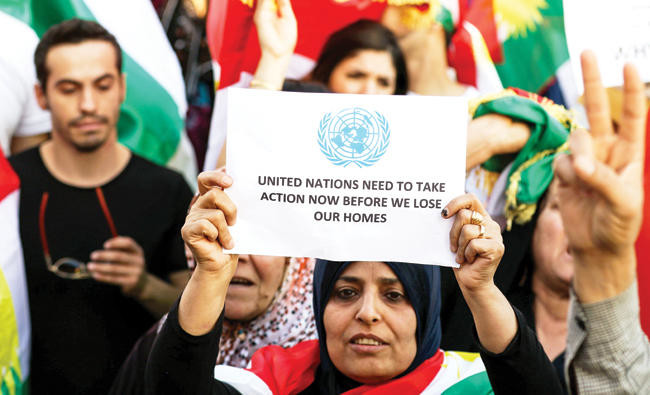
Iraqi Army: No intention to enter Kurdistan
Iraqi Army: No intention to enter Kurdistan

Latest updates


© 2026 SAUDI RESEARCH & PUBLISHING COMPANY, All Rights Reserved And subject to Terms of Use Agreement.