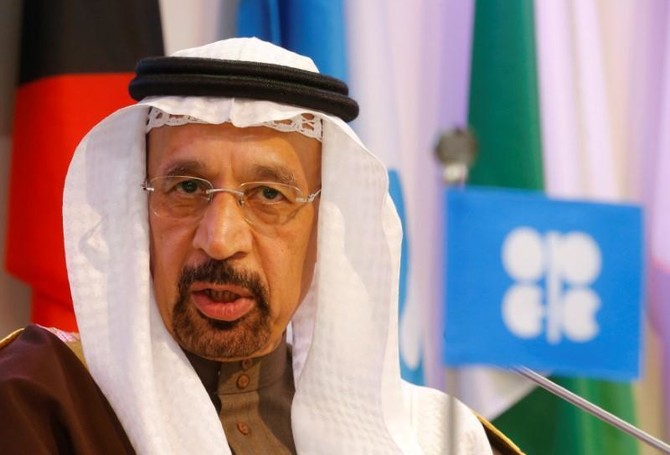
BAGHDAD: The global oil market is improving and stabilizing, Saudi Oil Minister Khalid Al-Falih said in Baghdad on Saturday.
In a speech at the opening of the Baghdad International Exhibition, Al-Falih praised the cooperation between Iraq and Saudi Arabia, which he said had helped to boost global oil prices.
Speaking later to reporters, he said Saudi Arabia and Iraq were in agreement on the need to “fully comply” with cutbacks in crude output agreed by OPEC, Russia and several other producers to push up prices.
“The market has improved a lot but has still some way to go,” he said.
Al-Falih is the first Saudi official to make a public speech in Baghdad for several decades.
The two countries began taking steps toward detente in 2015 after 25 years of troubled relations starting with the Iraqi invasion of Kuwait in 1990. Al-Falih visited Iraq earlier this year.
“The best example of the importance of cooperation between our two countries is the improvement and stability trend seen in the oil market,” said Al-Falih, to applause from the audience of Iraqi ministers, senior officials and businessmen.
Saudi Arabia and Iraq are the largest and second largest producers of the Organization of the Petroleum Exporting Countries (OPEC).
The Iraqi oil ministry said in a statement Falih and his Iraqi counterpart, Jabar Al-Luaibi, agreed to cooperate in implementing decisions by oil exporting countries to curb global supply in order to lift crude prices. OPEC, Russia and other producers have reduced production by about 1.8 million barrels per day (bpd) since the start of 2017, helping to boost oil prices. The cutbacks should continue until March 2018.

Saudi’s Al-Falih says global oil market improving, stabilizing
Saudi POS spending jumps 28% in final week of Jan: SAMA
RIYADH: Saudi Arabia’s point-of-sale spending climbed sharply in the final week of January, rising nearly 28 percent from the previous week as consumer outlays increased across almost all sectors.
POS transactions reached SR16 billion ($4.27 billion) in the week ending Jan. 31, up 27.8 percent week on week, according to the Saudi Central Bank. Transaction volumes rose 16.5 percent to 248.8 million, reflecting stronger retail and service activity.
Spending on jewelry saw the biggest uptick at 55.5 percent to SR613.69 million, followed by laundry services which saw a 44.4 percent increase to SR62.83 million.
Expenditure on personal care rose 29.1 percent, while outlays on books and stationery increased 5.1 percent. Hotel spending climbed 7.4 percent to SR377.1 million.
Further gains were recorded across other categories. Spending in pharmacies and medical supplies rose 33.4 percent to SR259.19 million, while medical services increased 13.7 percent to SR515.44 million.

Food and beverage spending surged 38.6 percent to SR2.6 billion, accounting for the largest share of total POS value. Restaurants and cafes followed with a 20.4 percent increase to SR1.81 billion. Apparel and clothing spending rose 35.4 percent to SR1.33 billion, representing the third-largest share during the week.
The Kingdom’s key urban centers mirrored the national surge. Riyadh, which accounted for the largest share of total POS spending, saw a 22 percent rise to SR5.44 billion from SR4.46 billion the previous week. The number of transactions in the capital reached 78.6 million, up 13.8 percent week on week.
In Jeddah, transaction values increased 23.7 percent to SR2.16 billion, while Dammam reported a 22.2 percent rise to SR783.06 million.

POS data, tracked weekly by SAMA, provides an indicator of consumer spending trends and the ongoing growth of digital payments in Saudi Arabia.
The data also highlights the expanding reach of POS infrastructure, extending beyond major retail hubs to smaller cities and service sectors, supporting broader digital inclusion initiatives.
The growth of digital payment technologies aligns with Saudi Arabia’s Vision 2030 objectives, promoting electronic transactions and contributing to the Kingdom’s broader digital economy.