East Timor government faces uncertainty after parliamentary defeat

Prime Minister Mari Alkatiri said the defeat in parliament on Thursday was “poison to my government.” (AFP)
Updated 20 October 2017
Follow

East Timor government faces uncertainty after parliamentary defeat

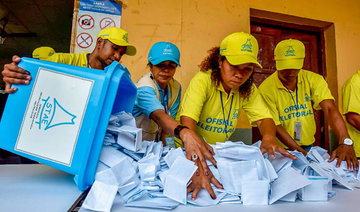
DILI, East Timor: East Timor’s new government has suffered a major setback after opposition parties vetoed its policy program, a blow that could see the impoverished young democracy return to the polls.
The Fretilin party, which won the July election by a narrow margin, did not receive enough votes to govern alone and has formed a minority coalition government with the Democratic Party.
With only 30 seats in the 65-seat house, the government relies on confidence and supply from other parties in parliament.
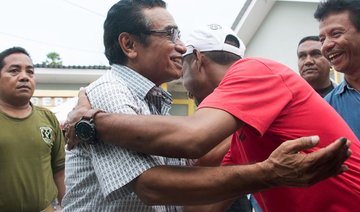
Prime Minister Mari Alkatiri said the defeat in parliament on Thursday was “poison to my government.”
“I asked everyone to remain calm, I will go to you and talk to you,” Alkatiri said in tears following the vote.
The bill outlined the government’s five-year strategic plan for the impoverished young democracy and included initiatives to improve health, infrastructure and better access to clean water.
East Timor analyst Damien Kingsbury, from Australia’s Deakin University, said if the government failed to pass the bill again the country could return to the polls.
“The president has two choices he has either to call for a majority in parliament to choose a new leader and appoint a new prime minister or the country goes to election, probably January next year. That would seem the most likely outcome at this stage,” Kingsbury said Friday.
Opposition parties, including the CNRT, PLP and Khunto, have said the current minority government was unconstitutional and its program unrealistic.
Nurima Ribeiro Alkatiri, from Fretilin, vowed the government would push ahead with its work.
“We are going to continue to work even though the opposition doesn’t believe in our program,” Alkatiri said.
East Timor, a former colony of Portugal, was invaded by Indonesia in 1975 before it gained independence in 2002 after UN sponsored referendum.


Uganda partially restores internet after president wins 7th term

Supporters of President Yoweri Museveni celebrate his winning the polls. (AFP)
Updated 9 sec ago
Follow

Uganda partially restores internet after president wins 7th term

  • “The internet shutdown implemented two days before the elections limited access to information, freedom ‌of association, curtailed economic activities ... it also created suspicion and mistrust on the ‍electoral process,” the team said in ‍their report

KAMPALA: Ugandan authorities have partially restored internet services late after 81-year-old President Yoweri Museveni won a seventh term to extend his rule into a fifth decade with a landslide ​victory rejected by 
the opposition.
Users reported being able to reconnect to the internet and some internet service providers sent out a message to customers saying the regulator had ordered them to restore services excluding social media.
“We have restored internet so that businesses that rely on internet can resume work,” David Birungi, spokesperson for Airtel Uganda, one of the country’s biggest telecom companies said. He added that the state communications regulator had ordered that social media remain shut down.
The state-run Uganda Communications Commission said it had cut off internet to ‌curb “misinformation, disinformation, ‌electoral fraud and related risks.” The opposition, however, criticized the move saying ‌it was ​to ‌cement control over the electoral process and guarantee a win for the incumbent.
The electoral body in the East African country on Saturday declared Museveni the winner of Thursday’s poll with 71.6 percent of the vote, while his rival pop star-turned-politician Bobi Wine was credited with 24 percent 
of the vote.
A joint report from an election observer team from the African Union and other regional blocs criticized the involvement of the military in the election and the authorities’ decision to cut 
off internet.
“The internet shutdown implemented two days before the elections limited access to information, freedom ‌of association, curtailed economic activities ... it also created suspicion and mistrust on the ‍electoral process,” the team said in ‍their report.

In power since 1986 and currently Africa’s third longest-ruling head of state, ‍Museveni’s latest win means he will have been in power for nearly half a century when his new term ends in 2031.

He is widely thought to be preparing his son, Muhoozi Kainerugaba, to take over from him. Kainerugaba is currently head of the military and has expressed presidential ambitions.
Wine, who was taking on ​Museveni for a second time, has rejected the results of the latest vote and alleged mass fraud during the election.
Scattered opposition protests broke out late on Saturday after results were announced, according to a witness and police.
In Magere, a suburb in Kampala’s north where Wine lives, a group of youths burned tires and erected barricades in the road prompting police to respond with tear gas.
Police spokesperson Racheal Kawala said the protests had been quashed and that arrests were made but said the number of those detained would be released later.
Wine’s whereabouts were unknown early on Sunday after he said in a post on X he had escaped a raid by the military on his home. People close to him said he remained at an undisclosed location in Uganda. Wine was briefly held under house arrest following the previous election in 2021.
Wine has said hundreds of his supporters were detained during the months leading up ‌to the vote and that others have been tortured.
Government officials have denied those allegations and say those who have been detained have violated the law and will be put through due process.