China industrial output, retail sales beat expectations, investment growth slows

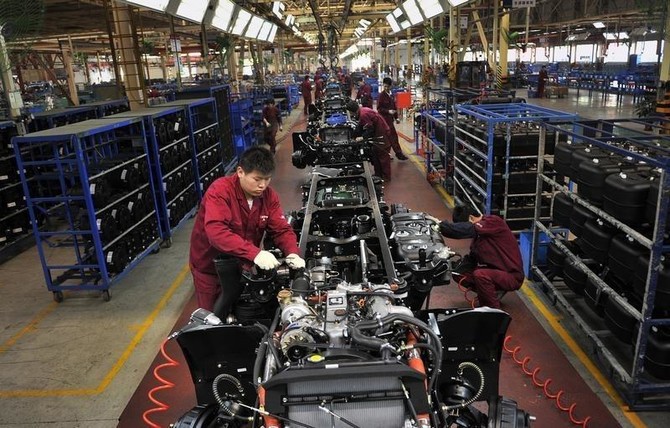
China’s industrial output rose 6.6 percent in September from a year earlier. (Reuters)
Updated 19 October 2017
Follow

China industrial output, retail sales beat expectations, investment growth slows

BEIJING: China’s industrial output growth accelerated to a three month high in September, while fixed asset investment growth continued to decline, falling to the slowest pace since December 1999.
Strong factory output and solid retail sales growth helped China’s economy meet expectations for 6.8 percent GDP growth in the third quarter, though a continued trend of weaker investment growth could raise concerns about growth going forward.
Industrial output rose 6.6 percent in September from a year earlier, beating expectations for 6.2 percent growth and up from 6 percent in August, data showed on Thursday.
Communication equipment output posted the biggest acceleration in growth in September, rising to 16.3 percent year-on-year from 13.0 percent in August.
But the government has also ordered some steel mills and factories in northern areas to cut back or halt production in coming months to reduce choking winter air pollution, which some analysts have said could hit the industrial sector.
Fixed-asset investment expanded 7.5 percent in the first nine months of the year, missing forecasts for 7.7 percent growth, and marking the slowest rate of growth since a 6.3 percent reading in December 1999, according to Reuters calculations.
Investment growth has slowed in recent years amid efforts by authorities to move away from investment-driven economic growth.
But private sector fixed-asset investment continues to lag state spending, slowing to 6.0 percent growth for Jan-Sept, compared to 11.0 percent growth in investment by state firms. Private investment rose 6.4 percent in the previous period.
Retail sales rose 10.3 percent in September on-year, beating expectations and indicating consumption continues to hold up well. Retail sales growth has hovered in the 10 to 11 percent range for the last two years.
Analysts had forecasted sales would rise 10.2 percent, slightly more than in August.
After a surprisingly strong start to the year, the world’s second largest economy is expected to easily meet or beat the government’s full-year growth forecast of around 6.5 percent.
But most China watchers expect activity will slow in coming months as higher financing costs and measures to cool the heated property market start to weigh on activity.


Acwa signs key terms to develop 5GW of renewable energy capacity in Turkiye

Updated 23 February 2026
Follow

Acwa signs key terms to develop 5GW of renewable energy capacity in Turkiye

JEDDAH: Saudi utility giant Acwa has signed key investment agreements with Turkiye’s Ministry of Energy and Natural Resources to develop up to 5 gigawatts of renewable energy capacity, starting with 2GW of solar power across two plants in Sivas and Taseli.

Under the investment agreement, Acwa will develop, finance, and construct, as well as commission and operate both facilities, according to a press release.

The program builds on the company’s first investment in Turkiye, the 927-megawatt Kirikkale Independent Power Plant, valued at $930 million, which offsets approximately 1.8 million tonnes of carbon dioxide annually, the statement added.

A separate power purchase agreement has been concluded with Elektrik Uretim Anonim Sirketi for the sale of electricity generated by each facility.

Turkiye aims to boost solar and wind capacity to 120GW by 2035, supported by around $80 billion in investment, while recent projects have already helped prevent 12.5 million tonnes of CO2 emissions and reduced reliance on imported natural gas.

Turkiye’s energy sector has undergone a rapid transformation in recent years, with renewable power emerging as a central pillar of its strategy.

Raad Al-Saady, vice chairman and managing director of ACWA, said: “The signing of the IA (implementation agreement) and PPA key terms marks a pivotal moment in Acwa’s partnership with Turkiye, reflecting the country’s strong potential as a clean energy leader and manufacturing powerhouse.”

He added: “Building on our long-standing presence, including the 927MW Kirikkale Power Plant commissioned in 2017, this step elevates our partnership to a new level,” Al-Saady said.

In its statement, Acwa said the 5GW renewable energy program will deliver electricity at fixed prices, enhancing predictability for grid planning and supporting long-term industrial investment.

By replacing imported fossil fuels with domestically generated clean energy, the initiative is expected to reduce Turkiye’s exposure to global energy market volatility, strengthening energy security and lowering long-term power costs.

The company added that the economic impact will extend beyond the anticipated investment of up to $5 billion in foreign direct investment, with thousands of jobs expected during the construction phase and hundreds of high-skilled roles created during operations.

The energy firm concluded that its existing progress in Turkiye reflects a strong appreciation for Turkish engineering, construction, and manufacturing capacity, adding that localization has been a strategic priority, and it has already achieved 100 percent local employment at its developments in the country.