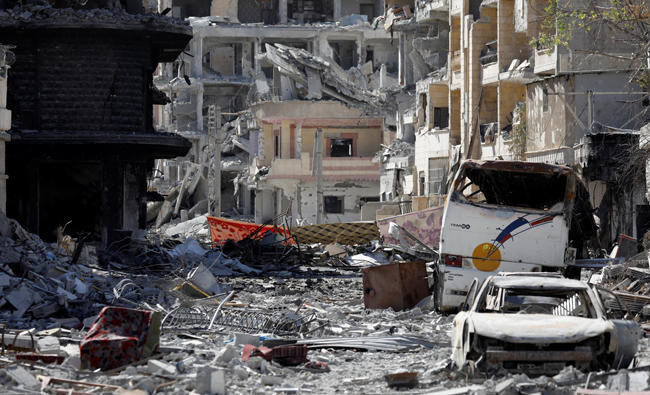
RAQQA: US-backed forces combed the ruins of Raqqa for survivors and bombs Wednesday, after retaking the Syrian city from Daesh terrorists and dealing their dreams of statehood a fatal blow.
A lightning final assault by the Syrian Democratic Forces (SDF) on Tuesday saw Daesh defenses collapse faster than expected and the SDF claim a landmark victory in the three-year fight against the terrorist organization.
SDF fighters flushed militant holdouts from Raqqa’s main hospital and municipal stadium, wrapping up a more than four-month offensive against what used to be the inner sanctum of Daesh’s self-proclaimed “caliphate.”
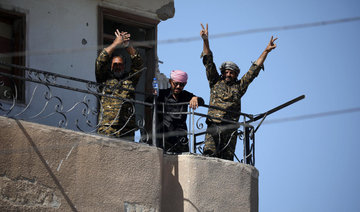
Waving their yellow flags, the Kurdish-led SDF forces celebrated their victory on an infamous traffic circle where Daesh used to carry out public executions and that had become known as the “Roundabout of Hell.”
On Wednesday, teams of SDF fighters deployed across the rubble-strewn streets of Raqqa to look for unexploded ordnance and booby traps left behind by the terrorists. “They are making sure there are no more sleeper cells” in Raqqa, SDF spokesman Mustefa Bali told AFP.
“Mine-clearing operations and the re-opening of the city are underway,” Bali said, adding that his organization would only formally announce the liberation of the city once they are completed.
The SDF and the Kurdish intelligence services issued clear instructions forbidding the tens of thousands of displaced families from attempting to return to their homes.
“We urge our people in Raqqa who fled Daesh rule not to return to the city for their own security until it is rid of terrorist explosives,” the Kurdish internal security services said in a statement.
The loss of Raqqa left Daesh ruling over a small “rump caliphate” straddling the Iraqi-Syrian border and covering a fraction of the territory it held when it declared its “state” in July 2014.
The US-led coalition supporting anti-Daesh forces in Iraq and Syria said on Tuesday that Daesh had lost 87 percent of the territory they had three years ago.
Brett McGurk, the White House’s envoy to the multinational coalition, said on social media that Daesh had lost 6,000 fighters in Raqqa and described the organization as “pathetic and a lost cause.”
Raqqa was one of the most emblematic Daesh bastions, at the heart of both its military operations and its propaganda.
Several of the most high-profile attacks Daesh claimed in the West — such as the 2015 massacres in Paris — are believed to have been at least partly masterminded from Raqqa, earning the city the nickname of “terror central.”
Raqqa also featured heavily in the propaganda videos — from public beheadings to training — which Daesh used to instill fear among the caliphate’s residents and appeal to new recruits globally.
The breakthrough in the months-old operation to retake Raqqa came last week when a local deal was struck for the safe exit of several thousand civilians who had been used as human shields by Daesh and for the surrender of Syrian militants.
It had been believed that up to 400 mostly foreign Daesh fighters remained in the city, prepared for a bloody last stand in their final redoubts. Yet the sequence that followed the announcement on Sunday of the operation’s final phase gives few clues as to their fate.
“Some surrendered, others died,” Talal Sello, another SDF spokesman said, without elaborating further or providing figures.
The Syrian Observatory for Human Rights, a Britain-based monitor relying on an extensive network of sources across Syria, said most of the foreign fighters surrendered and were being held by Western intelligence services.
“They are not visible because intelligence services are detaining them,” Observatory chief Rami Abdel Rahman told AFP. It was not immediately possible to corroborate his claim.
Col. Ryan Dillon, the US-led coalition’s spokesman, only spoke of four confirmed cases of foreign Daesh fighters surrendering and stressed that they were in SDF custody.
“We, as the coalition, do not hold or control any of these detainees,” he said, adding that the SDF may make separate arrangements with the detained militants’ countries of origin for some of them to be handed over and prosecuted.


![]()
US-backed forces comb Raqqa after Daesh ouster
US-backed forces comb Raqqa after Daesh ouster
Latest updates


© 2026 SAUDI RESEARCH & PUBLISHING COMPANY, All Rights Reserved And subject to Terms of Use Agreement.