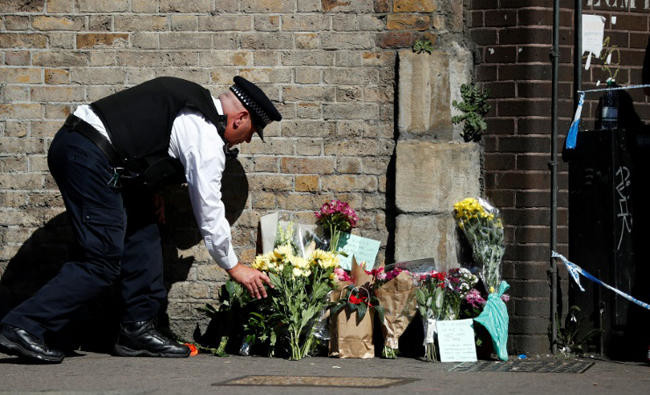
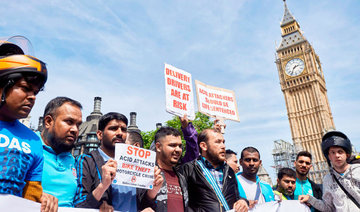
LONDON: Hate crimes in Britain surged by the highest amount on record last year, official figures showed on Tuesday, with the vote to leave the EU a significant factor. But despite the rise prosecutions fell.
There were 80,393 offenses in 2016/17, a rise of 29 percent from the year before. In the same period, hate crime prosecutions dropped to 14,480 from 15,442, a fall of 6.2 percent, according to Home Office data.
Assistant Chief Constable Mark Hamilton, National Police Chiefs’ Council Lead for Hate Crime, said in a statement to Arab News: “Police forces are making themselves more visible and accessible to local communities to ensure victims or anyone feeling vulnerable has the confidence to come forward.”
“We can do better at securing convictions,” Hamilton admitted.
“Nobody should have to face hatred because of who they are.”
Shaista Aziz, a British-Muslim journalist and founder of The EveryDay Bigotry Project, a digital anti-racism platform, said: “‘Today’s data showed a correlation between political events and terrorism attacks and peaks in reported hate crime.
“Many of the victims that I work with have not reported their hate crimes to the police because they may not have a witness to the crime or because they do not have confidence in the police or, even more worryingly, they say that these racialized incidents of hate are part of their daily lives.”
Fiyaz Mughal, founder of the hate crime reporting site Tell MAMA, told Arab News: “This is concerning. We know that the Crown Prosecution Service does a sterling job in sending out a message – where crimes have taken place and it is in the public interest to prosecute, they will do so with vigor and energy.
“The CPS will be reviewing their prosecution rates though there may be something in the hate crimes which relate to the online world which are much more difficult to get evidence on.”
Alison Saunders, the Director of Public Prosecutions, said: “The drop in referrals recorded last year has impacted on the number of completed prosecutions and we are working with the police at a local and national level to understand the reasons for the overall fall in referrals in the past two years.”
Saunders added that more than half of 2016-17 cases involving hostility on the grounds of race, religion, sexual orientation, disability or transgender identity saw sentences “uplifted.” This means that the courts passed increased sentences in more than 6,300 cases.

Hate crimes surge in Britain
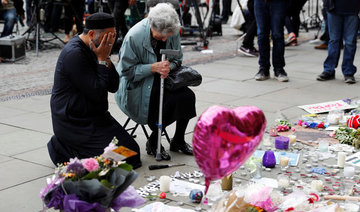
Ramadan lights illuminate London’s heart as mayor calls for unity
- A sign reading ‘Happy Ramadan,’ decorated with stars and crescent moons, will be illuminated from sunrise to sunset
- This year, the Muslim fasting month coincides with Lent, a 40-day season of prayer, fasting, and almsgiving
LONDON: Mayor of London Sadiq Khan has switched on the Ramadan lights as British Muslims prepare to welcome the fasting month this week.
“A beautiful celebration of the holy month and a reminder that our city is a beacon of hope, unity, and inclusivity. A city where diversity is a strength, and where everyone is loved and wanted,” Khan wrote on X.
The heart of London’s West End is now illuminated by 30,000 LED bulbs for the fourth consecutive year, celebrating culture, cuisine, and community during the holy month when Muslims fast from sunrise to sunset.
Rahima Aziz BEM, a trustee of the charitable Aziz Foundation, told Arab News that organizing the canopy of lights on Coventry Street, near Piccadilly Circus, has expanded every year since 2023.
“And what started as just a simple light installation has become something where you can really experience the spirit of Ramadan and what it has to offer,” she said.
For this year’s program, the Aziz Foundation has organized “Shared Lights,” an interfaith art exhibition in the basement of the Zedwell Hotel, featuring 20 artists from across the UK who explore the values central to Ramadan, including love, peace, generosity, and hope.
The charity has also created an interactive digital map of halal and vegetarian-friendly restaurants, allowing visitors to plan their iftar meals from exclusive set menus and locate nearby prayer spaces and evening activities.
“Many young Muslims will choose to have iftar out with their friends and family, in central London. So, we wanted to provide them with more incentive to really spend and boost the local economy, through freebies and special discounts,” Aziz said.
An estimated 4 million British Muslims live across England, Scotland, Northern Ireland, and Wales, with over 1 million living in London alone, according to the 2021 census. London was the first major European city to adorn its central streets with Ramadan lights, which have become part of the city’s calendar alongside Hanukkah and Diwali.
A sign that reads “Happy Ramadan,” decorated with stars and crescent moons, will be illuminated nightly from 5:00 p.m. until 5:00 a.m., and will then change to “Happy Eid” in celebration of Eid Al-Fitr in March. This year, Ramadan coincides with Lent, a 40-day season of prayer, fasting, and almsgiving. Lent begins on Feb. 18 and concludes on April 2. If the moon is sighted, Ramadan is expected to start on Feb. 17 and end on March 18.
“Eventually, we’ll get to a time where we’re sharing Ramadan with Christmas, which is just beautiful. Great opportunity for some cross-cultural experiences,” Aziz added.
Ramadan, which follows the lunar Hijri calendar, occurs approximately 10 to 11 days earlier each year in relation to the Gregorian solar calendar. This year, Muslims in London will fast for between 12 and 14 hours daily. Iftar is held around 5:30 p.m. at the beginning of the month and around 6:30 p.m. as the month approaches the end. However, when Ramadan falls in the summer, the fasting period can last nearly 19 hours, and these hours vary across countries and regions within a country.
Fasting during Ramadan is one of the five pillars of Islam, alongside the Shahada, a profession of faith, prayer, giving alms, and performing Hajj. Muslims refrain from food, drink, and some activities during daylight for 30 days as a way to reflect on religion, life, and empathize with the poor.
“I grew up in London. I’ve been here most of my life,” Aziz said. “What is really special for me is seeing the curiosity about Ramadan and about Islam increase. Ramadan lights are about making people feel that London is a melting pot of diversity, for everyone.”