582,000 Rohingya to Bangladesh from Myanmar since August 25: UN

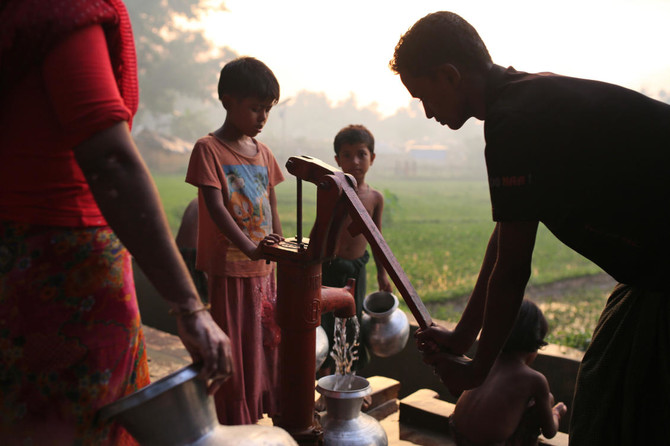
Rohingya refugees collect water from a hand pump near Kutupalong refugee camp in Cox’s Bazar, Bangladesh, on Tuesday, October 3, 2017. (File photo by AP)
Updated 17 October 2017
Follow

582,000 Rohingya to Bangladesh from Myanmar since August 25: UN

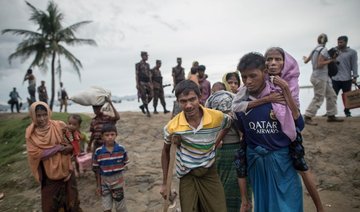
GENEVA: Some 582,000 Rohingya refugees have fled their homes in Myanmar and arrived in Bangladesh since late August, the United Nations said Tuesday, warning that thousands more were stranded at the border.
The UN said 582,000 members of the Rohingya community had crossed into Bangladesh since August 25, marking a jump of 45,000 from the 537,000 figure given at the weekend.
Marixie Mercado, a spokeswoman for the UN children’s agency, told reporters in Geneva though that the hike was not likely due to a sudden influx, but rather to improved access to some areas where many refugees had previously gone uncounted.
The Rohingya are fleeing violence in Myanmar’s Rakhine state, where the UN has accused troops of waging an ethnic cleansing campaign against them.
The numbers have soared since August 25, when militant attacks on Myanmar’s security forces in Rakhine sparked a major military backlash.
UN refugee agency (UNHCR) spokesman Andrej Mahecic expressed deep concern over the “condition of thousands of new arrivals who are stranded near the Bangladesh-Myanmar border.”
“Since Sunday night, an estimated 10,000-15,000 Rohingya refugees have entered Bangladesh through the Anjuman Para border crossing point in Ukhia district in the country’s south-east,” he told reporters.
He said many of them had chosen to remain in their homes in Myanmar’s northern Rakhine state despite repeated threats to leave or be killed.
“They finally fled when their villages were set on fire,” he said.
He said UNHCR staff had spoken with people who described walking for around a week to reach the Bangladesh border.
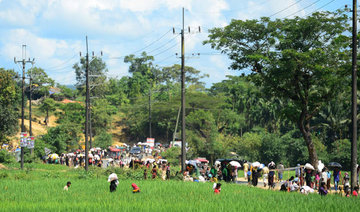
Most are still squatting in paddy fields in Bangladesh, and were waiting for permission to move away from the border, he said.
“UNHCR is advocating with the Bangladesh authorities to urgently admit these refugees fleeing violence and increasingly-difficult conditions back home,” Mahecic said.
“Every minute counts, given the fragile conditions they’re arriving in,” he stressed.


Trump says he asked Putin not to target Kyiv for 1 week during brutal cold spell

Updated 7 sec ago
Follow

Trump says he asked Putin not to target Kyiv for 1 week during brutal cold spell

  • “I personally asked President Putin not to fire on Kyiv and the cities and towns for a week during this ... extraordinary cold,” Trump said
  • Zelensky, for his part, thanked Trump for his effort and welcomed the “possibility” of a pause

KYIV: US President Donald Trump said Thursday that President Vladimir Putin has agreed not to target the Ukrainian capital and other towns for one week as the region experiences frigid temperatures.
There was no immediate confirmation from the Kremlin that Putin has agreed to such a pause.
Russia has been pounding Ukraine’s critical infrastructure, hoping to wear down public resistance to the war while leaving many around the country having to endure the dead of winter without heat.
“I personally asked President Putin not to fire on Kyiv and the cities and towns for a week during this ... extraordinary cold,” Trump said during a Cabinet meeting at the White House, adding that Putin has “agreed to that.”
Kremlin spokesman Dmitry Peskov was asked earlier Thursday whether a mutual halt on strikes on energy facilities was being discussed between Russia and Ukraine, and he refused to comment on the issue.
Ukrainian President Volodymyr Zelensky late Wednesday had warned that Moscow was planning another large-scale barrage despite plans for further US-brokered peace talks at the weekend.
Trump said he was pleased that Putin has agreed to the pause. Kyiv, which has grappled with severe power shortages this winter, is forecast to enter a brutally cold stretch starting Friday that is expected to last into next week. Temperatures in some areas will drop to minus 30 degrees Celsius (minus 22 Fahrenheit), the State Emergency Service warned.
“A lot of people said, ‘Don’t waste the call. You’re not going to get that.’” the Republican US president said of his request of Putin. “And he did it. And we’re very happy that they did it.”
Zelensky, for his part, thanked Trump for his effort and welcomed the “possibility” of a pause in Russian military action on Kyiv and beyond. “Power supply is a foundation of life,” Zelensky said in his social media post.
Trump did not say when the call with Putin took place or when the ceasefire would go into effect. The White House did not immediately respond to a query seeking clarity about the scope and timing of the limited pause in the nearly four-year war.
Russia has sought to deny Ukrainian civilians heat and running water over the course of the war, which began with Russia’s full-scale invasion on Feb. 24, 2022. Ukrainian officials describe the strategy as “weaponizing winter.”
Last year was the deadliest for civilians in Ukraine since 2022 as Russia intensified its aerial barrages behind the front line, according to the UN Human Rights Monitoring Mission in the country.
The war killed 2,514 civilians and injured 12,142 in Ukraine — 31 percent higher than in 2024, it said.