DUBLIN: Ireland was hit by what officials called an “unprecedented storm” on Monday that left three people dead, more than 300,000 customers without power and shut down schools as well as government offices.
A police spokesman said one woman in her 50s was killed outside the village of Aglish, near the south coast, when a tree fell on her car. A female passenger in her 70s suffered non-life-threatening injuries.
One man died in an accident while he was clearing a fallen tree with a chainsaw near the town of Cahir, about 35 kilometers (22 miles) further inland.
And the third victim was a man killed on the roads by a falling tree north of Dundalk in the northeast, close to the border with Northern Ireland, police said in a statement.
Perhaps most extraordinary image of #Ophelia: trees felled by storm near #Cork’s #GAA stadium, Páirc Uí Chaoimh. pic.twitter.com/OTMNqbtMNE
— Jon Williams (@WilliamsJon) October 16, 2017
Ophelia, the largest hurricane ever recorded so far east in the Atlantic Ocean and the furthest north since 1939, was downgraded to a storm before it hit the Irish coast but nonetheless wrought havoc.
“It will still however bring violent and destructive winds for a time,” Met Eireann, the Irish National Meteorological Service, said on Monday.
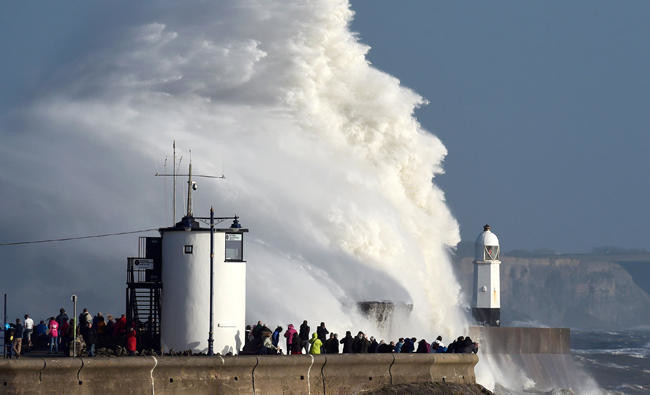
Flooding was also expected “due to either heavy thundery downpours or storm surges in coastal areas,” the service said after issuing a red alert for the whole country.
Winds reached 191 kilometers (119 miles) per hour at Fastnet Rock, Ireland’s southernmost point, while the strongest winds recorded onshore were 156 kph (97 mph) at the entrance to Cork Harbor in the southwest.
Seventeen millimeters of rain fell at Valentia on the southwest coast, including nine millimeters (third of an inch) in one hour.
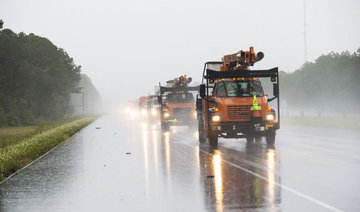
The Electricity Supply Board said 330,000 customers were without power, due to more than 3,200 individual faults on the network.
“We can predict that it will take a number of days to restore power to all customers. Five to 10 percent of this number will be without power for up to 10 days,” it said.
Dublin Airport scrapped 180 flights while Cork Airport canceled most flights in what it said was the worst storm seen in its 56-year history. Meanwhile several services to and from Shannon, the third-biggest airport, were also grounded.
Across the border in Northern Ireland, Belfast airport also saw extensive delays and cancelations.
Power cuts affected 18,000 customers in Northern Ireland, after power lines and poles came down due to strong winds and flying debris, supplier NIE Networks said.
“Stay indoors wherever you are until the storm has passed,” Prime Minister Leo Varadkar said in comments to reporters.
“I don’t want anyone to think that this is anything other than a national emergency and a red alert.”
Latest forecasted track of #HurricaneOphelia: Wind&rain in some West part, South-east stays dry but windy.
Check: https://t.co/UKF5UgQCNO pic.twitter.com/YIeCVsx8UH— Windy (@windyforecast) October 14, 2017
The Department of Education closed all schools, colleges and other education institutions on Monday due to the “unprecedented storm,” with minister Richard Burton saying schools would remain closed on Tuesday.
Government offices were also shut.
Ireland’s top football team Cork City were hit when their stadium roof collapsed, the day before they hoped to seal the league title at their Turners Cross ground.
The eye of the storm is forecast to track across Northern Ireland and then Scotland.
Though it will weaken as it goes, gusts are expected to reach 80 mph (129 kph) in the UK.
Britain’s Met Office issued amber severe weather warnings for Northern Ireland, Wales, and southern Scotland, saying power cuts, transport disruption, flying debris and large waves were likely.
“This leads to the potential for injuries and danger to life,” the national weather service said.
The fringes of the storm turned the hitherto sunny afternoon skies over London a murky shade of brown-orange, due to the southerly warm winds bringing dust from the Sahara Desert.
Ophelia came 30 years to the day after the Great Storm, which ravaged southern England in the early hours of October 16, 1987, leaving 18 people dead.
Ophelia is the 15th named storm of the 2017 Atlantic season, which is expected to last until the end of November.
Three major hurricanes — Harvey, Irma and Maria — caused catastrophic damage in the Caribbean and the US Gulf Coast.
Ophelia was classed Category 3 on Saturday as it passed near Portugal’s Azores islands, which means it packed winds of at least 178 kilometers per hour.
Though seven of the nine islands in the Azores were on high alert, the storm did not cause major damage.