MADRID: Madrid on Monday warned Catalonia’s separatist leader that he has only three days left to “return to legality” after he refused to say whether he would follow through on a threat to declare independence from Spain.
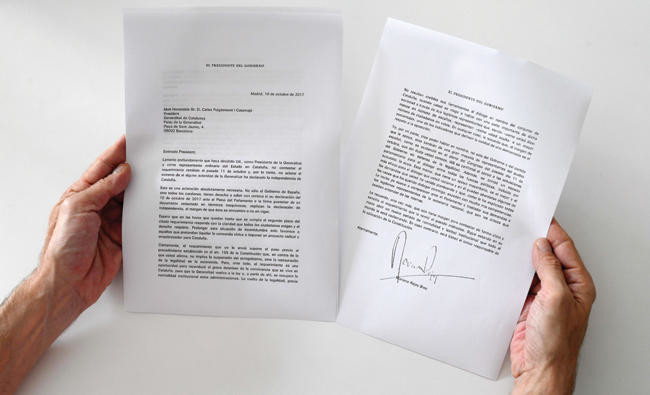
Responding to an initial deadline set by the central government, Carles Puigdemont called for talks with Prime Minister Mariano Rajoy “as soon as possible” as Spain struggles with its worst political crisis in decades.
But Puidgemont stopped short of giving a definitive “yes or no” as demanded by Madrid, and Spain gave him until Thursday morning to clarify.
Anything less than a full climb-down by Thursday’s 0800 GMT deadline is likely to prompt moves by Madrid to impose direct control over the semi-autonomous region — the so-called “nuclear option.”
“The government regrets that the president of the Catalan government has decided not to respond to the request made by the government,” Deputy Prime Minister Soraya Saenz de Santamaria told a news conference.
“All we are asking for is clarity.”
The crisis has showed no signs of abating since a banned independence referendum on October 1, when a violent police crackdown on Catalan voters shocked the world.
Puigdemont declared last week that he was ready for Catalonia to “become an independent state” after the referendum produced a 90 percent ‘Yes’ vote, although turnout was only 43 percent and many of those who back unity with Spain stayed at home.
The Catalan leader had said however that he was “suspending” his independence bid to allow time for negotiations with Madrid — leaving Spain in limbo, rattling stock markets and worrying European leaders who are already grappling with Brexit.
Unideco, the parent company of winemaker Codirniu Raventos which markets itself as Spain’s oldest family business, on Monday became the latest of hundreds of companies to move their headquarters out of wealthy Catalonia in a bid to minimize the instability.
Adding to the tensions, Catalan police chief Josep Lluis Trapero appeared in court accused of failing to stop the referendum going ahead, with Spanish prosecutors demanding he be remanded in custody.
Trapero, who became a popular figure in Catalonia for his handling of August’s jihadist attacks in Barcelona and nearby Cambrils, faces up to 15 years in jail for sedition.
Puigdemont wrote in his letter to Rajoy that “for the next two months, our main objective is to bring you to dialogue.”
Rajoy said in a written response that it was “absolutely necessary” that Catalonia clarify its position.
“I hope that in the hours that remain until the second deadline... you reply with all the clarity which citizens demand and the law requires,” Rajoy said, calling on the Catalan separatists to “return to legality.”
Puigdemont and some separatist allies want mediation with Madrid over the fate of the 7.5 million-strong region, an idea the central government says is a non-starter.
Catalonia has its own language and distinct culture but is deeply divided over independence.
Separatists argue the northeastern region pays more in taxes than it gets back and that breaking away would allow it to prosper, but those who back unity say a split would spell economic and political disaster.
Though it represents about a fifth of Spanish gross domestic product, Catalonia is deeply indebted to Madrid and cannot borrow internationally.
Madrid says the growing uncertainty imperils Spain’s recovery from the financial crisis.
The two biggest Catalan banks have already moved their legal headquarters to other parts of Spain, while ratings agency Standard and Poor’s has warned of a recession in the region if the crisis drags on.
Puigdemont, a 54-year-old former journalist, is under intense pressure from Madrid and world leaders to back off.
Barcelona Mayor Ada Colau on Monday urged him to abandon a unilateral independence bid, saying the uncertainty was “bad for everybody.”
“Before reaching a definitive solution, what we can do is bring about a stable dialogue — and for that, it will be necessary to give up a unilateral independence declaration once and for all,” she told La Sexta television.
But Puigdemont is also being squeezed by separatist allies to crack on with independence.
They have threatened mass strikes and protests in the event of a climb-down.


![]()
Spain gives Catalans three days to drop independence bid
Spain gives Catalans three days to drop independence bid


Latest updates





Recommended


© 2026 SAUDI RESEARCH & PUBLISHING COMPANY, All Rights Reserved And subject to Terms of Use Agreement.