Thousands respond ‘me too’ to actress’s Twitter prompt on sexual abuse

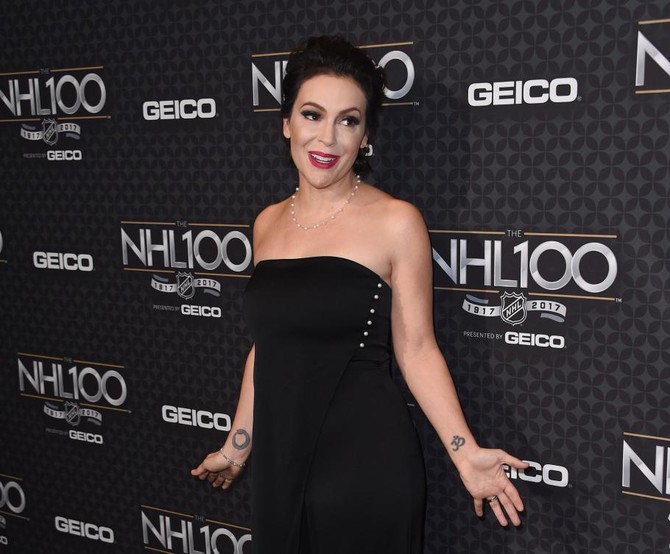
Actress Alyssa Milano launched a “Me Too” Twitter hashtag on Sunday, October 15, 2017, requesting people reply on the social network if they have been victims of sexual assault or harassment. According to US media reports Milano is receiving thousands of responses. (AFP/Chris Delmas)
Updated 16 October 2017
Follow

Thousands respond ‘me too’ to actress’s Twitter prompt on sexual abuse

WASHINGTON: Actress Alyssa Milano has sparked a massive outpouring with a simple Twitter request that women respond “me too” if they’ve been sexually assaulted or harassed.
More than 27,000 people replied, making “#MeToo” the top trending topic through the day Sunday.
The avalanche of painful personal stories comes amid a series of high profile sex abuse scandals — the latest one centered around powerful Hollywood producer Harvey Weinstein.
The intensity and breadth of the response highlighted that the problem reaches well beyond the rich and famous and features in the everyday lives of women around the world.
“If you’ve been sexually harassed or assaulted write ‘me too’ as a reply to this tweet,” Milano wrote.
Many women appeared to be speaking out for the first time about abuses they had suffered, and said they had to overcome feelings of shame and embarrassment to do so.
Some just responded “#MeToo.”

Others said they had been abused as children by relatives, or as a teenager by a person they trusted. That nobody believed them when they spoke about it emerged as a common refrain.
“I wish I could remember who I was before #MeToo,” wrote a woman named Rosey.
“Molested by a family member. Raped as a kid and an adult. Became a drug addict and then overcame. Don’t ever give up. I’m here#MeToo,” said Amy Christensen in her post.
“Sexual assaulted by a military doctor at Lackland AFB. 1973,” said DebiDay.
“Me, too. I spoke out. What did I learn. That no one, absolutely no one, would listen, much less help,” said Lisa Omlid.
“If you are not at the point where you can share your #MeToo I stand with you,” said Kelly Douglas. “Your story is valid whether you share it or not.”
There were many sympathetic responses from men.
Vinay Ramesh encouraged “all my fellow men to learn about #MeToo. The responsibility to stop sexual violence is absolutely on us.”
“I feel disgusted and sad,” said Ed Krassenstein.

Although the overwhelming majority of the posts were personal in nature, the Weinstein scandal and US President Donald Trump’s videotaped boasts of groping women with impunity also drew comments.
“Just as I did after the #Trump tapes, I’m having flashbacks due to the Harvey Weinstein assault & rape allegations. Abuse is forever,” wrote BuffieHippie.
More than 20 women — a who’s who of Hollywood — have come forward to accuse Weinstein of rape, assault and sexual harassment.
Milano, probably best known for her role in the 1980s sitcom “Who’s the Boss,” is not among the accusers.
Weinstein, who insists any sexual encounters were consensual, was expelled this week from the Academy of Motion Picture Arts and Sciences.
A court document made public on Sunday revealed that Trump’s campaign has been subpoenaed for all documents related to assault allegations that emerged during his run for the presidency.
The subpoena is part of a defamation lawsuit brought by Summer Zervos, a former contestant on Trump’s reality TV show “The Apprentice” who alleged he tried to kiss and grope her without her consent.
UAE outlines approach to AI governance amid regulation debate at World Economic Forum

Updated 22 January 2026
Follow

UAE outlines approach to AI governance amid regulation debate at World Economic Forum

  • Minister of State Maryam Al-Hammadi highlights importance of a robust regulatory framework to complement implementation of AI technology
  • Other experts in panel discussion say regulators should address problems as they arise, rather than trying to solve problems that do not yet exist

DUBAI: The UAE has made changes to 90 percent of its laws in the past four years, Maryam Al-Hammadi, minister of state and the secretary-general of the Emirati Cabinet, told the World Economic Forum in Davos on Wednesday.

Speaking during a panel discussion titled “Regulating at the Speed of Code,” she highlighted the importance of having a robust regulatory framework in place to complement the implementation of artificial intelligence technology in the public and private sectors.

The process of this updating and repealing of laws has driven the UAE’s efforts to develop an AI model that can assist in the drafting of legislation, along with collecting feedback from stakeholders on proposed laws and suggesting improvements, she said.

Although AI might be more agile at shaping regulation, “there are some principles that we put in the model that we are developing that we cannot compromise,” Al-Hammadi added. These include rules for human accountability, transparency, privacy and data protection, along with constitutional safeguards and a thorough understanding of the law.

At this stage, “we believe AI can advise but still (the) human is in command,” she said.

Authorities in the UAE are aiming to develop, within a two-year timeline, a shareable model to help other nations learn and benefit from its experiences, Al-Hammadi added.

Argentina’s minister of deregulation and state transformation, Federico Sturzenegger, warned against overregulation at the cost of innovation.

Politicians often react to a “salient event” by overreacting, he said, describing most regulators as “very imaginative of all the terrible things that will happen to people if they’re free.”

He said that “we have to take more risk,” and regulators should wait to address problems as they arise rather than trying to create solutions for problems that do not yet exist.

This sentiment was echoed by Joel Kaplan, Meta’s chief global affairs officer, who said “imaginative policymakers” often focus more on risks and potential harms than on the economic and growth benefits of innovation.

He pointed to Europe as an example of this, arguing that an excessive focus on “all the possible harms” of new technologies has, over time, reduced competitiveness and risks leaving the region behind in what he described as a “new technological revolution.”