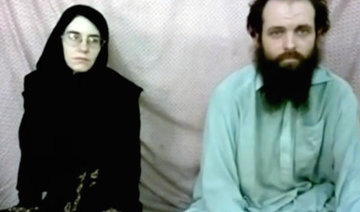
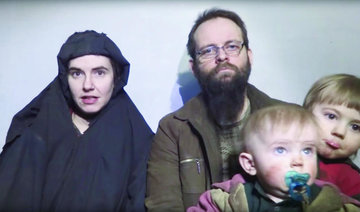
Kabul rejects Pakistani account of hostage rescue

Freed Canadian hostage Joshua Boyle and one of his children walk outside the Boyle family home in Smiths Falls, Ontario, on Saturday. (AFP)
Updated 15 October 2017
Follow

Kabul rejects Pakistani account of hostage rescue

KABUL: An American-Canadian family released last week after five years in captivity were kidnapped by the Haqqani network in the Afghan province of Wardak and kept in Pakistan, the spokesmen for the Afghan defense and interior ministries said on Sunday.
Pakistan’s high commissioner to Canada said the elite Pakistani Special Services Group, acting on “real-time” intelligence from American sources, attacked the kidnappers as they moved the hostages across the border from Afghanistan.
“Pakistani commandos took action at the border and there was a shootout, and eventually (the hostages) were rescued,” Tariq Azim Khan told a Canadian media outlet on Thursday.
“One or two (of the kidnappers) escaped… and a search operation is still ongoing to catch them.”
But regarding the claim that the kidnappers had moved the hostages from Afghanistan, Gen. Dawlat Waziri, chief spokesman for the Afghan Defense Ministry, told Arab News: “We utterly deny this.”
Afghan Interior Ministry spokesman Najib Danesh told Arab News: “There’s enough evidence to prove that they were in Pakistan since the time of their abduction.”
Waziri said Pakistan freed the hostages under the guise of rescuing them from kidnappers, in order to “reduce American and international pressure.”
According to media reports a few months ago, the US withheld $50 million in aid to Pakistan because it was allegedly doing too little to combat the terrorist organization that seized the hostages.
On Thursday, US President Donald Trump said the release of the family of five was “a positive moment for our country’s relationship with Pakistan.” The release came ahead of a meeting of senior US officials with Pakistani leaders, and the resumption of Afghan peace talks in Oman.
Representatives of Afghanistan, China, Pakistan and the US will take part in the talks, but there are no reports of the Taliban’s participation. Islamabad has been under pressure to bring the Taliban to the negotiating table.
Rape denied
In a related development, a Taliban spokesman denied on Sunday accusations by Joshua Boyle, the former hostage, that one of his children had been murdered and his wife raped while they were being held captive, according to a Reuters report.
Boyle told reporters soon after he, his wife, Caitlan Coleman, and their three children returned to Canada on Friday that their captors had murdered a fourth child and raped his wife.
Taliban spokesman Zabiullah Mujahid rejected that as propaganda by the Western governments that helped rescue the family.
“We strongly reject these fake and fabricated allegations of this Canadian family, now in the hands of the enemy,” he said in a statement sent to media.
“Whatever statement the enemy wants to put in their mouth, the family is forced to make it.” Boyle called on the Taliban to “provide my family with the justice we deserve.”
Mujahid said the couple was intentionally never separated in order to protect their safety. He also denied that their child had been murdered, but acknowledged that one child became sick and died.
“We were in a remote area without access to a doctor and medications that led to the loss of the child,” he said. Three children, all born in captivity, were rescued along with Boyle and Coleman.
The U.S. government calls the Haqqani network “the most lethal and sophisticated insurgent group” in Afghanistan.
Its operational chief, Sirajuddin Haqqani, was named deputy to the Taliban’s newly appointed leader Mullah Akhtar Mohammad Mansour in 2015, cementing the ties between the groups.
The Haqqanis previously held U.S. Army Sergeant Bowe Bergdahl, who was freed in a swap for Taliban prisoners in 2014, and are suspected of holding two professors, an American and an Australian, who were kidnapped outside their university in Kabul in 2016.
A senior Afghan government official told Reuters that American and Afghan special forces launched two unsuccessful raids to try to rescue the professors in Afghanistan, but officials now believe the pair has been taken to Haqqani hideouts over the border in Pakistan. (Writing by Josh Smith; Editing by Robert Birsel)


Pakistani fighter jet crashes in Jalalabad, pilot captured: Afghan military, police

Updated 42 min 34 sec ago
Follow

Pakistani fighter jet crashes in Jalalabad, pilot captured: Afghan military, police

  • Fighting between Pakistan and Afghanistan’s Taliban military entered its third day on Saturday
  • Pakistan’s strikes on Friday hit Taliban military installations and posts, including in Kabul and Kandahar

JALALABAD: A Pakistani jet has crashed in Jalalabad city and the pilot captured alive, the Afghan military and police said Saturday, with residents telling AFP the man parachuted from the plane before being detained.
"A Pakistani fighter jet was shot down in the sixth district of Jalalabad city, and its pilot was captured alive," police spokesman Tayeb Hammad said.
Wahidullah Mohammadi, spokesman for the military in eastern Afghanistan, confirmed the Pakistani jet was downed by Afghan forces "and the pilot was captured alive".

The AFP journalist heard a jet overhead before blasts from the direction of the airport in Jalalabad, the capital of Nangarhar province, which sits on the road between Kabul and the Pakistani border.

Fighting between Pakistan and Afghanistan’s Taliban military entered its third day on Saturday, following overnight clashes as the international community expressed increasing concern about the conflict and called for urgent talks.

Pakistan’s strikes on Friday hit Taliban military installations and posts, including in Kabul and Kandahar, in one of the deepest Pakistani incursions into its western neighbor in years, officials said.

Islamabad accuses the Taliban of harboring Tehreek-e-Taliban Pakistan (TTP) militants, who it claims are waging an insurgency inside Pakistan, a charge the Taliban denies.

Pakistan described its actions as a response to cross-border assaults, while Kabul denounced them as a breach of its sovereignty, saying it remained open to dialogue but warned any wider conflict would result in serious consequences.

The fighting has raised ‌the risk ‌of a protracted conflict along the rugged 2,600-kilometer frontier.

Diplomatic efforts gathered ‌pace ⁠late on Friday ⁠as Afghanistan said its foreign minister, Amir Khan Muttaqi, spoke by telephone with Saudi Arabia’s Prince Faisal bin Farhan about reducing tensions and keeping diplomatic channels open.

The European Union called for both sides to de-escalate and engage in dialogue, while the United Nations urged an immediate end to hostilities.

Russia urged both sides to halt the clashes and return to talks, while China said it was deeply concerned and ready to help ease tensions.

The United States supports Pakistan’s right to defend itself against attacks by ⁠the Taliban, a State Department spokesperson said.

Border fighting continues

Exchanges of fire continued along ‌the border overnight.

Pakistani security sources said an operation dubbed “Ghazab Lil Haq” was ongoing and that Pakistani forces had destroyed multiple Taliban posts and camps in several sectors. Reuters could not independently verify the claims.

Both sides have reported heavy losses with conflicting tolls that Reuters could not verify. Pakistan said 12 of its ‌soldiers and 274 Taliban were killed while the Taliban said 13 of its fighters and 55 Pakistani soldiers died.

Taliban deputy spokesman Hamdullah Fitrat ⁠said 19 civilians were ⁠killed and 26 wounded in Khost and Paktika. Reuters could not verify the claim.

Pakistan’s Defense Minister Khawaja Muhammad Asif said “our cup of patience has overflowed” and described the fighting as “open war,” warning that Pakistan would respond to further attacks.

Taliban Interior Minister Sirajuddin Haqqani said in a speech in Khost province that the conflict “will be very costly,” and that Afghan forces had not deployed broadly beyond those already engaged.

He said the Taliban had defeated “the world, not through technology, but through unity and solidarity,” and through “great patience and perseverance,” rather than superior military power.

Pakistan’s military capabilities far exceed those of Afghanistan, with a standing army of hundreds of thousands and a modern air force.

In stark contrast, the Taliban lacks a conventional air force and relies largely on light weaponry and ground forces.

However, the Islamist group is battle-hardened after two decades of insurgency against US-led forces before returning to power in 2021.