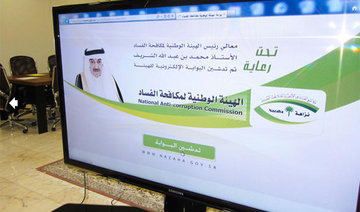
RIYADH: Saudi Arabia has progressed 18 points in the control of corruption indicator 2016, which the World Bank issued last week, compared to 2015, the National Anti-Corruption Commission (Nazaha) said in a statement to Arab News on Thursday.
With this ranking, the Kingdom earned its highest percentage in controlling corruption since its entry in the World Bank indicator report in 1996.
“This came in the Worldwide Governance Indicators which the World Bank publishes every year in six different governance dimensions including: Voice and accountability; political stability and absence of violence/terrorism; government effectiveness; regulatory quality; rule of law; and control of corruption for more than 200 countries,” said the statement.
Nazaha added that this indicator includes all developed and developing countries, and it derives its information from a number of resources, surveys from research centers, and opinions of experts who work in NGOs and private companies.
The statement added that the Kingdom’s progress is a result of reforms that Saudi Arabia has recently made, and because of the efforts made by concerned entities in achieving Vision 2030, which stipulates that transparency in performance and a zero-tolerance policy on corruption in all its forms, benefit best practices, improve governance standards, activate high standards of accountability and broaden the range of services.


![]()
Saudi Arabia advances 18 points in World Bank report on corruption control
Saudi Arabia advances 18 points in World Bank report on corruption control


Latest updates


© 2026 SAUDI RESEARCH & PUBLISHING COMPANY, All Rights Reserved And subject to Terms of Use Agreement.