RIYADH: Saudi Arabia has welcomed Donald Trump’s “firm” strategy on Iran after the US president declined to certify Tehran’s compliance with the nuclear deal, according to the Kingdom’s state news agency.
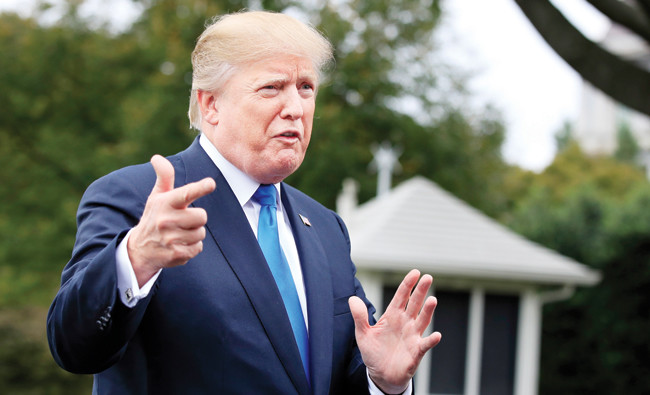
Trump on Friday warned he might ultimately terminate the deal, as he announced a new Iran strategy that includes additional measures to ensure the “rogue regime” in Tehran does not destabilize the region or acquire nuclear weapons.
The nuclear deal — known as the Joint Comprehensive Plan of Action (JCPOA), which Iran signed with six nations including the US — limits Iran’s nuclear enrichment activities in return for sanctions relief.
Trump announced the major shift in US policy in a speech in which he detailed a more confrontational approach to Iran over its nuclear and ballistic missile programs and alleged support for extremist groups in the Middle East, Reuters reported.
“I am directing my administration to work closely with Congress and our allies to address the (nuclear) deal’s many serious flaws so that the Iranian regime can never threaten the world with nuclear weapons,” Trump said.
Saudi Arabia praised Trump’s “vision” and commitment to work with US allies in the region in order to face “common challenges, particularly Iran’s aggressive policies and actions,” according to the Saudi Press Agency.
A statement stressed that Saudi Arabia had previously supported the nuclear agreement between Iran and the “5 + 1” powers, in the belief that it is necessary to limit the proliferation of weapons of mass destruction.
But it added that Iran had “exploited” the economic benefits of eased sanctions and continued to “destabilize the region.”
The Saudi statement pointed to Iran’s ballistic missile development program and alleged support of terrorism in the region, including its backing of Hezbollah and Houthi militias in Yemen.
Iran continues in its “aggressive” approach through the Iranian Revolutionary Guard Corps (IRGC) and Houthi militia, has repeatedly targeted international navigation passageways in the Red Sea and Arabian Gulf, and has launched cyberattacks against the Kingdom and other regional countries, the statement said.
President Trump stressed the importance of denying the IRGC funding for its “malign” activities. The US Treasury Department on Friday added the IRGC to its sanctions list “for providing support to a number of terrorist groups,” including Hezbollah, Hamas and the Taliban.
While Trump’s decision does not abrogate the nuclear deal itself, it leaves open the possibility that the US Congress will respond by levying new sanctions on Iran. Iranian officials have threatened to pull out of the agreement should the US impose new sanctions. Tehran has also made it clear that it is not willing to renegotiate the agreement.
Marcelle Wahba, former US ambassador to the UAE and current president of the Arab Gulf States Institute in Washington, said that the new US policy shows Trump is getting tough on Iran.
“I think the president believes not certifying the agreement will send a clear message to Iran that the US intends to push back on Iran’s destabilizing activities in the region and particularly over its support of terrorist organizations such as Hezbollah,” Wahba told Arab News.
Harvard scholar and Iran specialist Majid Rafizadeh told Arab News that the “decertification of the nuclear deal should be part of a broader strategy to pressure Tehran for its belligerent behavior,ballistic missile tests, and military adventurism.”


![]()
![]()
Saudi Arabia welcomes ‘firm’ US strategy on Iran
Saudi Arabia welcomes ‘firm’ US strategy on Iran
Latest updates


© 2026 SAUDI RESEARCH & PUBLISHING COMPANY, All Rights Reserved And subject to Terms of Use Agreement.