TABUK: Saudi international missions operating in the Tabuk region under the supervision of the Saudi Commission for Tourism and National Heritage (SCTH) have discovered a large number of tools, engravings and architectural units in three sites in the region.
These discoveries date back to different civilizations beginning from the Stone Age until the Islamic Era.
The specialized teams said that these sites need further study and excavation. Tabuk region was a conduit for ancient trade routes.
There are rock and animal drawings at Kilwa site, northeast of Tabuk. The Kilwa site is located inside the Al-Tabik Reserve. The joint Saudi-French team found ancient artifacts and a large number of rock-and-animal drawings which date back to the Stone Age.
The Kilwa historical site and the surrounding area are important archaeological sites, because these sites contain distinguished archaeological units.
Thus, many stages of civilization can be distinguished from prehistoric times to historical periods and pre-Islamic periods in addition to the Islamic period.
The stone drawings in the region of Kilwa are among the most ancient places in the Arabian Peninsula and could date back to 7,000 BC to 9,000 BC.
In the valleys and pastoral areas between the Tabuk and Jouf regions, a Saudi-Japanese team recorded 30 sites dating back to various periods and ages of the Paleolithic, Neolithic, Bronze, Iron Age and sites of Islamic times.
Under the supervision of the SCTH, there are more than 30 missions and scientific teams specialized in research and archaeological exploration. These teams include Saudi scientists and others from the world’s top universities and the most prestigious research centers from countries including France, Italy, the United States, Britain, Germany, Japan, Belgium, Poland, Finland, the Netherlands, Austria and others.
The Kingdom will hold the first forum specialized in archaeology. It is the first of its kind in Saudi Arabia, which will be held in Riyadh under the auspices of King Salman from Safar 18-20, 1439 AH.


![]()
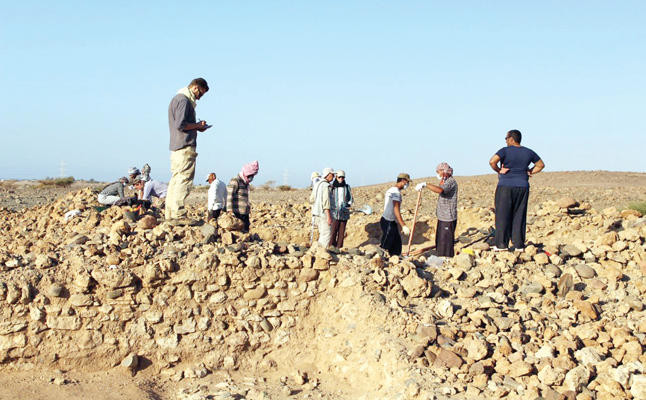
Saudi-French team discovers Stone Age sites in Tabuk
Saudi-French team discovers Stone Age sites in Tabuk


Latest updates


© 2026 SAUDI RESEARCH & PUBLISHING COMPANY, All Rights Reserved And subject to Terms of Use Agreement.