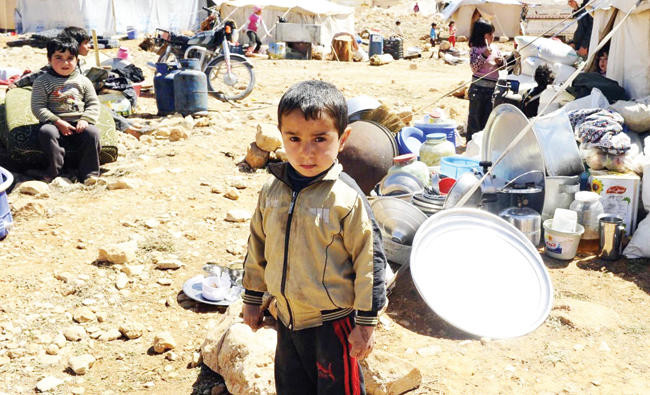
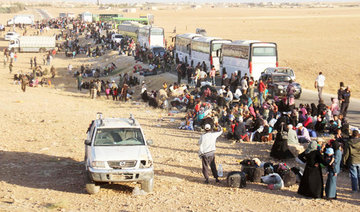
BEIRUT: Political leaders, religious authorities and the media were urged on Wednesday not to make Syrian refugees scapegoats for Lebanon’s problems.
“Lebanon is headed toward parliamentary elections, and there are so many controversial debates about issues that affect Lebanese society, politics and the economy,” said Mireille Girard, representative in Lebanon for the UN refugee agency, UNHCR.
“Tension may sometimes be focused on refugees because they are believed to be the cause of many current political, security and economic problems. Thus, it is very important that we sit together and thoroughly discuss this matter.
“The media is responsible for reducing tension and being objective, and this is also the responsibility of political leaders, religious authorities and other concerned sectors.”
Girard was speaking at a workshop organized with the Ministry of Information on media coverage of the refugee issue. Information Minister Melhem Riachy called for “positive media coverage that does not conceal facts, violate the principle of objectivity and suggest that the whole population of a country are murderers because one of them committed a crime.”
Riachy accused some media outlets of promoting racism and ideas that contradicted historical fact. “If we wish for refugees to return safely to their own country, we must work to ease the causes of tension in Lebanon,” he said.
UNHCR Protection Officer Esther Pinzari said immigrants and displaced people were not the same as Syrian refugees, of whom there were 1 million in Lebanon. Ensuring their safe and voluntary return was important, she said. “Seeking refuge in a third country is the solution for a small number of people who suffer from extremely fragile conditions.”
Nasser Yassin, director of research at the Institute for Public Policy and International Affairs at the American University of Beirut, said most Syrian refugees were women and children, and they contributed $1.25 billion to Lebanon’s economy.
“In the past, they used to spend their money inside Syria,” he said. “If refugees returned to Syria today, only the tension would be eased, but not Lebanon’s economic crisis.”
Schott Gregg, UNHCR media officer, said refugees could not be forced to return to Syria while violence continued. “The war in Syria is not over yet,” he said. “The areas that are safe this week may not be so next week.”

Don’t blame Syrian refugees for your problems, Lebanon told
The French village where Ayatollah Khomeini fomented Iran’s revolution
NEAUPHLE-LE-CHATEAU: It has been nearly 50 years since the Ayatollah Ruhollah Khomeini recorded speeches calling for an Islamic revolution from a country home in an affluent village west of Paris.
But the inhabitants of Neauphle-le-Chateau have still not got over their famous guest, as the US-Israeli war against Iran puts the spotlight back on the ayatollah’s legacy.
Khomeini, the original spiritual guide of Iran’s modern theocracy, spent barely 120 days ensconced in a villa in the village 40 kilometers (25 miles) west of the French capital, before returning in a blaze of publicity to complete the ousting of the Shah, Mohammad Reza Pahlavi, in the Iranian Revolution in early 1979.
Andre, an 86-year-old neighbor of the house that was briefly Khomeini’s headquarters, recalled the sudden storm that hit sleepy Neauphle-le-Chateau in the Yvelines department.
“One evening on the television, they announced that an ayatollah had set up home in a comfortable district in the Yvelines,” said the retired engineer, who declined to give his family name but has lived in the village since 1974.
“From the Saturday morning, there was an invasion of journalists. They were parked everywhere.”
Neauphle-le-Chateau, which is just 20 kilometers (12 miles) from Versailles palace, soon became a major draw. “The number of people that the ayatollah would receive, especially the young Iranians who studied in Germany,” said Andre.
“It was incredible. He organized the whole Iranian revolution from Neauphle-le-Château.”
Revolutionary exile
Khomeini, then 76, needed a new bolthole after being expelled from his exiled base in the Iraqi city of Najaf by the country’s dictator Saddam Hussein.
“The only place an Iranian could go to without a visa was France,” said Bernard Hourcade, a specialist on Iran at the CNRS, France’s main research institute.
Abolhassan Banisadr, a future president of the Islamic Republic, at first offered accommodation at Cachan, southeast of Paris. But then a friend offered the house west of the capital and Neauphle-le-Chateau became internationally famous.
The ayatollah arrived on October 6, 1978 and left France again on February 1, 1979. He died in Iran in 1989.
According to Hourcade, one of Khomeini’s main activities at the house was to record speeches condemning the shah and calling for revolution, which were recorded on cassettes and secreted into Iran.
Michel, an 87-year-old resident, who also did not want to give his family name, recalled the “police checks” and “blocked roads” during the ayatollah’s stay.
“We weren’t bothered by his presence, but the neighbors on Chevreuse road (where the ayatollah lived) were quite inconvenienced.”
Some, like former resident Alain Simonneau, 80, played down the ayatollah’s role in the history of the village. “It was a minor event for Neauphle-le-Chateau, even if it’s part of our collective memory, whether we like it or not.”
But Lydie Kadiri, who arrived in 1999, said it is a part of history that everyone remembers. “When we say we come from Neauphle-le-Château, everyone immediately remembers the ayatollah!” she said.
The destiny of the house where the ayatollah stayed is another mystery.
The home was destroyed in an explosion in February 1980, a few months after the ayatollah’s death. Other buildings have since been erected.
“One evening, I heard an explosion and suddenly, everything burst into flames. The house shook from the blast. Some glass was cracked in my hall,” recalled Andre.
For some years, a signboard stood on the land where the house had been, signalling the link between Iran’s original spiritual guide and the village. This was vandalized in 2023.
Now pilgrimages are held each year to mark his return to Iran on February 1, 1979.
Khomeini’s successor, Ayatollah Ali Khamenei, was killed in the US-Israeli air strikes on Iran.
A Neauphle-le-Chateau resident, speaking on condition of anonymity, said that between 150 and 200 people came each year with Iran’s ambassador “to celebrate the anniversary” of Khomeini’s return to Iran.
In Tehran, a road is named after Neauphle-le-Chateau. The French embassy is located on the street.
But the inhabitants of Neauphle-le-Chateau have still not got over their famous guest, as the US-Israeli war against Iran puts the spotlight back on the ayatollah’s legacy.
Khomeini, the original spiritual guide of Iran’s modern theocracy, spent barely 120 days ensconced in a villa in the village 40 kilometers (25 miles) west of the French capital, before returning in a blaze of publicity to complete the ousting of the Shah, Mohammad Reza Pahlavi, in the Iranian Revolution in early 1979.
Andre, an 86-year-old neighbor of the house that was briefly Khomeini’s headquarters, recalled the sudden storm that hit sleepy Neauphle-le-Chateau in the Yvelines department.
“One evening on the television, they announced that an ayatollah had set up home in a comfortable district in the Yvelines,” said the retired engineer, who declined to give his family name but has lived in the village since 1974.
“From the Saturday morning, there was an invasion of journalists. They were parked everywhere.”
Neauphle-le-Chateau, which is just 20 kilometers (12 miles) from Versailles palace, soon became a major draw. “The number of people that the ayatollah would receive, especially the young Iranians who studied in Germany,” said Andre.
“It was incredible. He organized the whole Iranian revolution from Neauphle-le-Château.”
Revolutionary exile
Khomeini, then 76, needed a new bolthole after being expelled from his exiled base in the Iraqi city of Najaf by the country’s dictator Saddam Hussein.
“The only place an Iranian could go to without a visa was France,” said Bernard Hourcade, a specialist on Iran at the CNRS, France’s main research institute.
Abolhassan Banisadr, a future president of the Islamic Republic, at first offered accommodation at Cachan, southeast of Paris. But then a friend offered the house west of the capital and Neauphle-le-Chateau became internationally famous.
The ayatollah arrived on October 6, 1978 and left France again on February 1, 1979. He died in Iran in 1989.
According to Hourcade, one of Khomeini’s main activities at the house was to record speeches condemning the shah and calling for revolution, which were recorded on cassettes and secreted into Iran.
Michel, an 87-year-old resident, who also did not want to give his family name, recalled the “police checks” and “blocked roads” during the ayatollah’s stay.
“We weren’t bothered by his presence, but the neighbors on Chevreuse road (where the ayatollah lived) were quite inconvenienced.”
Some, like former resident Alain Simonneau, 80, played down the ayatollah’s role in the history of the village. “It was a minor event for Neauphle-le-Chateau, even if it’s part of our collective memory, whether we like it or not.”
But Lydie Kadiri, who arrived in 1999, said it is a part of history that everyone remembers. “When we say we come from Neauphle-le-Château, everyone immediately remembers the ayatollah!” she said.
The destiny of the house where the ayatollah stayed is another mystery.
The home was destroyed in an explosion in February 1980, a few months after the ayatollah’s death. Other buildings have since been erected.
“One evening, I heard an explosion and suddenly, everything burst into flames. The house shook from the blast. Some glass was cracked in my hall,” recalled Andre.
For some years, a signboard stood on the land where the house had been, signalling the link between Iran’s original spiritual guide and the village. This was vandalized in 2023.
Now pilgrimages are held each year to mark his return to Iran on February 1, 1979.
Khomeini’s successor, Ayatollah Ali Khamenei, was killed in the US-Israeli air strikes on Iran.
A Neauphle-le-Chateau resident, speaking on condition of anonymity, said that between 150 and 200 people came each year with Iran’s ambassador “to celebrate the anniversary” of Khomeini’s return to Iran.
In Tehran, a road is named after Neauphle-le-Chateau. The French embassy is located on the street.
© 2026 SAUDI RESEARCH & PUBLISHING COMPANY, All Rights Reserved And subject to Terms of Use Agreement.