Troops recover bodies of 22 ‘militants’ in Marawi

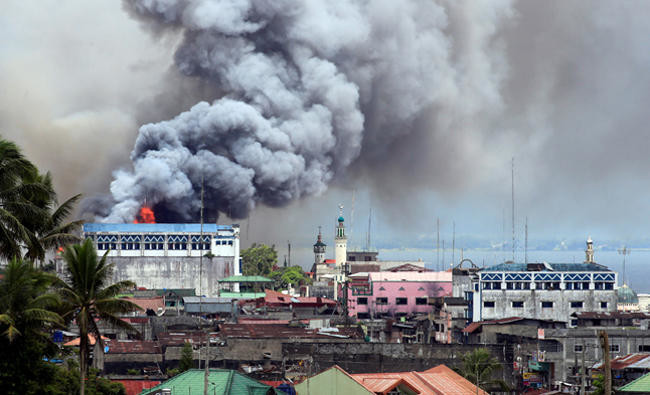
Black smoke comes from a burning building in a commercial area of Osmena street in Marawi city, Philippines, in this file photo. The Philippine military on Wednesday said troops have recovered 22 bodies believed to be of Daesh-linked militants in Marawi. (REUTERS/Romeo Ranoco)
Updated 12 October 2017
Follow

Troops recover bodies of 22 ‘militants’ in Marawi

MANILA: The Philippine military announced on Wednesday that it has recovered the bodies of 22 suspected Maute militants in the war-torn city of Marawi on the island of Mindanao.
Maj. Gen. Restituto Padilla, spokesman for the Armed Forces of the Philippines (AFP), told Arab News it is “probable” that one of those dead was one of the leaders of the Daesh-inspired Muslim extremist group.
The crisis in the Philippines’ only Muslim city has left over 1,000 dead in clashes between government troops and the group. After 142 days, the death toll includes 802 militants, 160 government troops and policemen, and 47 civilians, according to the military.
Padilla stressed that the military remained focused in its mission to liberate the city completely from the clutches of the Maute group.
The 22 corpses were recovered following a heavy firefight on Tuesday as the army attacked a terrorist base of two buildings, Padilla said. Eighteen bodies were recovered from one of the buildings and four from the other.
“The assault paved the way for the police’s forensic experts to come in. They will conduct DNA tests on the recovered bodies,” Padilla explained. Those tests will enable Philippine National Police (PNP) scenes of crime officers (SOCOs) to establish the identities of the dead, and to confirm if one of the Maute group’s leaders is indeed among them.
When asked what made the military conclude that the remains belonged to militants, Padilla said the buildings from which the bodies were recovered were the scene of “heavy resistance” from Maute fighters in a battle that “went on for a number of days.”
Aside from the 22 bodies, Padilla said the troops also recovered eight high-powered firearms, including two RPGs, four M16s, one M4, and one M14, along with “dozens and dozens” of improvised explosive devices (IEDs).
“This must be the place where the rebels have been manufacturing the IEDs that have been used in the remaining areas of enemy-held territory,” Padilla explained.
Asked about Isnilon Hapilon, leader of Daesh in the Philippines, and Omar Maute, co-founder of the Dawlah Islamiyah group in Mindanao (commonly known as the Maute group), the AFP spokesman said they are still in the area, citing testimonies from rescued hostages.
Padilla also said the area controlled by the Maute group has now shrunk to five hectares or less, while the number of buildings that the military still need to clear is down to approximately 150.
He said the AFP believe that around 40 Maute fighters are still in the area but added that the military is “not giving any categorical statement on the deadline” for an end to the fighting.
Padilla stressed that the armed forces are doing everything possible to end the crisis so that efforts to rebuild the city can start. However, he noted: “The battle is still ongoing. Our troops are focused and determined to finish it as soon as possible, but they have to take into consideration the remaining hostages, who include a number of children.”


Old Delhi iftars revive Mughal heritage, one course at a time

Updated 4 sec ago
Follow

Old Delhi iftars revive Mughal heritage, one course at a time

  • Dastarkhwan-e-Jahaanuma iftars have been held in Old Delhi since 2017
  • Muslim and non-Muslim participants arrive from across India and abroad

NEW DELHI: On a rooftop in Delhi’s historic walled city, guests from across India sit on cushions around a low table overlooking Jama Masjid, waiting for its sunset call to prayer — the signal to start a special iftar that will take them back four centuries, to the Mughal era, if only for a while.

Mughals ruled the Indian subcontinent between the 16th and 19th centuries. Originally from Central Asia, they carried traditions borrowed from Arabs, Persians and Ottomans, which they merged with the various local Indian styles — a fusion that marked the global revival of Islamic architecture and culture.

Jama Masjid is one of the most iconic examples of the Mughal style — a scenic background to the curated iftars that bring 40 to 50 people from across India to share a meal, knowledge and experience.

“People getting together from different walks of life, different parts of the country, different religions, different cultures coming together — it was absolutely and completely amazing,” said Arvind Sirohi, who took part in the event with his wife.

“Lovely storytelling, amazing food, and end of the day, right next to Jama Masjid in Old Delhi. The ambience, the environment, the atmosphere came together so beautifully.”

The community-led iftar experience is called Dastarkhwan-e-Jahaanuma — from Urdu words meaning a “spread of food” and “showing the world.”

For Veena Sirohi, it did exactly what the name promised by bringing together people from different communities, different parts of India, and abroad.

“I think that’s a great way of synthesizing different cultures, bringing people together, bringing the human aspect of what we all are ... we are actually all one,” she told Arab News.

“And we had some wonderful comperes who told us about … the history of Ramadan, what goes behind it, how the food is curated, and how each and every item has a specific place in the menu.”

Served in gilded bowls and plates from traditional Indian crockery, with rose petals dotting the dastarkhwan cloth, the dishes were some of the festive Ramadan delicacies, offering a taste of Mughal culinary heritage.

Among them was mutanjan, or fragrant rice cooked with ghee, sugar, saffron, cardamom, and studded with nuts, which for many Indian Muslims is traditionally the first dish to break the fast.

It was followed by shabde, a rich, slow-cooked aromatic meat stew or the Delhi biryani — a fragrant, mildly spiced saffron rice and meat dish, where marinated chicken or mutton is layered with basmati rice and cooked slowly.

The hearty feast closed with nihari, a hearty stew simmered overnight with spices and bone marrow, which emerged in the 18th century and was originally eaten by Mughal royals for breakfast.

“These are the traditional dishes which are not usually available in the market, but are specially prepared by the bawarchees (cooks) of Old Delhi. Some of the dishes are occasional dishes,” said Abu Sufiyan Khan, the founder of Tales of City, the cultural experience company that has been curating Dastarkhwan-e-Jahaanuma since 2017.

The special iftars are hosted once a week throughout the fasting month, usually on weekends. There are variations in dishes served as they come from different kitchens, as Tales of City collaborates with various local artisans and cooks.

“We are curating this with different experts and every time the menu changes,” Khan said.

“We bring all these dishes onto a single dastarkhwan, and we share this meal with the people coming from all over India to break bread together in the holy month of Ramadan, know each other, learn about each other’s culture, and create a dialogue space where we can have more meaningful conversations and an opportunity to get to know each other.”

Those who take part, like Ayandrali Dutta, a food critic, appreciate everything about the experience, especially as it takes place in Old Delhi, where the vibe is always “jovial, lively, in all positive ways” during Ramadan.

“You get to meet interesting people, you get to hear interesting stories ... It’s a great initiative to show what Ramadan is, what kind of food is eaten, talk about the cultures between Lucknow and Delhi and other parts of the country. And it just brings a lot of happiness,” she said.

“I loved it. My heart is happy, my belly is full. Nothing else I can ask for.”