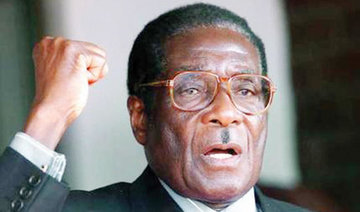
HARARE: Zimbabwean President Robert Mugabe’s cabinet reshuffle quashed opposition within his government, state media said Tuesday, as the 93-year-old leader prepares to stand again in elections next year.
Mugabe stripped Vice President Emmerson Mnangagwa of his role as justice minister, reassigned the finance minister and created a new cyber-security ministry in the major reshuffle late Monday.
Mnangagwa is one of the top candidates likely to succeed Mugabe, but has recently been accused by undermining the president over claims that Mnangagwa was poisoned at a party rally.
The state-run Herald — seen as the government’s official voice — on Tuesday hailed the reshuffle as “a welcome move that would send a reverberating message that the president is fully in control.”
“Ministers to the new cabinet should also ensure that their loyalty is solely to their appointing authority, who is none other than President Mugabe. They should subordinate themselves to him,” it said.
The paper castigated ministers for “squabbling” as in-fighting intensifies between rivals competing to succeed Mugabe, who has ruled since 1980 and is in increasingly frail health.
Mnangagwa’s main opposition for the presidency comes from the “G-40” group led by Mugabe’s wife Grace.
“This is a Grace Mugabe reshuffle. It’s part of the succession plan and aimed at discrediting and emasculating Mnangagwa,” Takavafira Zhou, a political analyst from Masvingo State University, told AFP.
“The reshuffle deflates Mnangagwa’s plans. Mugabe has demoted those who associated with him.”
Mnangagwa — widely known as “the crocodile” — was hospitalized in Johannesburg in August saying he had been poisoned.
His supporters allege he was struck down by ice cream made on a farm owned by first lady Grace Mugabe, who last week publicly denied poisoning him.
“The reshuffle is to deal with the factional and succession politics within the ruling ZANU-PF party,” Bulawayo-based analyst Dumisani Mpofu told AFP.
“Mugabe has also created the cyber-security ministry as an attempt to clamp down on social media movements that pose a big threat to his regime ahead of the election.”
Mugabe has already been named by ZANU-PF as its presidential candidate for the 2018 poll.

Mugabe reshuffle cracks down on dissent
Pakistan combing for perpetrators after deadly separatist attacks
- Around a dozen sites where the attacks took place — including the provincial capital Quetta — remained sealed off
- The Baloch Liberation Army, the province’s most active militant separatist group, claimed responsibility for the attacks
QUETTA, Pakistan: Pakistan forces were hunting on Sunday for the separatists behind a string of coordinated attacks in restive Balochistan province, with the government vowing to retaliate after more than 120 people were killed.
Around a dozen sites where the attacks took place — including the provincial capital Quetta — remained sealed off, with troops combing the area a day after militants stormed banks, jails and military installations, killing at least 18 civilians and 15 security personnel, according to the military’s count.
At least 92 militants were also killed, the military added, while an official said that a deputy district commissioner had been abducted.
Mobile Internet service across the province has been jammed for more than 24 hours, while road traffic is disrupted and train services suspended.
After being rocked by explosions, typically bustling Quetta lay quiet on Sunday, with major roads and businesses deserted, and people staying indoors out of fear.
Shattered metal fragments and mangled vehicles litter some roads.
“Anyone who leaves home has no certainty of returning safe and sound. There is constant fear over whether they will come back unharmed,” Hamdullah, a 39-year-old shopkeeper who goes by one name, said in Quetta.
The Pakistan military said it was conducting “sanitization operations” in the areas that had been targeted in Saturday’s attacks.
“The instigators, perpetrators, facilitators and abettors of these heinous and cowardly act... will be brought to justice,” it said in a statement Saturday night.
The Baloch Liberation Army (BLA), the province’s most active militant separatist group, claimed responsibility for the attacks in a statement sent to AFP.
The group said it had targeted military installations as well as police and civil administration officials in gun attacks and suicide bombings.
Saturday’s attacks came a day after the military said it killed 41 insurgents in two separate operations in the province.
Pakistan has been battling a Baloch separatist insurgency for decades, with frequent armed attacks on security forces, foreign nationals and non-local Pakistanis in the mineral-rich province bordering Afghanistan and Iran.
Pakistan’s poorest province despite an abundance of untapped natural resources, Balochistan lags behind the rest of the country in almost every index, including education, employment and economic development.
Baloch separatists have intensified attacks on Pakistanis from other provinces working in the region in recent years, as well as foreign energy firms that they believe are exploiting its riches.
The separatists attacked a train with 450 passengers on board last year, sparking a two-day siege during which dozens of people were killed.
Around a dozen sites where the attacks took place — including the provincial capital Quetta — remained sealed off, with troops combing the area a day after militants stormed banks, jails and military installations, killing at least 18 civilians and 15 security personnel, according to the military’s count.
At least 92 militants were also killed, the military added, while an official said that a deputy district commissioner had been abducted.
Mobile Internet service across the province has been jammed for more than 24 hours, while road traffic is disrupted and train services suspended.
After being rocked by explosions, typically bustling Quetta lay quiet on Sunday, with major roads and businesses deserted, and people staying indoors out of fear.
Shattered metal fragments and mangled vehicles litter some roads.
“Anyone who leaves home has no certainty of returning safe and sound. There is constant fear over whether they will come back unharmed,” Hamdullah, a 39-year-old shopkeeper who goes by one name, said in Quetta.
The Pakistan military said it was conducting “sanitization operations” in the areas that had been targeted in Saturday’s attacks.
“The instigators, perpetrators, facilitators and abettors of these heinous and cowardly act... will be brought to justice,” it said in a statement Saturday night.
The Baloch Liberation Army (BLA), the province’s most active militant separatist group, claimed responsibility for the attacks in a statement sent to AFP.
The group said it had targeted military installations as well as police and civil administration officials in gun attacks and suicide bombings.
Saturday’s attacks came a day after the military said it killed 41 insurgents in two separate operations in the province.
Pakistan has been battling a Baloch separatist insurgency for decades, with frequent armed attacks on security forces, foreign nationals and non-local Pakistanis in the mineral-rich province bordering Afghanistan and Iran.
Pakistan’s poorest province despite an abundance of untapped natural resources, Balochistan lags behind the rest of the country in almost every index, including education, employment and economic development.
Baloch separatists have intensified attacks on Pakistanis from other provinces working in the region in recent years, as well as foreign energy firms that they believe are exploiting its riches.
The separatists attacked a train with 450 passengers on board last year, sparking a two-day siege during which dozens of people were killed.
© 2026 SAUDI RESEARCH & PUBLISHING COMPANY, All Rights Reserved And subject to Terms of Use Agreement.


