Qatar must shun ‘extremism’ to host World Cup, says Gargash

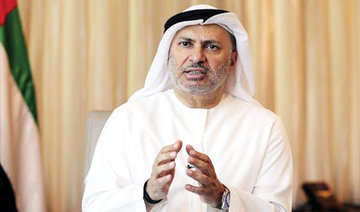
Anwar Gargash, UAE minister of state for foreign affairs.
Updated 10 October 2017
Follow

Qatar must shun ‘extremism’ to host World Cup, says Gargash

DUBAI: Anwar Gargash, the UAE’s minister of state for foreign affairs, said Qatar’s hosting of the 2022 World Cup should depend on it rejecting “extremism and terrorism.”
The Anti-Terror Quartet (ATQ) — comprising Saudi Arabia, Bahrain, Egypt and the UAE — severed diplomatic, trade and travel ties with Qatar in June, accusing it of sponsoring extremist groups.
“Qatar’s hosting of World Cup 2022 should include a repudiation of policies supporting extremism and terrorism. Doha should review its record,” Anwar Gargash, UAE minister of state for foreign affairs, wrote on Twitter.
“Hosting World Cup 2022 should not be tainted by support of extremist individuals and (organizations)/terrorist figures, review of Qatar’s policies a must,” he added.
The World Cup is the centerpiece of a carefully crafted strategy to project Qatar onto the global stage via sport. In the run-up, Qatar is scheduled to host events across different sports aimed at improving infrastructure and expertise.
Egypt is the top-ranked soccer team in Africa, and Saudi Arabia and the UAE are both in Asia’s top eight.
Last month officials from the ATQ did not turn up to the draw for a Middle East soccer tournament in Doha and said they wanted to postpone the competition that could be an early test for the World Cup hosts.
Qatari officials could not be immediately reached for comment on Gargash’s remarks.
Qatar has previously said that the rift has not affected its preparations to host the tournament and that alternative sources for construction materials had been secured.
Soccer’s governing body FIFA has said it has been in regular contact with Qatar since the row erupted.
Gargash made his comments after a former Dubai police chief wrote on Twitter this week that the Gulf crisis could end if Doha forfeited hosting the World Cup.
Gargash said the official, Dhahi Khalfan, had been misunderstood in media coverage.


As US weighs its options with Tehran, the region awaits with anticipation

Updated 6 sec ago
Follow

As US weighs its options with Tehran, the region awaits with anticipation

  • Saudi sources deny any attempts to influence position in Washington, DC

RIYADH: The US is continuing to weigh its options toward Iran as the aircraft carrier USS Abraham Lincoln heads toward the Middle East, amid heightened tensions and widespread protests across the Islamic Republic.

The deployment, reported since late Friday, comes as Washington reiterates that all options remain on the table in its approach to Tehran, which it considers a major regional foe, with Iran’s handling of the protests as a key factor in their ongoing deliberations.

Saudi officials have rejected claims that Riyadh is attempting to influence decision-making in Washington.

A senior Saudi official at the Kingdom’s embassy in the US said that reports suggesting Saudi Arabia had advised the US against striking Iran “are not true.”

Earlier this week, Saudi Minister of State for Foreign Affairs Adel Al-Jubeir was asked about the unrest in Iran and the prospect of a US response during a major business conference in Riyadh.

While stopping short of offering a direct view on potential military action, Al-Jubeir said that “everybody is watching the situation very closely,” expressing hope that tensions could be resolved in a way that would “minimize any kind of damage.”

Saudi commentator Ali Shihabi also denied that Riyadh was lobbying either for or against a strike on Iran. Writing on X, he said: “Saudi Arabia did not get involved in this discussion one way or the other.”

In a separate commentary published in the Saudi daily Asharq Al-Awsat, columnist Abdulrahman Al-Rashed hinted that Iran itself now holds the key to avoiding further escalation.

“Ending the nuclear program and stopping external activity could spare Iran foreign intervention that enables internal change by exploiting widespread domestic unrest,” he argued.

Al-Rashed described the current moment as unprecedented for the Islamic Republic.

“The Iranian regime is facing an existential crisis for the first time since the founder of the Islamic Republic returned to Tehran,” he said.

“There is only one actor capable of preventing its descent, and possibly its collapse, and it is neither Washington, nor Israel, nor the Gulf states. The only party capable of saving the Iranian regime from its fate is the regime itself.”

“This time, the threats against it have converged, and together they are capable of bringing it down. Danger surrounds it both internally and externally,” he concluded.