Photographer killed in Mexico as journalist death toll nears record

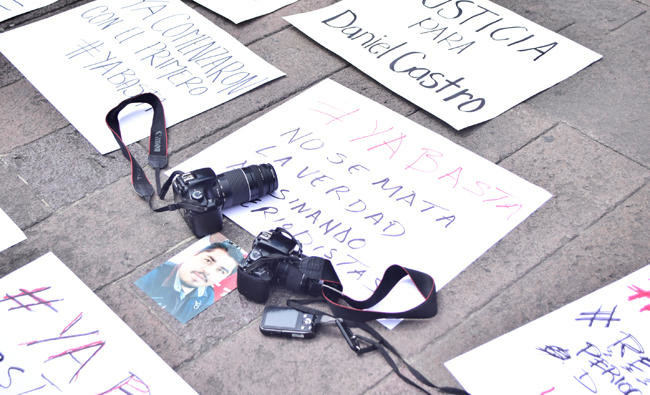
Cameras are placed over a placard reading "You don't kill the truth killing journalists" during a protest following the murder of photojournalist Daniel Esqueda outside the Municipal Palace in San Luis Potosi, Mexico, on Friday. (REUTERS)
Updated 07 October 2017
Follow

Photographer killed in Mexico as journalist death toll nears record

MEXICO CITY: The bullet-riddled body of a news photographer was found in central Mexico on Friday, state officials, putting 2017 on track to become the deadliest year yet for journalists in the notoriously violent country.
Edgar Daniel Esqueda, 23, who worked with Metropoli San Luis and Vox Populi SLP in the state of San Luis Potosi, was found in the state capital with at least three bullet wounds in the back of his neck, authorities said.
The news outlets where Esqueda worked reported had reported his abduction from his home by gunmen on Thursday morning.
San Luis Potosi’s governor, Manuel Carreras, told a press conference an investigation was underway. He did not say whether Esqueda’s murder was linked to his work as a journalist.
With Esqueda’s killing, 2017 could become the bloodiest year yet for reporters in Mexico, according to press freedom and journalists’ advocacy group Articulo 19.
The photo journalist was the 11th reporter killed so far this year, the group said. That matched the total in 2016, which was the highest number on record in a country torn by runaway levels of criminal and drug-related bloodletting.
Over the past 17 years, 111 journalists have been killed in Mexico, 38 of them under the current government of President Enrique Pena Nieto.
Reporters Without Borders and the Committee for the Protection of Journalists (CPJ) both rank Mexico among the deadliest countries in the world for reporters.
Activists have repeatedly criticized Mexican prosecutors for failing to fully investigate many journalists’ murders, allowing the killers to operate with impunity.
Mexico’s human rights commission has asked state authorities to provide protection for Esqueda’s family members, who were at home with the photographer when he was taken by force, according to Articulo 19.
Witnesses who spoke with the group said Esqueda asked his kidnappers for their identity when they broke into the home where he was asleep with his wife, and they responded that they were police officers.
The state police force said via Twitter that “there has not been any police action against a reporter in the capital.”
“Criminals, sometimes connected with state actors, know that they can get away with killing journalists in Mexico because of chronic impunity for these crimes. Until that changes, the violence will continue,” Alexandra Ellerbeck, the CPJ’s program coordinator for North America, said in a statement.
Esqueda had reported threats months ago to a government-run human rights group in San Luis Potosi, one of his colleagues told Reuters.


Pakistani fighter jet crashes in Jalalabad, pilot captured: Afghan military, police

Updated 28 February 2026
Follow

Pakistani fighter jet crashes in Jalalabad, pilot captured: Afghan military, police

  • Fighting between Pakistan and Afghanistan’s Taliban military entered its third day on Saturday
  • Pakistan’s strikes on Friday hit Taliban military installations and posts, including in Kabul and Kandahar

JALALABAD: A Pakistani jet has crashed in Jalalabad city and the pilot captured alive, the Afghan military and police said Saturday, with residents telling AFP the man parachuted from the plane before being detained.
"A Pakistani fighter jet was shot down in the sixth district of Jalalabad city, and its pilot was captured alive," police spokesman Tayeb Hammad said.
Wahidullah Mohammadi, spokesman for the military in eastern Afghanistan, confirmed the Pakistani jet was downed by Afghan forces "and the pilot was captured alive".

The AFP journalist heard a jet overhead before blasts from the direction of the airport in Jalalabad, the capital of Nangarhar province, which sits on the road between Kabul and the Pakistani border.

Fighting between Pakistan and Afghanistan’s Taliban military entered its third day on Saturday, following overnight clashes as the international community expressed increasing concern about the conflict and called for urgent talks.

Pakistan’s strikes on Friday hit Taliban military installations and posts, including in Kabul and Kandahar, in one of the deepest Pakistani incursions into its western neighbor in years, officials said.

Islamabad accuses the Taliban of harboring Tehreek-e-Taliban Pakistan (TTP) militants, who it claims are waging an insurgency inside Pakistan, a charge the Taliban denies.

Pakistan described its actions as a response to cross-border assaults, while Kabul denounced them as a breach of its sovereignty, saying it remained open to dialogue but warned any wider conflict would result in serious consequences.

The fighting has raised ‌the risk ‌of a protracted conflict along the rugged 2,600-kilometer frontier.

Diplomatic efforts gathered ‌pace ⁠late on Friday ⁠as Afghanistan said its foreign minister, Amir Khan Muttaqi, spoke by telephone with Saudi Arabia’s Prince Faisal bin Farhan about reducing tensions and keeping diplomatic channels open.

The European Union called for both sides to de-escalate and engage in dialogue, while the United Nations urged an immediate end to hostilities.

Russia urged both sides to halt the clashes and return to talks, while China said it was deeply concerned and ready to help ease tensions.

The United States supports Pakistan’s right to defend itself against attacks by ⁠the Taliban, a State Department spokesperson said.

Border fighting continues

Exchanges of fire continued along ‌the border overnight.

Pakistani security sources said an operation dubbed “Ghazab Lil Haq” was ongoing and that Pakistani forces had destroyed multiple Taliban posts and camps in several sectors. Reuters could not independently verify the claims.

Both sides have reported heavy losses with conflicting tolls that Reuters could not verify. Pakistan said 12 of its ‌soldiers and 274 Taliban were killed while the Taliban said 13 of its fighters and 55 Pakistani soldiers died.

Taliban deputy spokesman Hamdullah Fitrat ⁠said 19 civilians were ⁠killed and 26 wounded in Khost and Paktika. Reuters could not verify the claim.

Pakistan’s Defense Minister Khawaja Muhammad Asif said “our cup of patience has overflowed” and described the fighting as “open war,” warning that Pakistan would respond to further attacks.

Taliban Interior Minister Sirajuddin Haqqani said in a speech in Khost province that the conflict “will be very costly,” and that Afghan forces had not deployed broadly beyond those already engaged.

He said the Taliban had defeated “the world, not through technology, but through unity and solidarity,” and through “great patience and perseverance,” rather than superior military power.

Pakistan’s military capabilities far exceed those of Afghanistan, with a standing army of hundreds of thousands and a modern air force.

In stark contrast, the Taliban lacks a conventional air force and relies largely on light weaponry and ground forces.

However, the Islamist group is battle-hardened after two decades of insurgency against US-led forces before returning to power in 2021.