OSLO: Nuclear disarmament group ICAN won the Nobel Peace Prize on Friday for its decade-long campaign to rid the world of the atomic bomb as nuclear-fueled crises swirl over North Korea and Iran.
More than 70 years since atomic bombs were used on the Japanese cities of Hiroshima and Nagasaki, the Nobel committee sought to highlight ICAN’s tireless non-proliferation efforts.
The decision sent a strong message to nuclear-armed nations at a time when US President Donald Trump has threatened to tear up a 2015 deal curbing Iran’s nuclear abilities and who last month alarmed delegates at the UN General Assembly by warning he may be forced to “totally destroy” North Korea over Pyongyang’s atomic weapons program.
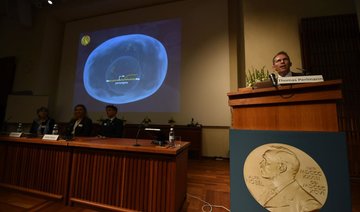
ICAN “is receiving the award for its work to draw attention to the catastrophic humanitarian consequences of any use of nuclear weapons and for its ground-breaking efforts to achieve a treaty-based prohibition of such weapons,” said Norwegian Nobel committee president Berit Reiss-Andersen in announcing the prize in Oslo.
“We live in a world where the risk of nuclear weapons being used is greater than it has been for a long time,” she said.
But she stressed that the committee’s decision wasn’t aimed at any particular world leader, adding: “We’re not kicking anyone’s leg with this prize.”
Founded in Vienna in 2007 on the fringes of an international conference on the nuclear non-proliferation treaty, ICAN (the International Coalition to Abolish Nuclear Weapons) has mobilized campaigners and celebrities alike in its cause.
It was a key player in the adoption of a historic nuclear weapons ban treaty, signed at the UN by 122 countries in July.
However, the accord was largely symbolic as none of the nine known world nuclear powers put their names down. It still needs to be ratified before entering into force.
ICAN, a coalition of hundreds of NGOs, says its main objective is the adoption of an international treaty banning nuclear weapons, along the lines of earlier agreements forbidding the use of biological and chemical weapons, land mines and cluster munitions.
Reacting to its win, ICAN said the “moment is now” to push for a total nuclear arms ban.
“This prize is a tribute to the tireless efforts of many millions of campaigners and concerned citizens worldwide who... have loudly protested nuclear weapons, insisting that they can serve no legitimate purpose and must be forever banished from the face of our earth,” it said in a statement.
ICAN’s high-profile supporters include form UN Secretary-General Ban Ki-moon, Nobel laureate Desmond Tutu and the Dalai Lama.
Although global atomic weapons stockpiles have plummeted — from around 64,000 warheads in 1986 at the height of the Cold War to more than 9,000 in 2017 according to the Bulletin of Atomic Scientists — the number of nuclear-armed nations has grown.
Friday’s award — the climax to a week of prize-giving honoring the world’s leading lights in the fields of physics, chemistry, medicine and literature — comes as Iran’s nuclear deal is under increasing pressure from Trump.
The US leader has threatened to bin the agreement altogether, saying Tehran is developing missiles that may be used to deliver a nuclear warhead when the deal’s restrictions are lifted in 2025.
Tensions have also soared between the US and North Korea, which has test-fired two missiles over Japan and conducted a string of apparent underground nuclear tests this year.
“This is a time of great global tension, when fiery rhetoric could all too easily lead us, inexorably, to unspeakable horror,” ICAN said.
The UN welcomed ICAN’s win on Friday, with spokeswoman Alessandra Vellucci telling reporters in Geneva that the prize was a “good omen” for the ratification of a nuclear ban treaty.
EU foreign affairs chief Federica Mogherini also congratulated ICAN, tweeting: “We share a strong commitment to achieving the objective of a world free from nuclear weapons.”
The Nobel committee has rewarded anti-nuclear weapons drives on several previous occasions, handing out the prestigious prize to Soviet dissident Andrei Sakharov in 1975, the international non-proliferation IPPNW group in 1985, and the IAEA’s then head Mohamed ElBaradei 20 years later.
More than 300 people and organizations were thought to have been nominated for this year’s Peace Prize, including the UN’s refugee agency UNHCR, Syria’s White Helmets rescue service and Congolese doctor Denis Mukwege.
The Peace Prize, which comes with a gold medal and a cheque for nine million Swedish kronor (943,000 euros, $1.1 million) will be presented in Oslo on December 10, the anniversary of the death of its founder, Swedish philanthropist and dynamite inventor Alfred Nobel.