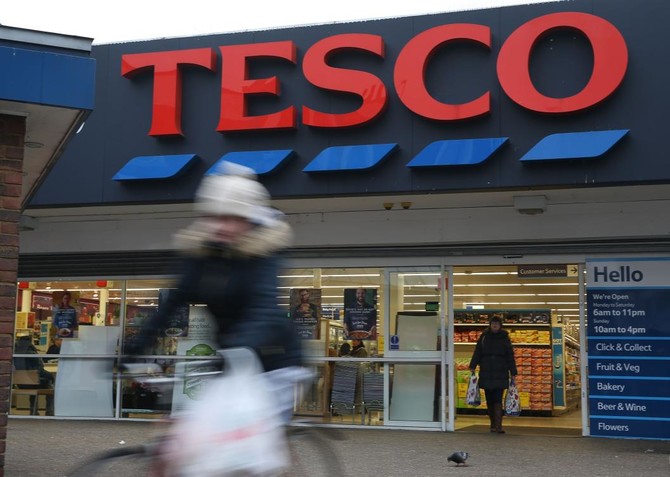
LONDON: Britain’s biggest retailer Tesco said it would pay a dividend for the first time in three years, signalling further progress in its recovery from crisis under CEO Dave Lewis.
The supermarket group also reported a 27 percent rise in first half profit and a seventh straight quarter of underlying sales growth in its home market as it successfully navigated an inflationary environment.
However, after an initial rise Tesco’s shares were flat by mid-morning and are down 8 percent so far this year reflecting lingering concerns over the merits of its £3.7 billion ($4.90 billion) agreed bid for wholesaler Booker and a need to increase contributions to cut its pension deficit.
Lewis has been leading the fightback after Tesco’s sales and profit were hammered by changing shopping habits, the rise of the German discounters Aldi and Lidl and a 2014 accounting scandal which plunged the firm into its worst crisis in its near 100-year history.
Lewis, who joined just before the scandal was uncovered, said paying the 1 pence interim dividend was a key moment.
“It’s a significant milestone in the recovery of the business and one which demonstrates the confidence we and the board have in our plans,” he told reporters.
Fund manager Ed Meier at Old Mutual Global Investors, a top-40 investor, according to Thomson Reuters data, said he expected a 3 pence dividend for the full year.
“While we anticipated this return to the dividend list, we still consider this a strong indication from the company that it is indeed on track for a full recovery.”
Lewis first stabilized Tesco then got it growing again with a focus on more competative prices, new and streamlined product ranges, better customer service and improved supplier relationships.
Tesco remains the largest of Britain’s supermarket groups by a clear margin, having a market share of almost 28 percent according to the latest industry figures.
By purchasing a tighter range of goods and working more closely with its suppliers, Tesco is able to exploit its huge buying scale.
It made operating profit before one off items of £759 million ($1.01 billion) for the six months to Aug. 26 — ahead of analysts’ forecasts and £596 million in the same period last year. Sales increased 3.3 percent to £25.2 billion.
UK like-for-like sales rose 2.1 percent in the second quarter, reflecting strong fresh food volume growth. That was, however, a slight slowdown from growth of 2.3 percent in the first quarter.
“Sales are up, profits are up, cash generation continues to strengthen and net debt levels are less than half what they were when we started our turnaround three years ago,” Lewis said.
Net debt was down 25 percent year-on-year to £3.3 billion.
Tesco said its pension deficit had reduced to £2.4 billion but it would still increase annual contributions by £15 million to £285 million from April 2018.
Despite its progress, the discounters remain a major threat to Tesco and its traditional rivals. Aldi said last week it was pressing on with its aggressive expansion in Britain despite a third straight year of falling profits.

Tesco’s first dividend since 2014 crisis cements recovery
Australia Day protesters demand Indigenous rights
SYDNEY: Thousands of people rallied in cities across Australia demanding justice and rights for Indigenous peoples on Monday, a national holiday marking the 1788 arrival of a British fleet in Sydney Harbor.
Crowds took to the streets in Sydney, Melbourne, Canberra, Perth and other cities on Australia Day, many with banners proclaiming: “Always was, always will be Aboriginal land.”
In Sydney, police allowed the protests to go ahead despite new curbs introduced after gunmen opened fire on a Jewish Hanukkah festival on Bondi Beach on December 14, killing 15 people.
Millions of Australians celebrate the annual holiday with beers and backyard barbecues or a day by the sea, and this year a broad heatwave was forecast to push the temperature in South Australian capital Adelaide to 45C.
Shark sightings forced people out of the water at several beaches in and around Sydney, however, after a string of shark attacks in the region this month — including one that led to the death of a 12-year-old boy.
Many activists describe the January 26, 1788, British landing as “Invasion Day,” a moment that ushered in a period of oppression, lost lands, massacres and Indigenous children being removed from their families.
Aboriginal and Torres Strait Islander peoples make up about four percent of the population.
They still have a life expectancy eight years shorter than other Australians, higher rates of incarceration and deaths in custody, steeper youth unemployment and poorer education.
- Anti-immigration protests -
“Let’s celebrate on another day, because everyone loves this country and everyone wants to celebrate. But we don’t celebrate on a mourning day,” Indigenous man Kody Bardy, 44, told AFP in Sydney.
Another Indigenous protester in Sydney, 23-year-old Reeyah Dinah Lotoanie, called for people to recognize that a genocide happened in Australia.
“Ships still came to Sydney and decided to kill so many of our people,” she said.
Separately, thousands of people joined anti-immigration “March for Australia” protests in several cities, with police in Melbourne mobilizing to keep the two demonstrations apart.
In Sydney, “March for Australia” protesters chanted, “Send them back.” Some carried banners reading: “Stop importing terrorists” or “One flag, one country, one people.”
“There’s nowhere for people to live now, the hospitals are full, the roads are full, you’ve got people living on the streets,” said one demonstrator, 66-year-old Rick Conners.
Several also held aloft placards calling for the release of high-profile neo-Nazi Joel Davis, who is in custody after being arrested in November on allegations of threatening a federal lawmaker.
“There will be no tolerance for violence or hate speech on Sydney streets,” New South Wales Premier Chris Minns told reporters.
“We live in a beautiful, multicultural community with people from around the world, but we will not tolerate a situation where on Australia’s national day, it’s being pulled down by divisive language, hate speech or racism,” he said.
“Police are ready and willing to engage with people that breach those rules.”
Crowds took to the streets in Sydney, Melbourne, Canberra, Perth and other cities on Australia Day, many with banners proclaiming: “Always was, always will be Aboriginal land.”
In Sydney, police allowed the protests to go ahead despite new curbs introduced after gunmen opened fire on a Jewish Hanukkah festival on Bondi Beach on December 14, killing 15 people.
Millions of Australians celebrate the annual holiday with beers and backyard barbecues or a day by the sea, and this year a broad heatwave was forecast to push the temperature in South Australian capital Adelaide to 45C.
Shark sightings forced people out of the water at several beaches in and around Sydney, however, after a string of shark attacks in the region this month — including one that led to the death of a 12-year-old boy.
Many activists describe the January 26, 1788, British landing as “Invasion Day,” a moment that ushered in a period of oppression, lost lands, massacres and Indigenous children being removed from their families.
Aboriginal and Torres Strait Islander peoples make up about four percent of the population.
They still have a life expectancy eight years shorter than other Australians, higher rates of incarceration and deaths in custody, steeper youth unemployment and poorer education.
- Anti-immigration protests -
“Let’s celebrate on another day, because everyone loves this country and everyone wants to celebrate. But we don’t celebrate on a mourning day,” Indigenous man Kody Bardy, 44, told AFP in Sydney.
Another Indigenous protester in Sydney, 23-year-old Reeyah Dinah Lotoanie, called for people to recognize that a genocide happened in Australia.
“Ships still came to Sydney and decided to kill so many of our people,” she said.
Separately, thousands of people joined anti-immigration “March for Australia” protests in several cities, with police in Melbourne mobilizing to keep the two demonstrations apart.
In Sydney, “March for Australia” protesters chanted, “Send them back.” Some carried banners reading: “Stop importing terrorists” or “One flag, one country, one people.”
“There’s nowhere for people to live now, the hospitals are full, the roads are full, you’ve got people living on the streets,” said one demonstrator, 66-year-old Rick Conners.
Several also held aloft placards calling for the release of high-profile neo-Nazi Joel Davis, who is in custody after being arrested in November on allegations of threatening a federal lawmaker.
“There will be no tolerance for violence or hate speech on Sydney streets,” New South Wales Premier Chris Minns told reporters.
“We live in a beautiful, multicultural community with people from around the world, but we will not tolerate a situation where on Australia’s national day, it’s being pulled down by divisive language, hate speech or racism,” he said.
“Police are ready and willing to engage with people that breach those rules.”
© 2026 SAUDI RESEARCH & PUBLISHING COMPANY, All Rights Reserved And subject to Terms of Use Agreement.