Solar drives rise in global renewable energy forecast

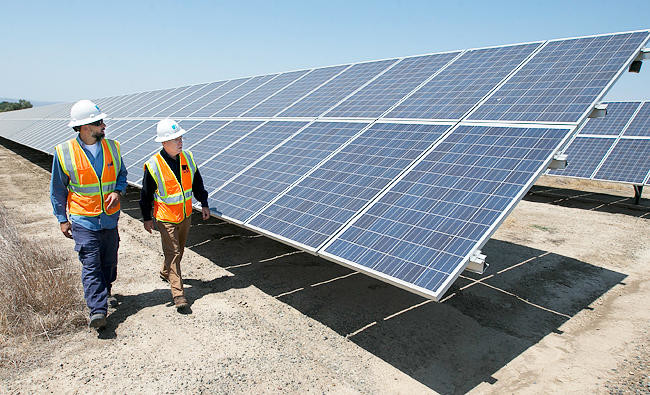
In this Aug. 17, 2017 photo, solar tech Joshua Valdez, left, and senior plant manager Tim Wisdom walk past solar panels at a Pacific Gas and Electric Solar Plant, in Dixon, Calif. (AP)
Updated 04 October 2017
Follow

Solar drives rise in global renewable energy forecast

LONDON: The International Energy Agency (IEA) has raised its forecasts for renewable energy over the next five years following a record 2016, mainly driven by a surge in solar photovoltaic (PV) capacity in China, India and the US.
In its medium-term renewables market report, the IEA expects global renewable electricity capacity to rise by more than 920 gigawatts, or 43 percent, by 2022, due to supportive policies for low-carbon energy and cost reductions for solar PV and wind.
The projected growth is 12 percent more bullish than the IEA’s forecast last year.
In 2016, net additions to renewable energy capacity — including hydropower, solar, wind, bioenergy, wave and tidal — set another world record, growing by 165 gigawatts (GW), 6 percent more than in 2015, the report said.
Solar PV capacity grew by 50 percent to reach more than 74 GW last year and it was the first time solar PV additions rose faster than any other fuel, surpassing the net growth in coal.
“We see renewables growing by about 1,000 GW by 2022, which equals about half of the current global capacity in coal power, which took 80 years to build,” Fatih Birol, the IEA’s executive director, said in a statement.
“What we are witnessing is the birth of a new era in solar PV. We expect that solar PV capacity growth will be higher than any other renewable technology through 2022,” Birol added.
The Paris-based IEA, the West’s leading energy forecaster, had been criticized by environment campaigners in previous years for underestimating the growth of renewables and over-emphasizing the continued role of fossil fuels.
The agency sees renewable power generation rising by more than a third to 8,169 terawatt-hours (TWh) in 2022 — from around 6,012 TWh in 2016 — which is equivalent to the combined electricity consumption of China, India and Germany.
Renewables will account for 29 percent of the global energy mix in five years’ time, compared to the 24 percent forecast last year.
“While coal remains the largest source of electricity generation in 2022, renewables close in on its lead. In 2016, renewable generation was 34 percent less than coal but by 2022 this gap will be halved to just 17 percent,” the report said.
China will be responsible for the largest amount of global renewable capacity growth, driven by strong government targets, economic incentives and air pollution concerns.
Despite policy uncertainty, the US will remain the second-largest renewables growth market, mainly due to tax incentives and state-level policies for solar PV, the IEA said.
India’s renewable electricity growth could surpass the European Union’s by 2022 for it to become the joint second-largest growth market alongside the US as it is seen more than doubling its current capacity.
— Reuters


Saudi Aramco achieves significant progress in its gas production plan

Updated 26 February 2026
Follow

Saudi Aramco achieves significant progress in its gas production plan

RIYADH: Saudi Aramco has announced the achievement of significant progress in its plan to expand gas production, with the start of production at the Jafurah field, the largest unconventional gas field in the Middle East, and the commencement of operational activities at the Tanajib Gas Plant, one of the largest gas plants in the world.

The oil giant aims to increase its sales gas production capacity by approximately 80 percent by 2030 compared to 2021 production levels, reaching nearly 6 million barrels of oil equivalent per day from total gas and associated liquids production, according to the Saudi Press Agency.

This is expected to generate additional operating cash flows ranging between $12 billion and $15 billion in 2030, subject to future demand for sales gas and liquids prices.

President and CEO of Saudi Aramco, Amin Al-Nasser, said: “We are proud to commence production at the Jafurah field and begin operations at the Tanajib Gas Plant. These are major achievements for Saudi Aramco and the future of energy in the Kingdom. Our ambitious gas program is expected to become a key source of profitability.”

He affirmed that these mega-projects contribute to meeting the growing domestic demand for gas, supporting industrialization and development in several key sectors, in addition to producing significant quantities of high-value liquids.

Al-Nasser expressed his gratitude for the support, trust, and attention that Saudi Aramco receives from the Custodian of the Two Holy Mosques, King Salman bin Abdulaziz Al Saud, and His Royal Highness Prince Mohammed bin Salman bin Abdulaziz Al Saud, crown prince and prime minister, noting that this has had the most profound impact on the company’s achievements and distinguished projects that serve the Kingdom’s Vision 2030.

The gas extracted from the Jafurah field is expected to support the Kingdom’s growth targets in key sectors such as energy, artificial intelligence, major industries, and petrochemicals, potentially providing a major boost to the Kingdom’s economy and strengthening its position among the world’s top ten gas producers.

Saudi Aramco began first producing unconventional shale gas from the Jafurah field in December 2025, with technology playing a pivotal role in unlocking the potential of the Jafurah field and establishing it as a global benchmark for unconventional gas development. 

Since its inception, the project has leveraged technology to help reduce drilling and stimulation costs and enhance well productivity, contributing to its strong economic prospects.

The Jafurah area covers 17,000 sq. km and is estimated to contain 229 trillion standard cubic feet of raw gas and 75 billion barrels of condensates. The Jafurah field project aims to produce 2 billion standard cubic feet per day of sales gas, 420 million standard cubic feet per day of ethane, and approximately 630,00 barrels per day of gas liquids and condensates by 2030.

The Tanajib Gas Plant is a key pillar in Aramco’s strategy to increase gas processing capacities and diversify its energy product portfolio, helping to foster long-term economic growth. 

Operations began in December 2025, and its raw gas processing capacity is expected to reach 2.6 billion standard cubic feet per day in 2026. The start of operations at the Tanajib Plant coincided with the commencement of production from the Marjan field expansion and development program. 

The plant is distinguished by its digital integration, enhanced operational efficiency, capability to execute complex projects, and optimal use of resources. It processes raw gas associated with crude oil production from the offshore Marjan and Zuluf fields.

Aramco’s gas expansion is expected to create thousands of direct and indirect job opportunities, generating significant added value and strengthening its position as a reliable energy provider. 

It also helps meet the growing demand for natural gas and enhances its supply to national industries. 

The expansion strategy supports efforts aimed at achieving the optimal energy mix for local electricity generation, advancing the Kingdom’s liquid fuel displacement program, which will have a positive environmental impact, supporting the Kingdom’s ambition to achieve net-zero emissions by 2060, enhancing energy security, and contributing to building a more diversified national economy.