MOSCOW: Saudi King Salman’s visit to Russia, which began Wednesday, represents a “real turning point in relations between the two countries,” Russian Foreign Minister Sergei Lavrov told Asharq Al-Awsat newspaper in Moscow.
He said Moscow shared Riyadh’s conviction to “further develop bilateral relations at various levels,” and to work toward regional and global stability.
Both countries have maintained high-level dialogue that has produced tangible results, he added.
“We are intensifying efforts to strengthen trade ties and humanitarian relations with the Kingdom,” Lavrov said. “Our common goal is to increase the volume of trade and expand the range of commodities.”
Russia and the Kingdom are jointly working on implementation of agreements between the Organization of the Petroleum Exporting Countries (OPEC) and non-OPEC oil producers to reduce global production, he added.
“We consider it extremely important to continue to coordinate efforts with our partners in Saudi Arabia in this regard,” Lavrov said.
He added that King Salman and Russian President Vladimir Putin will discuss the need to find sustainable and permanent solutions to ongoing crises in the region.
The visit will “take cooperation between us to a new level, achieving a fruitful contribution to stability in the Middle East and North Africa,” Lavrov said.
Asked whether a political solution to the Syrian war would be reached soon, Lavrov replied: “Since the beginning of the Syrian crisis, Russia has insisted on a solution through peaceful means by holding an extensive dialogue between the various parties. We also called on the international community to extend a helping hand to the Syrian people to end the violence and bloodshed, and to prevent the support of criminals and terrorists inside the country.”
He said: “The Arab League and many regional and international parties have taken a decision to strip Syrian President Bashar Assad of his legitimacy for a variety of reasons. In doing so, they have effectively attacked the right of the Syrian people to decide who will rule Syria and in what way. We strongly disagree with this approach.”
Lavrov added: “In various international forums, we have always supported the independence, unity and territorial integrity of the Syrian Arab Republic. We have reiterated that the fate and future of Syria must be in the hands of the Syrian people, in a fully legal manner and through national dialogue.”
He said Russia has responded to Syrian government requests to help it eradicate terrorism. “At the same time, we continue to believe that the military campaign against extremists must be accompanied by the search for a political solution to the crisis,” Lavrov added.
“To this end, we continue to fight terrorist groups, while strengthening our efforts to stop the bloodshed, provide humanitarian assistance to the population and boost the political process, as stipulated in UN Security Council resolution 2254.”
He underlined the importance of the Astana meetings on Syria, during which he said the concerned parties agreed that there is no alternative to a political and diplomatic settlement under UN auspices, and expressed their commitment to the cease-fire.
“Today, all actors must abandon their own geopolitical ambitions and contribute fully to the restoration of stability and security in Syria, and throughout the Middle East and North Africa,” Lavrov said.
Russia “attaches great importance to cooperation with Turkey and Iran as part of the settlement of the Syrian crisis and to help Baghdad face ISIS (Daesh) terrorist threats,” he added.
“We believe that joint efforts between Russia, Turkey and Iran have succeeded in improving the situation in Syria, destroying the hubs of ISIS, Al-Nusra Front and other terrorist groups, and guaranteeing conditions for a broad and constructive dialogue between Syrian parties.”
Moscow is “not to blame for the current deterioration in US-Russian relations. This is a direct result of the policies of (former President Barack) Obama’s administration, which destroyed the foundations of our cooperation.” Lavrov said.
“In addition, before its departure, the administration planted time bombs to make things more difficult for the new government.”
He said Russia “stands ready to seek new ways, in cooperation with the new US administration, to improve bilateral relations based on the principles of mutual trust and respect for each other’s interests.”
But the accusation of Russian interference in last year’s US election “clearly hampers any attempt to normalize dialogue between the two sides,” Lavrov added.
“There is an unmistakable impression that some in Washington are not happy with the way the American people have expressed their will, trying to blame us for their failures,” he said.
“We have been careful to exercise restraint, especially considering the complex reality of the internal political scene in which the new US administration must work. However, we cannot remain silent toward hostile actions,” including “imposing sanctions.”
Lavrov said there is still considerable unexploited potential for US-Russian cooperation in international affairs.
“We have long urged our counterparts in the United States to build real coordination with us in the fight against terrorism, as well as to deal with other serious challenges, such as the proliferation of weapons of mass destruction, the drug trade and cybercrime,” he added.
There are also opportunities for mutually beneficial initiatives in trade and investment, he said.
“It is remarkable that US companies attach great importance to their presence in the Russian market, and wish to participate in projects that serve the interests of both sides.”
Asked to evaluate the US-led coalition against Daesh, and the extent of Russia’s role in fighting the terrorist organization, Lavrov replied: “One should start by saying that from the perspective of the Syrians and international law, this alliance is prying on Syria. For its part, the Syrian government remains tolerant as long as coalition activities are directed against terrorists inside Syrian territory.”
He added: “In reality, it was airstrikes by the Russian air force and the Syrian Army that forced ISIS to retreat.”


![]()
![]()

Russian FM: Saudi king’s visit a ‘turning point’ in relations
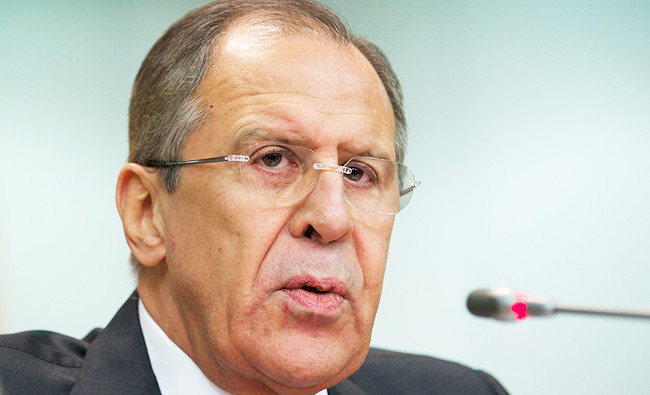
Russian FM: Saudi king’s visit a ‘turning point’ in relations


Latest updates


© 2026 SAUDI RESEARCH & PUBLISHING COMPANY, All Rights Reserved And subject to Terms of Use Agreement.