BAGHDAD: The flashpoint in the independence stand-off between the Kurdistan Region and the Iraqi government shifted to Kirkuk on Tuesday, as Baghdad moved to take control of the area’s lucrative oil wells.
The Kurdistan Regional Government exports 550,000 barrels of Iraqi oil per day through a pipeline linking Kirkuk to Ceyhan in Turkey, of which 400,000 barrels come from Kirkuk. If Prime Minister Haider Al-Abadi’s government took control of the oil it would deprive the KRG of about 75 percent of its daily revenue, and separate the Kurds from the most valuable part of their proposed independent state.
“Baghdad intends to regain its legal and constitutional role in Kirkuk and all the nearby disputed areas, including the oil fields,” Abbas Al-Bayati, an Iraqi politician who is close to Al-Abadi, told Arab News. “We, as legislative and executive authorities, are working to regain control of those areas.”
A senior security official told Arab News: “The situation is very cloudy and anything is possible relating to Kirkuk, but we know that the government wants to secure the oilfields.
“It is an open area. There will be no need for large numbers of troops; actually the operation can be carried out by airborne forces.”
Kirkuk, the fifth Iraqi city in terms of population, is a mixed area. Only Basra has larger oilfields. The KRG seized control of the city and its oil wells in the summer of 2014, when the Iraqi army fled in the face of an onslaught by Daesh militants.
On Tuesday, Iraq stopped selling dollars to leading banks in Kurdistan and banned foreign currency transfers to the autonomous region.
The financial sanctions follow a ban on direct international air travel to the region imposed by the central government on Friday.
Iraq’s central bank informed the Kurdistan Regional Government (KRG) that it would stop selling dollars to four major Kurdish banks and stop all foreign currency transfers to the region, banking and government sources told Reuters.
“The condition for ending the dollar sale prohibition is to have the Kurdish banks under the central bank’s control,” an Iraqi official told Reuters.
Meanwhile, Kurdistan announced on Tuesday it was calling presidential and parliamentary elections for Nov. 1.
The November polls are for the Parliament and presidency of the region, not for an independent state, said a report by Reuters.
Kurds voted for independence last month in a controversial referendum in the Kurdistan Region and the disputed areas, including Kirkuk, seized by the peshmergas.
The Iraqi Parliament views the referendum as an illegal and unconstitutional threat to Iraq’s unity and integrity, and has approved punitive measures against the Kurdistan Region and Kurdish leaders, including regaining control of the disputed areas and the oil wells in Kirkuk.
Thousands of Iraqi security forces, including Shiite paramilitaries, are taking part in a major military operation to dislodge Daesh militants from Hawija, a town in Kirkuk province 45km west of the city. The campaign was launched only a day before the referendum, and many view it as a pretext by Al-Abadi to deploy more troops near Kirkuk.
Military sources told Arab News said that not all the Iraqi troops near Kirkuk were taking part in the fighting. Asa’ib Ahl Al-Haq, a prominent Shiite armed faction supporting the Iraqi government in the fight against Daesh, was assigned by Al-Abadi to be ready to move to secure the oilfields.
“The decision was made (by the Parliament and the government), (and) the authority of the federal government has to be imposed in all the disputed areas, including Kirkuk,” Asa’ib spokesman Na’aim Al-Abodi told Arab News. “There are large numbers of troops near Kirkuk to participate in the battle to retake Hawija,” he said, and any “childish or reckless act” by Kurdish leaders “will have serious consequences.”
Baghdad wants the referendum to be annulled as the main condition for talks with Irbil. The KRG said on Tuesday it was not authorized to do so.
“Cancelling the results of the referendum would not be as easy as officials in Baghdad think,” a spokesman said. “It related to the people of Kurdistan, and those people have decided what they want pertaining to this issue.”
The KRG has deployed more Kurdish troops in Kirkuk over the past two weeks. On Monday, Al-Abadi warned of the consequences of such “military mobilization procedures,” which he described as “risky and not acceptable.”
Al-Abadi asked Kurdish troops to withdraw beyond the areas where they were deployed before Oct. 18, 2016, before military operations to recapture Nineveh. “Imposing reality by force in the disputed areas is rejected,” he said.


![]()
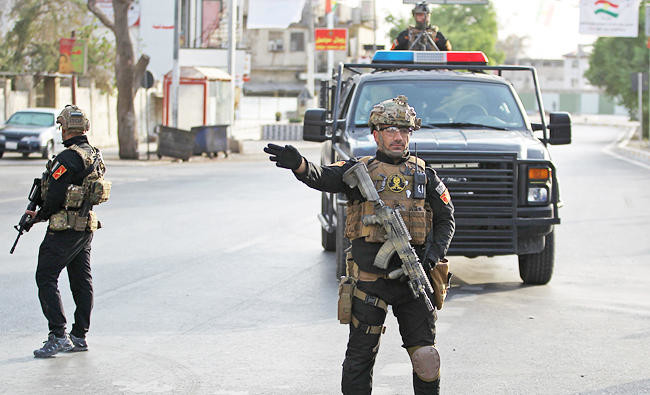
New Kurdish flashpoint as Baghdad eyes Kirkuk’s oil
New Kurdish flashpoint as Baghdad eyes Kirkuk’s oil


Latest updates


© 2026 SAUDI RESEARCH & PUBLISHING COMPANY, All Rights Reserved And subject to Terms of Use Agreement.