Monarch chief blames collapse on terror attacks

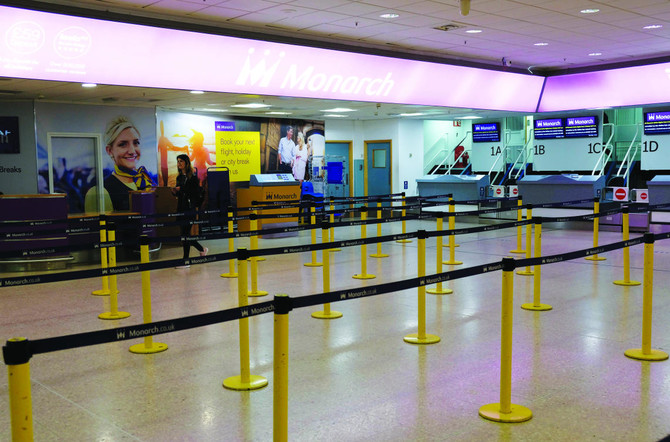
Monarch Airlines check-in desks stand empty at Birmingham Airport after the airline collapsed on Monday. (REUTERS)
Updated 03 October 2017
Follow

Monarch chief blames collapse on terror attacks

LONDON: British authorities are scrambling to bring home 110,000 travelers after Monarch Airlines collapsed Monday, canceling all flights by what had been Britain’s fifth biggest carrier.
The Civil Aviation Authority said it has leased 30 aircraft to transport Monarch customers scattered around holiday destinations ranging from Turkey to Spain and Sweden. Flights will be provided at no additional cost to passengers.
“This is a hugely distressing situation for British holidaymakers abroad, and my first priority is to help them get back to the UK,” Transport Secretary Chris Grayling said in a statement. “That is why I have immediately ordered the country’s biggest ever peacetime repatriation to fly about 110,000 passengers who could otherwise have been left stranded.”
Monarch ceased operations after failing to reach a deal with regulators to extend the company’s license to sell package holidays to overseas destinations. Monarch Chief Executive Andrew Swaffield said the airline’s troubles stemmed from recent terror attacks in Egypt and Tunisia and the “decimation” of the tourist trade in Turkey.
The airline had tried to pivot from short-haul flights to long-haul travel to reduce losses as consumers shied away from Middle Eastern and North African destinations after the June 2015 attack on tourists at a resort in Tunisia, the bombing of a Russian airliner that had taken off from Sharm el-Sheikh, Egypt, a few months later and the attempted coup in Turkey in 2016.
The CAA is advising Monarch customers who are trying to get home from abroad to visit the agency’s website for information about their flights. Passengers who were preparing to leave the UK on Monarch flights should not go to the airport.
The first repatriation flight carrying 165 passengers from the Spanish resort island of Ibiza has already arrived at London’s Gatwick Airport, the aviation authority said.
“The scale and challenge of this operation means that some disruption is inevitable,” agency CEO Andrew Haines said. “We ask customers to bear with us as we work around the clock to bring everyone home.”
Monarch’s collapse represents the biggest ever failure of a British airline.
The Unite union, which represents around 1,800 engineers and cabin crew working for Monarch, claimed that the government rebuffed requests to provide a bridging loan that would have helped the airline keep operating.
The airline said companies affected by its failure include Monarch Airlines, Monarch Holidays, First Aviation, Avro, and Somewhere2stay.
“All future holidays and flights provided by these companies have been canceled and are no longer operating,” the company said.
Greybull Capital, which owns The Monarch Group, issued a statement saying it was “deeply saddened” by the airline’s failure. It said it was working with regulators to minimize disruptions.
— REUTERS


Oil prices rise sharply after attacks in Middle East disrupt global energy supply

Updated 02 March 2026
Follow

Oil prices rise sharply after attacks in Middle East disrupt global energy supply

  • Traders were betting the supply of oil from Iran and elsewhere in the Middle East would slow or grind to a halt.
  • Attacks throughout the region have restricted countries’ ability to export oil to the rest of the world

NEW YORK: Oil prices rose sharply Monday as US and Israeli attacks on Iran and retaliatory strikes against Israel and US military installations around the Gulf sent disruptions through the global energy supply chain.
Traders were betting the supply of oil from Iran and elsewhere in the Middle East would slow or grind to a halt. Attacks throughout the region, including on two vessels traveling through the Strait of Hormuz, the narrow mouth of the Arabian Gulf, have restricted countries’ ability to export oil to the rest of the world. Prolonged attacks would likely result in higher prices for crude oil and gasoline, according to energy experts.
West Texas Intermediate, the light, sweet crude oil produced in the United States, was selling for about $72 a barrel early Monday, up around 7.3 percent from its trading price of about $67 on Friday, according to data from CME group.
A barrel of Brent crude, the international standard, was trading at $78.55 per barrel early Monday, according to FactSet, up 7.8 percent from its trading price of $72.87 on Friday, which had been a seven-month high at the time.
Higher global energy prices could lead to consumers paying more for gasoline at the pump and shelling out more for groceries and other goods, at a time when many are already feeling the impacts of elevated inflation.
Roughly 15 million barrels of crude oil per day — about 20 percent of the world’s oil — are shipped through the Strait of Hormuz, making it the world’s most critical oil chokepoint, according to Rystad Energy. Tankers traveling through the strait, which is bordered in the north by Iran, carry oil and gas from Saudi Arabia, Kuwait, Iraq, Qatar, Bahrain, the UAE and Iran.
Iran had temporarily shut down parts of the strait in mid-February for what it said was a military drill, which led oil prices to jump about 6 percent higher in the days that followed.
Against that backdrop, eight countries that are part of the OPEC+ oil cartel announced they would boost production of crude Sunday. The Organization of Petroleum Exporting Countries, in a meeting planned before the war began, said it would increase production by 206,000 barrels per day in April, which was more than analysts had been expecting. The countries boosting output include Saudi Arabia, Russia, Iraq, the United Arab Emirates, Kuwait, Kazakhstan, Algeria and Oman.
“Roughly one-fifth of global oil supply passes through the Strait of Hormuz, a vital artery for world trade, meaning markets are more concerned with whether barrels can move than with spare capacity on paper,” said Jorge León, Rystad’s senior vice president and head of geopolitical analysis, in an email. “If flows through the Gulf are constrained, additional production will provide limited immediate relief, making access to export routes far more important than headline output targets.”
Iran exports roughly 1.6 million barrels of oil a day, mostly to China, which may need to look elsewhere for supply if Iran’s exports are disrupted, another factor that could increase energy prices.