Mountains of garbage and despair in India’s dirtiest city

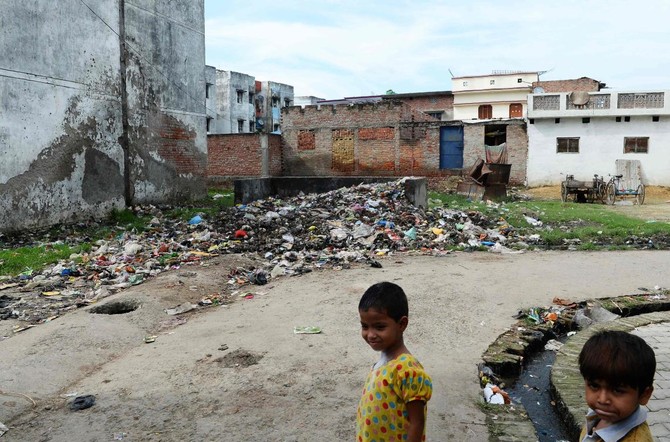
In this photograph taken on August 20, 2017, Indian children stand near a road section used as a dumpsite in Gonda district, in the Indian state of Uttar Pradesh. Flies throng over piles of faeces, the drains overflow with sewage and the foul smell in the air is inescapable. Welcome to Awas Vikas: one of the most exclusive areas of Gonda, a city suffering the ignominy of being branded the dirtiest in India. (AFP)
Updated 02 October 2017
Follow

Mountains of garbage and despair in India’s dirtiest city

GONDA CITY, India: Flies throng over piles of feces, the drains overflow with sewage and the foul smell in the air is inescapable.
Welcome to Awas Vikas: one of the most exclusive parts of Gonda, a city suffering the ignominy of being branded the dirtiest in India.
Even in such upmarket areas, garbage trucks are rarely seen, green spaces are littered with rubbish, and residents are desperate for their bickering leaders to bring about change.
Gonda, 80 miles (125 kilometers) from the Uttar Pradesh state capital of Lucknow, was best known as a quiet stopover point for people traveling to Nepal or to see the region’s temples.
Infamy arrived in May when Gonda came bottom of an Indian government cleanliness survey of 434 cities. The study looked at the use of toilets, waste collection, civic infrastructure and other areas.
It is a daily battle for pedestrians and cars to navigate the piles of plastic bottles, discarded food containers and animal excreta.
The stray cows love it, but residents in Awas Vikas are at breaking point.
“The filth and the stench have made us infamous across the country,” said Durgesh Mishra, gesturing desolately at a crater in the road by his house, which is now filled with dirty water and buzzing with mosquitoes.
“It is a really pathetic state of affairs. We’ve been rated as India’s dirtiest — just look around and you can see it’s a perfect ranking. You can’t imagine how we live here,” he added.
Most locals hope the ‘dirtiest city’ accolade will shame politicians into action and break the cycle of civic apathy and corruption, which is blamed for the mess.
“The manpower and infrastructure issues that we face today are a result of unplanned development over the last 10 years,” Rajiv Rastogi, a trader and veteran local politician told AFP.

Political rivalry between Gonda and the Uttar Pradesh state government has also bogged down projects.
Signs of the dysfunction are everywhere.
Houses have been abandoned and left to decay, while neighborhood parks and ponds have become dumping grounds.
Those who can afford it, hire laborers to clear garbage from outside their homes — even if that means discarding it out of sight in another part of town.
Kanshiram colony is regarded by some as the most insalubrious part of India’s dirtiest city.
“We live in sickness. Diseases like cholera are an everyday issue,” Kanshiram resident Sushila Tewari told AFP as she swatted away flies and mosquitoes from a waste-filled pond opposite her home.
“We don’t see a municipal worker around here for days at a time. When stray animals die and lay rotting here, sometimes we have to cover them with soil ourselves,” she added.
Kirti Vardhan Singh, a three-term lawmaker for the area, said he has been “bombarded” with telephone calls and social media messages since the survey.
“It was very, very embarrassing,” he told AFP. “I explained to as many as I could that, as a parliamentarian, I don’t have any say or authority over local civic body matters — the mismanagement, inaction and corruption over the last decade.”
Singh acknowledges that Gonda is dirty but is skeptical that it is really the dirtiest city in the nation.
“I feel it got the ranking because of a lack of cooperation and communication between the survey team and the local administration,” he said.
He feels Gonda’s story is typical of other smaller Indian cities that have grown quickly in India’s economic boom without a plan or rules.
J.B Singh, district magistrate for the region, acknowledges there are problems but does not believe Gonda’s ranking is fair.
“The bottlenecks were the biggest issue in the past but we are working to bring change, and locals will see it within the next two months,” Singh said, adding that new garbage trucks and dustbins are being purchased.
The town is also looking for a private waste collection agency to help tackle the problem and will launch a cleanliness awareness campaign, he explained.
Some argue Gonda’s ranking and the subsequent media attention has made an issue that is endemic across the nation, seem like a unique local problem.
Even if the city’s administrative and political problems are solved, many feel the biggest challenge is changing attitudes in a populace often happy to dump at will.
Prime Minister Narendra Modi launched the ‘Clean India’ campaign to improve public hygiene, cleanliness and encourage people to use public toilets, soon after he came to power in 2014.
Promising millions in central government funding for the drive to get the nation clean in time for the 150th anniversary of the birth of Mahatma Gandhi in 2019, Modi has said eradicating filth is a patriotic duty.
“This mission ... aspires to realize Gandhi-ji’s dream of a clean India,” announced Modi, who pledged during his election campaign to build “toilets first, temples later.”
He said at the time: “Together we can make a big difference.”

Trump says US could run Venezuela and its oil for years

Updated 58 min 2 sec ago
Follow

Trump says US could run Venezuela and its oil for years

  • US president made the comments less than a week after Washington seized Maduro in a raid on Caracus
  • Oil has emerged as the key to US control over Venezuela, which has the world’s largest proven reserves

WASHINGTON: The United States could run Venezuela and tap into its oil reserves for years, President Donald Trump said in an interview published Thursday, less than a week after toppling its leader Nicolas Maduro.
“Only time will tell” how long Washington would demand direct oversight of the South American country, Trump told The New York Times.
But when asked whether that meant three months, six months or a year, he replied: “I would say much longer.”
The 79-year-old US leader also said he wanted to travel to Venezuela eventually. “I think at some point it’ll be safe,” he said.
US special forces snatched president Maduro and his wife in a lightning raid on Saturday and whisked them to New York to face trial on drug and weapons charges, underscoring what Trump has called the “Donroe Doctrine” of US hegemony over its backyard.
Since then Trump has repeatedly asserted that the United States will “run” Venezuela, despite the fact that it has no boots on the ground.
Venezuela’s interim leader Delcy Rodriguez insisted that no foreign power was governing her country. “There is a stain on our relations such as had never occurred in our history,” Rodriguez said of the US attack.
But she added it was “not unusual or irregular” to trade with the United States now, following an announcement by state oil firm PDVSA that it was in negotiations to sell crude to the United States.

‘Tangled mess’

Oil has in fact emerged as the key to US control over Venezuela, which has the world’s largest proven reserves.
Trump announced a plan earlier this week for the United States to sell between 30 million and 50 million barrels of Venezuelan crude, with Caracas then using the money to buy US-made products.
On the streets of Caracas, opinions remain mixed about the oil plan.
“I feel we’ll have more opportunities if the oil is in the hands of the United States than in the hands of the government,” said Jose Antonio Blanco, 26. “The decisions they’ll make are better.”
Teresa Gonzalez, 52, said she didn’t know if the oil sales plan was good or bad.
“It’s a tangled mess. What we do is try to survive, if we don’t work, we don’t eat,” she added.
Trump, who will meet oil executives on Friday, is also considering a plan for the US to exert some control over Venezuela’s PDVSA, the Wall Street Journal reported.
The US would then have a hand in controlling most of the oil reserves in the Western Hemisphere, as Trump aims to drive oil prices down to $50 a barrel, the paper reported.
Vice President JD Vance underscored that “the way that we control Venezuela is we control the purse strings.”
“We tell the regime, ‘you’re allowed to sell the oil so long as you serve America’s national interest,’” he told Fox News host Jesse Watters in an interview broadcast late Wednesday.

‘Go like Maduro’

Vance, an Iraq veteran who is himself a skeptic of US military adventures, also addressed concerns from Trump’s “Make America Great Again,” saying the plan would exert pressure “without wasting a single American life.”
The US Senate is voting Thursday on a “war powers” resolution to require congressional authorization for military force against Venezuela, a test of Republican support for Trump’s actions.
Caracas announced on Wednesday that at least 100 people had been killed in the US attack and a similar number wounded. Havana says 32 Cuban soldiers were among them.
Trump’s administration has so far indicated it intends to stick with Rodriguez and sideline opposition figures, including Nobel Peace Prize winner Maria Corina Machado.
But Rodriguez’s leadership faces internal pressures, analysts have told AFP, notably from her powerful Interior Minister Diosdado Cabello and Defense Minister Vladimir Padrino Lopez.
“Her power comes from Washington, not from the internal structure. If Trump decides she’s no longer useful, she’ll go like Maduro,” Venezuela’s former information minister Andres Izarra told AFP in an email.
The US operation in Venezuela — and Trump’s hints that other countries could be next — spread shockwaves through the Americas, but but he has since dialed down tensions with Colombia.
A day after Colombia’s leftist President Gustavo Petro spoke with Trump on Wednedsday, Bogota said Thursday it had agreed to take “joint action” against cocaine-smuggling guerrillas on the border with Venezuela.