

Spanish PM Rajoy urged to resign as police injure 761 Catalonians voting for self-rule

1 / 2
Protesters confront Spanish national police officers during a demonstration at Puerta del Sol square in Madrid on Sunday in support of the right to hold a referendum on self-determination in Catalonia and against repression. Several left-wing Spanish politicians today demanded Prime Minister Mariano Rajoy resign after police used force to block voting in a banned independence referendum in Catalonia, injuring dozens of people. (AFP / JAVIER SORIANO)
2 / 2
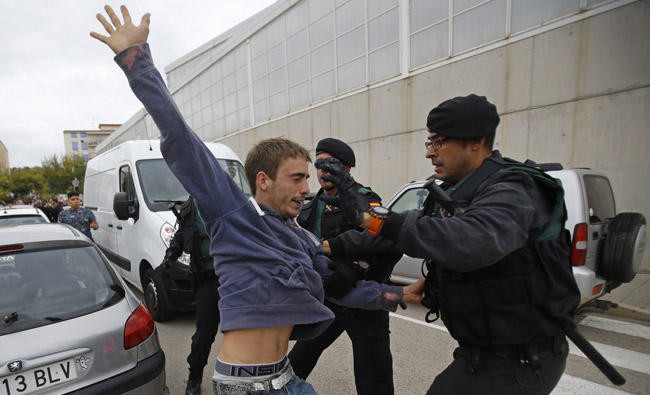
Civil guards grab a man in Sant Julia de Ramis, near Girona, Spain, on Sunday as scuffles erupt during a protest rally by voters after dozens of anti-rioting police broke into a polling station where the regional leader was expected to show up. (AP Photo/Francisco Seco)
Updated 01 October 2017
Follow

Spanish PM Rajoy urged to resign as police injure 761 Catalonians voting for self-rule

BARCELONA: Spain’s Prime Minister Mariano Rajoy was urged to resign on Sunday after national police attacked citizens in the northeastern region of Catalonia who were participating in a referendum that Madrid has declared illegal.
As voting centers started counting the votes cast, Catalonia’s health services also raised the number of people injured by police to 761 people who were treated at hospitals.
The service said two people are in serious condition in hospitals in Barcelona. It also said that another person is being treated for an eye injury that fits the profile of having been hit by a rubber bullet.
Spanish riot police smashed their way into polling stations across the northeastern region to try and stop Sunday’s referendum on independence. Spain’s top court had suspended the vote but local authorities went ahead anyway.
Police used batons, fired rubber bullets, and roughed up voters. Catalan authorities say police even used tear gas once.
Despite the violence, Catalonians declared success in the referendum as voting ended.
At one voting station in Barcelona, in the Joan Miro school, applause broke out Sunday night after 8 p.m. as it was announced that voting had ended. Volunteers opened the plastic ballot boxes, turned them over and started sorting the ballots. The “yes” pile was many times bigger than the “no” pile.
Joan Maria Pique, spokesman for Catalan president Carles Puigdemont, says that polling stations are closing except at those where people are still waiting to vote.
Amid the violence, Barcelona’s mayor called on Rajoy to quit in shame.
Mayor Ada Colau told TV3 that “Rajoy has been a coward, hiding behind the prosecutors and courts. Today he crossed all the red lines with the police actions against normal people, old people, families who were defending their fundamental rights.”
“It seems obvious to me that Mariano Rajoy should resign,” she said.
Colau also said that after the violence Sunday, Catalonia has “earned the right to demand” a proper vote on independence from Spain. She said “the European Union must take a stand on what has happened in Catalonia.”

‘Shame of Europe’
Catalonia’s pro-independence regional government said Spain is “the shame of Europe” for the way it has cracked down on the region’s bid to hold a secession referendum.
Government spokesman Jordi Turull said “what the police are doing is simply savage, it’s an international scandal.”
“Today, Spain is the shame of Europe,” Turull said.
Turull said that despite police actions “the trend we are seeing is that millions have voted,” adding that a recount of votes would take some time. He said police had closed 319 polling stations out of some 2,300.

‘Proportionate’ violence
Spain’s foreign minister said the violence seen Sunday was “unfortunate” and “unpleasant” but “proportionate.”
In an interview with The Associated Press, Foreign Minister Alfonso Dastis blamed the violence exclusively on Catalan President Carles Puigdemont and his regional government.
“If people insist in disregarding the law and doing something that has been consistently declared illegal and unconstitutional, law enforcement officers need to uphold the law,” he said.
Officials say at least 465 people and 11 police were injured Sunday. Videos showed police roughing up voters, who tried to shield themselves from blows.
Dastis said, however, “it was a proportionate use of force, there was no excessive violence and it was a reaction to the situation they were faced with when they were prevented from doing their job.”
On the streets of Madrid there are mixed reactions to the crackdown.
Francisco Lopez, 53, said the authorities’ use of force to stop the voting was justified. He says “when there is an unlawful act, the security forces are there to prevent this unlawful act.”
Jose Daniel Rodríguez, a 67-year-old university teacher, disagreed, saying the Spanish government should have let the vote go ahead. He says “in a democratic society, everyone has the right to express themselves.”
Others called for both sides to resolve the situation through negotiations, not police operations.
Ignacio Osorio, 51, says “I believe that from today we have to sit and talk, without conditions.”

Russian poisonings aim to kill — and send a message

Updated 58 min ago
Follow

Russian poisonings aim to kill — and send a message

  • Neurotoxin epibatidine, found in Ecuadoran frogs, was identified in laboratory analyzes of samples from Navalny’s body
  • Even if a poisoning can fail — some targets survived, such as Yushchenko and Skripal — it also serves to send a message

PARIS: Polonium, Novichok and now dart frog poison: the finding that Russian opposition leader Alexei Navalny was killed with a rare toxin has revived the spectre of Moscow’s use of poisons against opponents — a hallmark of its secret services, according to experts.
The neurotoxin epibatidine, found in Ecuadoran frogs, was identified in laboratory analyzes of samples from Navalny’s body, the British, Swedish, French, German and Dutch governments said in a joint statement released on Saturday at the Munich Security Conference.
“Only the Russian state had the means, motive and opportunity to deploy this lethal toxin,” said Britain’s Foreign Office, with the joint statement pointing to Russia as the prime suspect.
The Kremlin on Monday rejected what it called the “biased and baseless” accusation it assassinated Navalny, a staunch critic of President Vladimir Putin who died on February 16, 2024, while serving a 19-year sentence in a Russian Arctic prison colony.
But the allegations echo other cases of opponents being poisoned in connection — proven or suspected — with Russian agents.
In 2006, the Russian defector Alexander Litvinenko was killed by polonium poison in London. Ukrainian politician Viktor Yushchenko, campaigning against a Russian-backed candidate for the presidency, was disfigured by dioxin in 2004. And the nerve agent Novichok was used in the attempted poisoning of former double agent Sergei Skripal in the UK in 2018.
“We should remain cautious, but this hypothesis is all the more plausible given that Navalny had already been the target of an assassination attempt (in 2020) on a plane involving underwear soaked with an organophosphate nerve agent, Novichok, which is manufactured only in Russia,” said Olivier Lepick, a fellow at the Foundation for Strategic Research specializing in chemical weapons.

Toxin ‘never been used’

“To my knowledge, epibatidine has never been used for assassinations,” Lepick added.
Until now, the substance was mainly known for its effect on animals that try to attack Ecuadoran poison dart frogs.
“It’s a powerful neurotoxin that first hyperstimulates the nervous system in an extremely violent way and then shuts it down. So you’ll convulse and then become paralyzed, especially in terms of breathing,” said Jerome Langrand, director of the Paris poison control center.
But to the scientist, using this substance to poison Navalny is “quite unsettling.”
“One wonders, why choose this particular poison? If it was to conceal a poisoning, it’s not the best substance. Or is it meant to spread an atmosphere of fear, to reinforce an image of power and danger with the message: ‘We can poison anywhere and with anything’?” he said.

Russian ‘calling card’

For many experts, the use of poison bears a Russian signature.
“It’s something specific to the Soviet services. In the 1920s, Lenin created a poison laboratory called ‘Kamera’ (’chamber’ in Russian), Lab X. This laboratory grew significantly under Stalin, and then under his successors Khrushchev and Brezhnev... It was this laboratory that produced Novichok,” said Andrei Kozovoi, professor of Russian history at the University of Lille.
“The Russians don’t have a monopoly on it, but there is a dimension of systematization, with considerable resources put in place a very long time ago — the creation of the poison laboratory, which developed without any restrictions,” he added.
Even if a poisoning can fail — some targets survived, such as Yushchenko and Skripal — it also serves to send a message, and acted as “a calling card” left by the Russian services, according to Kozovoi.
“Poison is associated in the collective imagination and in psychology with a terrible, agonizing death. The use of chemical substances or poisons carries an explicit intention to terrorize the target and, in cases such as Litvinenko, Skripal or Navalny, to warn anyone who might be tempted to betray Mother Russia or become an opponent,” said Lepick.
“A neurotoxin, a radioactive substance, or a toxic substance is much more frightening than an explosive or being shot to death.”